
Selected Transcripts
commencement 2026
Dame Louise Richardson, President of Carnegie Corporation
Commencement Address: Flying High Together
May 17, 2026
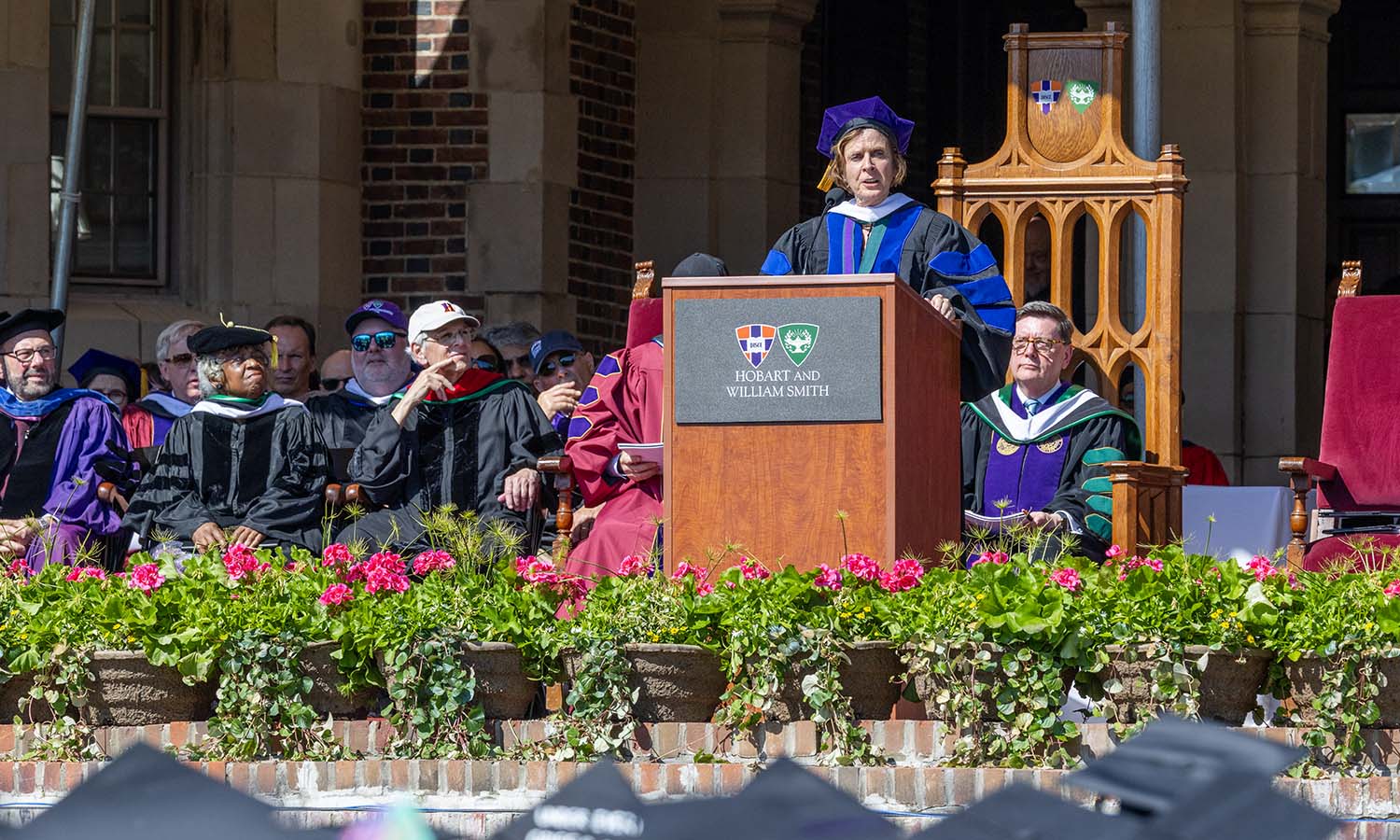
President Gearan, Professors, distinguished guests, graduates, families and friends, thank you. It is a great honor and a pleasure to be here today, to accept the Elizabeth Blackwell award, and to share in this unique moment of celebration with you.
I look around, seeing you resplendent in your robes and black caps that are about to be thrown joyfully into the air and it makes me think of a flock of bright-eyed birds with glossy plumage, who have settled on the lawn but are about to rise and fly.
I’m sure there were times when, for each one of you, it felt like you’d never get here. But you persisted. I congratulate your tenacity as well as your academic achievement.
A college degree represents not just the assignments you turned in, but the times you turned up - for yourself and for others. So I would like to congratulate as well, all those family, friends and supporters who kept you airborne.
Like migratory birds, all of you have faced a long and arduous journey. You fought off exhaustion over many miles, the dust storms of competing academic and extracurricular commitments, the trials of navigating by stars that were not always clearly visible. Now you have arrived. But of course, your arrival is just a pause, a perch, a dawn chorus at the beginning of a new phase of life on the wing. It’s normal to feel a little flighty, unsettled, as you set off into the future: buoyant but vulnerable.
What advice can I offer that is helpful at this time of change? A time that is not only uncertain for you but for the world?
I’ll suggest an insight from my own experience that seems particularly suited to this university: Building community is your real task. I know that might sound strange advice at a time when you are leaving, perhaps for the first time, to become a person wholly free of the constraints of family life and education. It is the moment of maximal individuation. When you finally fully determine where you live, your timetable, your associates, your chosen work. It’s an important leap into complete independence.
You might feel that getting a job, a place to live, a partner, winning fortune and renown are solo quests. But what if the idea of the solo quest is a myth? What if you don’t need to slay dragons? What if it is creating the Round Table that is the real flex?
Building community is relatively undramatic. It is both easier and harder than pursuing your goals alone. It is a matter of small steps and meaningful acts. Reaching out to others with whom you share interests and values. It involves empathy, imagination and listening. It is through creating the basis of trust, patience and reliability that we transform the company of strangers into a shared force for mutual good.
We achieve nothing alone. It doesn’t matter if you want to make a book or a building, a new polymer or a new digital platform, you are going to have to find those other people who will want to do it with you.
I’m emphasizing this today, because one of many things that makes Hobart and William Smith College special is its remarkable record of service. 100% of students participate in community service, generating over 80,000 hours of community service annually. That is an extraordinary achievement. This college is remarkable too for the number of students who become members of the Peace Corps, inspired by your wonderful President, no doubt.
According to the Princeton Review you are also among the happiest and friendliest students in the country. Those statistics can’t be accidental. Surely it is because you are a community who consciously pours time and effort into community that your stars shine so brightly as a constellation. Or, to return to the metaphor of birds, as a murmuration (as of starlings), an exaltation (of larks), or a convocation (of eagles).
To put it another way: the students and educators of this college recognize that collaboration, giving, and creating opportunities for others is the basis of the good society and the well-lived life.
Our lives are deeply entangled. As John Muir famously said: ‘when we try to pick out anything by itself, we find it hitched to everything else in the universe’. Many of us are brought up with the idea of Darwinism as telling us that competition is the basis of life. But modern ecology tells us otherwise. Coral reefs – living structures of deep symbiosis – have the highest biodiversity of any ecosystem on earth. Fungal mycelium holds together the world of soil, of plant roots, forming an interpenetrative web of life where the boundaries between one organism and another are functionally indefinable. Cooperation turns out to be the fundamental order upon which growth depends.
Knowing I was coming here I began to reflect on the story of Elizabeth Blackwell, the pioneering female doctor who is one of the most famous alumni of this college. She graduated in 1849, feeling rather cross that she had to invest in a black silk dress for the occasion, as she didn’t have the money to waste. The hall for her graduation was filled with women who had come to see the spectacle of the first woman in America to graduate with a medical degree. Elizabeth had already suffered many ups and downs in her young life. Born into a comfortably middle-class English family of 9 children, the daughter of a progressive sugar-refiner and abolitionist. While rather small in physical stature, Elizabeth was extremely strong. It is reported that when lectured by a man who said the weakest man was stronger than any woman, she physically picked him up and carried him three times round the room to prove him wrong.
The Blackwells moved to America, where Elizabeth’s father established sugar refineries in New York but he died suddenly in his forties. Many of his creditors defaulted, leaving the family in debt. They set up a school and taught basic skills to children and struggled financially.
She applied, famously, to colleges all across America before finally finding that Geneva College, the ancestor of HWS, was prepared to put it to the student body – would they let her study and allow her to complete her course unimpeded. Only when the student body cooperatively signed up to that agreement, could she enroll. It was not one enlightened teacher or administrator who let her in. It was you. It was the collective students of this college, who, by their shared daily actions, made it possible for a woman to pursue medicine and prove that women could be as effective and talented a doctor as any man. This place was the one, singular door that opened and it led to the creation of a whole new world for women’s health.
Elizabeth Blackwell was a truly remarkable individual, but her achievement was built on the foundation of community. She would go on, as you know, to make strides in medical treatment of women – opening a free hospital and dispensary in New York. As a result of admitting just one person to the community who would normally have been excluded, a whole new community of excluded people – women, many of them Black and poor – was served.
As it happens, there wasn’t just one Elizabeth Blackwell. You are all most familiar with the pioneering doctor whose statue stands in the quadrangle here. But before her there was a Scottish Elizabeth Blackwell, who was a pioneering botanical artist in the eighteenth century. Born in 1699 in Aberdeen, she followed her disaster-prone husband to London, where he got into serious trouble through opening a printing press without securing permissions. Unable to pay his fines, he was locked up in a debtors’ prison. Elizabeth, now effectively a single mother, hit on a scheme to get him out. She produced a popular and beautiful Curious Herball, an illustrated guide to 500 useful medical plants. She worked with botanists and pharmacists to introduce an eager public to the health benefits of plants. Her book was a hit. It generated enough money to release her husband, and was eagerly adopted by doctors and pharmacologists in Britain and America. Issued in weekly parts, it became one of the texts that popularized medicine, making the leaves of knowledge as accessible and attractive as a leaf you could pick in the garden. In that sense, one Elizabeth Blackwell helped to make possible the career of another.
One might point to many other Elizabeth Blackwells. Several of them were born in Virginia and Maryland, part of the Blackwell family tree that is one of the most comprehensive documents we have of slave ancestry in America. Over 3000 members of the Blackwell family are descended from two enslaved women transported from what is now Senegal in West Africa and given the name Blackwell after the owner of the plantation. That tree includes the international tennis champion and humanitarian Arthur Ashe, still the only Black man ever win the singles title at Wimbledon and the US Open. Dr Elizabeth Blackwell, was very aware that her family money came from sugar. Her legacy was built on the work of primarily Black men and women she would never know, whose labor secured her relative freedom – to study, to treat, to create preventive medicine.
My point is that all of our achievements, always, are part of a shared fabric: a common legacy of hope and labor and imagination.
There is never just one Elizabeth Blackwell, one extra-ordinary woman. There are hundreds. Our job is to lead in such a way that we lift up all of them. That we acknowledge their shared contribution to our culture and history. All men; all women. Building the good community of the future requires us to acknowledge the living tissue of shared experience, need, and possibility. To build bridges rather than walls. To challenge the narrative of irreducible difference, of exceptionalism, that keeps the sorrows of the many from impinging on the comforts of the few.
The prevailing impulse in America right now, feels to me to be one of individualism and isolationism. Retreat on global cooperation and agreements, on laws that protected our shared environment, our human and civil rights. Pulling back on investment in global health and global security. A narrow conception of self-interest: shortsighted and short-tempered. Dominance as a strategy that forces hands rather than shaking them and simply seizes or threatens to destroy what it cannot fairly gain. This may be a show of power, but it is not ultimately a position of strength. It creates a climate of fear.
Artificial divisiveness, exacerbated by our political system, tends to mask how much we have in common. How similar people’s views and needs really are. How much we depend on one another. Carnegie, the foundation I lead, has been working for some years to understand the problems and possible solutions to political and social polarization. We have learned that there is actually an enormous degree of convergence among about 70% of Americans on most issues around democracy, but a widespread misunderstanding on each side of the views on the other. It will take concentrated effort to overcome the algorithms that keep us in opposing camps, shaking our heads and our fists at those who disagree with us, but it has never been more vital to leap the fence.
The problems of the future require us to share our work. Climate breakdown; novel pathogens and antibacterial resistance; the ethics of artificial intelligence; the challenge to democracy posed by disinformation. They affect us all and must engage us all.
An excellent example of this kind of collaboration right here is the research on microplastics in the Finger Lakes undertaken by Professor of Geoscience Nan Crystal Arens. With colleagues and students in biology and chemistry, her project explores the Finger Lakes watershed as an interconnected system and examines how plastic pollution is moving into, through and around it, damaging the environment and entering into human food and water systems. Where problems cross boundaries, the solutions of the future must do so too – involving interdisciplinary, international expertise.
I believe that true community is the antidote to despair and the foundation of purpose. It is not a dilution of individual character but a concentration of shared energy.
We need, more than ever before, a generation of community builders. Of diplomats and architects, educators and physicians. Young people willing to think sideways, to reach out, to gain understanding across the barriers of language, gender, race, color and creed and to live the truth that we are all born equal and deserve equally to enjoy life, liberty and the pursuit of happiness: a generous and inclusive American ideal.
I believe that you, as HWS graduates, are uniquely well placed to be leaders of that generation.
My final piece of advice is to say: Don’t postpone your best life. Don’t put yourself off. Most of us have to make some compromises early in our career to get by, just as Elizabeth Blackwell did. But she never let go of her fundamental aspiration to be a doctor. She continued taking steps to achieve it, even when they were smaller and more indirect than she wished.
It is a mistake to view success as a sort of gem that we can unlock from the safe if we can only get the right combination. When I have a proper job; after I start a family; when I have a house. If we can get past this; get through that; surmount this hurdle or that dip.
Life is right now. Happiness is right now. There is very little difference you can make in the world that isn’t already in your hands to start. So why not begin today?
Don’t postpone the life you long for. The best of you. The risky. The creatively wild. The generous. Start it now. Then this commencement really will be the day you took off, not just into a new swoop and glide of life, but into a grand murmuration: a flight of shared purpose where no member of the flock is unimportant, where all are protected by the movement of the whole.
I wish you well in your adventure.
Congratulations again on your achievement. Thank you for listening. Enjoy your day!