
Pulteney Street Survey
PULTENEY STREET SURVEY - Spring 2020
The Last Word

Stern
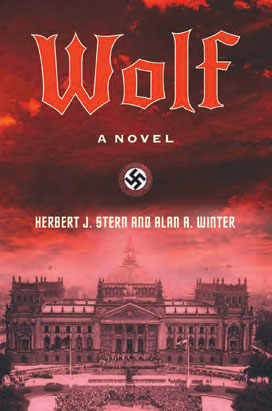
Rise of the Wolf
A historical novel by Herbert J. Stern ’58, P’03, LL.D. ’74 and Alan A. Winter
How did Adolph Hitler, a World War I corporal and failed painter, become dictator of one of the most educated, advanced countries in the world and turn it into an evil war machine that ultimately caused the deaths of 60 million people worldwide? In the newsreels, we see him as a not very attractive man making long, strident speeches before large German audiences. How did such a seemingly ordinary man rise to be the master of a nation?
Herbert J. Stern ’58, P’03, LL.D. ’74 and his coauthor Alan A. Winter provide the answers. Stern, a lawyer, former Federal prosecutor and judge, as well as an honorary HWS trustee, has written several successful books, but this is his first novel. His first book, A Judgement in Berlin, about the trial of a hijacker from East to West Berlin, in which he served as judge, was made into a movie and is excellent for its portrayal of the conflict between a judge’s duty to ensure a fair trial and the needs of the State Department in doing international diplomacy. Another of his books, The Diary of a DA, gives insight into the life of a prosecutor. Both are excellent reads, and though true, are as exciting as any work of fiction. Alan Winter, his co-author, has written several novels including Island Bluffs and the highly successful Savior’s Day.
The authors have quite thoroughly researched Hitler, his strengths as well as his flaws, and have written a novel that clearly explains his rise to power. Much has been written about Hitler as the genocidal maniac but few have really looked into the person to understand how he acquired power. The authors have masterfully portrayed Hitler, or “Wolf,†as he was known, as well as his rise. Accompanying this novel is a website that documents their research. In many ways the website is as interesting as the novel, as it updates much scholarship that overlooked aspects of Hitler’s personality that did not seem to fit the image of the monster he became.
Stern
Hitler was a master at managing his public image. He set out to become the leader of the German people and deliver them from the humiliation of the Treaty of Versailles. To do so, he portrayed himself as a man so dedicated to Germany he didn’t have time for relationships, let alone marriage. In reality he was rarely without at least one mistress, and often more. All of this he did out of the public eye, protecting his image assiduously. He was especially fond of 17 and 18 year olds, but he also charmed rich older women, who helped fund him. Although he wasn’t handsome, as Eva Braun explained to her parents, “he had such wonderful blue eyes.†And Hitler was very caring of old loves, sending them flowers and gifts, promoting their husbands and even attending or hosting their marriages. His old loves would come running when he sent for them years after their breakups. If you note the films taken after Hitler became the leader of Germany, you see young women swarm his stage just as young women did rock stars a generation after his death.
Hitler could also be very charming. While he never failed to get revenge against his enemies, he was very thoughtful of his friends and employees, as evidenced in many letters that he wrote. His secretaries said that he never raised his voice and would send them home when they were sick; sometimes he sent his personal physician.
One of the myths debunked here is his story in Mein Kampf that he had been gassed in 1918 and suffered blindness for a couple of weeks as a result. Many historians have taken him at his word. Actually, he was diagnosed as a psychopath with hysterical blindness and was treated in a hospital by a psychiatrist. When Hitler came to power, the hospital records disappeared and the psychiatrist was found deceased, a suicide by gunshot.
Although most of the characters in the novel are real, the authors have invented the main character, Friedrich Richard. While being treated in the hospital’s mental ward for amnesia resulting from his wounds, Friedrich meets Wolf. Because of his blindness, Wolf cannot even feed himself, so Friedrich cares for him and they form a lasting bond. As an outsider, but also a trusted friend of Hitler, he is in the unique position of seeing the effect of the Nazi’s actions on ordinary Germans while maintaining an important position within the party. Although Friedrich is not anti-Jewish, he believes that most of Wolf’s program is good for Germany. He naïvely expects that the anti-Semitism will fade when Hitler comes to power. The novel follows Friedrich from 1918 through Hitler’s rise to power in 1934. Along the way, we meet Friedrich’s friends and lovers and come to understand the delicate balance between his love for Germany and faithfulness to his friend on the one hand, and his empathy with the people that Hitler vilifies on the other.
The authors have succeeded marvelously in conveying an understanding of Hitler, the person and his rise to power. They have documented the people, events and personalities in the accompanying website, justifying their interpretation of the character of the individuals involved. This is a portrayal of historymodified to make it a compelling story rather than a dry recitation of events; a must read. — BILL BOYD
BOOK REVIEW BY BILL BOYD
Boyd holds a Ph.D. in mathematics from
the University of Tennessee, Knoxville,
an M.S. in computer science from the
University of Memphis and a B.S. in
physics from Rhodes College. The former
Visiting Scholar in the Quantitative
Analysis Center at Wesleyan University
is married to President Joyce P. Jacobsen.
Current Issue
- Upfront
- HWS and Cornell Law Take a LEAP
- Continued Success for Debate Team
- HWS Welcomed into Leading Liberal Arts Consortium
- Curry '75 to Deliver Commencement Address
- HWS Ranks High in Impact and Value
- HWS Earns Carnegie Designation
- President Joyce P. Jacobsen Inaugurated
- Pomona's Coffey named Provost and Dean of Faculty
- Leadership Changes for Diversity and Hobart Dean's Offices
- Leading Alumni House into the Future
- Regan and Weeden Look Back - and Move Forward
- A Glimpse into Blackwell's Private Life
- Comrade Dean
- Faculty Accomplishments
- Penn Elected Chair of LIGO Scientific Collaboration
- Photography Gifts Double Value of Art Collections
- Reynolds '78 Endows Sandra McGuire Scholarship
- Emerson Society Committee Welcomes New Chairs
- Leaping from One Path of Thought to Another: Seneca Review at 50
ATHLETICS
From the Ground Up
- Buildings of the Future
- The River Keeper
- Ensuring the Future of Children's Literature
- The National Pastime
- Changing the Conversation about Mental Illness
- Disrupting the Cycle of Violence, Poverty and Incarceration
- To Protect and Serve
- Making Community Connections
- The Lay of the Land
HWS Community
- Williams Club Membership Extends HWS Network
- New LGBTQIA+ Alumni/ae Network
- Kappa Alpha Celebrates 175 Years
- Indelible Effects
- The Last Word
- Parallels
Past Issues