
First-Year Seminars Fall 2026
It All Starts Here
Commonly referred to as “FSEMs,” First-Year Seminars are courses with only 12-16 students that help introduce you to college coursework and college life. Each FSEM is designed around a thought-provoking topic that will serve as a springboard for honing your critical thinking and communication skills. FSEMs will also help you acclimate to our academic values and build a network of relationships in and out of the classroom.
Your FSEM professor will serve as your academic adviser for at least your first year. You will be introduced to your FSEM professor in June and meet again during Orientation, when your FSEM course begins. Your advising relationship will continue to develop throughout the semester. Each FSEM will also include a First-Year Mentor, a current student who will support you during your first semester and beyond.
First-Year Seminars are the only courses required of all HWS students, and every incoming first-year student is required to take one during their fall semester.
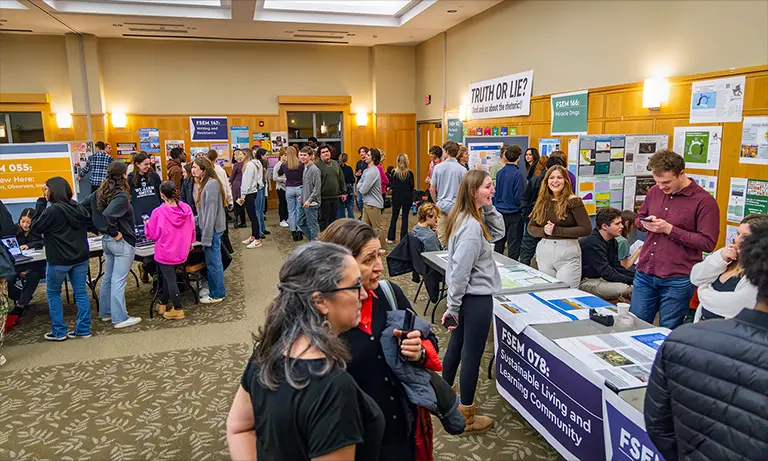
see students' projects from the first-year seminar symposium
Fall 2026 First-Year Seminar Offerings
Happy On Purpose
Shelle Basilio, Associate Vice President for Campus Life and Dean of Student Wellness and Support
Tu/Th 8:10-9:40 a.m.
Why do some people thrive while others burn out? Is happiness something you have, or something you learn? And what do relationships, purpose, and community have to do with a good life? Happy On Purpose explores what science and cultures around the world tell us about happiness—and how to practice it. Through discussion, reflection, and hands-on service-learning, you’ll build emotional intelligence, strengthen self-awareness and empathy, and learn skills that support well-being in college and beyond. This is a class for students who want to live well, connect deeply, and be happy on purpose. This course is part of a Living/Learning Community. Learn more here.
Pawprints! All Things Dogs
Betty Bayer, PROFESSOR OF GENDER, SEXUALITY, AND INTERSECTIONAL JUSTICE
Tu/Th 8:10-9:40 a.m.
Are dogs our oldest BFFs in history? Was it the mutual relationship between dogs and humans that shifted our own evolution? Does the tail of the dog wag our capacity for compassion and humanness? Beyond archeologists and paleogeneticists’ efforts to pin down this story of mutual development, some say a story that began roughly twentieth-three thousand years ago, dogs have their pawprints all over history, fiction, art, advertising, film, religion, television and digital media and the fields of history, psychology, economics, medicine, anthropology and canine cognition centers at major universities. Their pawprints cross worlds of adventure and discovery, tales of divination and evil as much as in worlds of violence in systems of apartheid and enslavement. Today commercials hound us to further domesticate our relations with dogs, inundating us with products, care, training, fashion, health, food, vet care and pet insurance – a multi-billion-dollar industry. Dogs are considered good (if not the best) therapists for medical and psychological needs; they are laborers in hospitals, classrooms, daycares, and hotels; they accompany people with emotional, neural diverse and physical needs; they are called on to sniff out disease, police airports, and lead rescue missions. At the heart of it all, however, dogs continue to walk beside us, showing us the way at times to take the lead, other times to chill and to play, nuzzle and bark or howl our way in this world. Dogs are in and of our world. Still, the question remains: What do we really know or understand about dogs or our relations with them? How does understanding them help us understand ourselves? This course follows the vast and sprawling pawprints across time and place, gender and race relations, to inquire into what these long standing and manifold connections may tell us about making worlds and humanity. Short essays; presentations and video essay as final project.
Podcasting America
Beth Belanger, PROFESSOR OF AMERICAN STUDIES
Tu/Th 8:10-9:40 a.m.
“Who lives, who dies, who tells your story?” In this class, students will research, write, produce, and publish podcasts exploring American culture. While students will be introduced to podcasting skills: research, scriptwriting, interviewing, recording, editing, and producing, this course is primarily designed to help students become better storytellers, think critically about stories they consume, and evaluate how podcasts share, tell, and construct American Culture. Finally, this course examines storytelling in the service of social justice, exploring how storytelling can promote social change.
Science Meets Art
Walter Bowyer, Professor of chemistry
Tu/Th 8:10-9:40 a.m.
Art and science sometimes seem incompatible. In this course, we challenge that perception. We begin with light and color, then move on to pigments and dyes. With that background, we look at a variety of art from various locations and time periods. Finally, we explore how science can be used to better understand art. Throughout, we use art projects to reinforce our understanding of fundamental scientific principles. This course is part of a Living/Learning Community. Learn more here.
Game Changers
Sigrid Carle, Professor of Biology
MWF 12-1 p.m.
How did early thinking on the causes of disease impact society? What scientific breakthroughs lead to the development of vaccines and antibiotics? What was the role of government in the development of cures? What parallels exist between societal reactions to COVID and to prior diseases and medicines? To answer questions like these about important advances in public health and the science that helped humanity fight deadly diseases, we will examine the history and science of vaccine development, as well as the social implications and controversies that surrounded such developments. Public health measures and vaccinations have changed the landscape of childhood diseases, as well as helped control our most recent epidemic- COVID-19, but developing medication that is stable and can be transported is not an easy feat: money and support, particularly from the United States government, was essential for the work on penicillin, for example. We will focus on the “game-changers,” key cases with significant impact: the few insightful individuals who figured out simple public health measures could prevent deadly infections in maternity wards and in cities such as London, the discovery of a mold that inhibited bacterial growth and led to the development of the first antibiotic, and other discoveries that continue to impact the way we live our lives today. This course is part of a Living/Learning Community. Learn more here.
Screen Time
Rob Carson, ASSOCIATE PROFESSOR OF ENGLISH AND CREATIVE WRITING
MWF 12-1 p.m.
Great movies prompt great conversations. Every week in this class we’ll watch an engaging movie — a wide range of Hollywood blockbusters, cinema classics, foreign films, and documentaries — and use it as an opportunity to discuss interesting and challenging questions. These conversations are designed to introduce you to the wide range of possible paths that you might want to pursue in your time with us at HWS. Our movie discussions will cover everything from the psychology of characters, to the ethics of their choices, to the politics and economics of the societies they inhabit, to the ways that culture and technology shapes the world around them. Naturally we’ll also talk a great deal about the artistry of filmmaking itself, both in terms of storytelling and in terms of visual art. This course is part of a Living/Learning Community. Learn more here.
History in your hands: the archaeology of orphaned artifacts
Brian Clark, VISITING ASSISTANT PROFESSOR OF ANTHROPOLOGY
Tu/Th 8:10-9:40 a.m.
What does it feel like to hold an 8,000-year-old piece of history in your hands? Do artifacts “speak for themselves” or do we shape their story? Why do we collect artifacts, who really owns them, and what happens when we remove them from their archaeological context? What are our responsibilities in the present to relics of the past? These are some of the questions we will explore in this course as you, budding young scholars, are invited to work with the Anthropology Department’s considerable collections of “orphaned” artifacts and return to them some of their lost histories. Ranging from Neolithic stone tools to the detritus of 19th century New York life, the Anthropology Department has for over a century been the final destination for a host of artifacts. Yet as the scholars who brought these finds to us have passed, so has the knowledge about their significance. Our responsibility now is to return to them their history so that they may again be useful objects for teaching and research, or perhaps be reunited with their source communities. Working closely with faculty, you will learn to do the kinds of work archaeologists and museum professionals conduct to restore an artifact’s story. As you describe, document, and research objects from our collection, you will develop important college skills such learning where and how to access resources, think critically, and write coherently. You will end the semester collaborating with one another to curate your collection and present your findings to the HWS community.
Matters of Memory
Matt CroW, PROFESSOR OF HISTORY
Tu/Th 8:10-9:40 a.m.
What is your earliest memory? What is your favorite memory, or your worst? Do you think these might change? Are you afraid of forgetting any of them? Do you think societies, cultural groups, or institutions remember and forget things, in the way that individual people might? What should we remember, how should we remember, and what if anything might be best left in the past? How does memory shape identity? Who are we if we remember different pasts, or live in different realities in the present? In this class, we will tackle these questions and others by thinking first about ourselves and then connect that discussion to a broader one about the art and politics of remembrance. This course is part of a Living/Learning Community. Learn more here.
Stories That Change Us: Social Justice Through Children's Literature and Performance
Darlene Daley, DIRECTOR OF ELEMENTARY EDUCATION & COORDINATOR OF STUDENT SUPERVISION
Tu/Th 8:10-9:40 a.m.
Stories shape identity—and they shape childhood. In this seminar, students explore how storytelling for young audiences can nurture empathy, confidence, curiosity, and social awareness. Through hands-on work in read-aloud techniques, poetry interpretation, script adaptation, and Readers Theatre, students will learn how voice, gesture, pacing, and structure allow a story to communicate meaning. Drawing on current children’s books, poems, and scripts, we will examine how stories introduce themes such as fairness, belonging, courage, and community action to primary and elementary-age learners. Students will craft and perform stories designed specifically for young audiences and reflect on how these processes shape their own emerging identities as learners, citizens, and campus community members.
Computer Brain: How technology and biology do “intelligence”
CHRIS FIETKIEWICZ, ASSOCIATE PROFESSOR OF MATHEMATICS & COMPUTER SCIENCE
MWF 12-1 p.m.
How do brains and computers each produce “intelligence”? Whether the AI revolution thrills or worries you, learn what is really happening inside your head as well as the AI data center. Understand how a biological brain full of neurons compares to a computer full of transistors, and whether a brain that learns is really like an AI that is trained. Play with brain and computer simulators to perform your own virtual experiments. Gain insight into how a brain can understand, while a “large language model” is the ultimate copycat. The similarities and differences will inform us as we consider the impact of computer intelligence on society. With a firm understanding of the basic biology and technology, students will critique a relevant case study, such as an academic paper, opinion piece, or fictional story.
Blue Planet
David Finkelstein, ASSOCIATE PROFESSOR OF GEOSCIENCE
MWF 12-1 p.m.
Water. Water is a universal solvent, wherever it goes, it takes along valuable chemicals, minerals, and nutrients. Water controls life on planet Earth. When water flows, its power can be harvested. Civilizations depend upon accessible, clean drinking water. When water doesn't flow or droughts persist, civilizations can collapse. What is our relationship with water? How does global climate change alter these relationships? We will characterize our local and global relationship with water and climate using scholarly articles, maps, biographies, movies, and music. Through discussions, presentations, debates, guided journals and short essays, we will explore the bounds that water places on humanity.
Hidden Systems: How People Get Around and Get Things Done
Emily Fisher, ASSOCIATE PROFESSOR OF PSYCHOLOGICAL SCIENCE
MWF 12-1 p.m.
Why does it always seem like the other lane of traffic is moving faster than your lane? How does plumbing increase workplace productivity? What is a public good, and how do people manage to work together to get something really big done? Those might seem like three very different questions, but this class is going to find a link between them. We’ll be studying how people, things, and data move through the world: traffic, water, electricity, and other networks of infrastructure. Along the way, we’ll learn about psychology, sociology, geography, politics, and engineering. Infrastructure is the stuff that people rely on to get through their daily lives, but we often don’t pay attention to it unless it breaks. This class will help us notice these ubiquitous systems and see how many interesting things they can teach us about humanity.
Monkeys, Morality & the Mind
GREGORY FROST-ARNOLD, PROFESSOR OF PHILOSOPHY
Tu/Th 8:10-9:40 a.m.
In this course, we examine whether recent scientific research can answer ancient philosophical questions about morality and minds. For example: (1) Does neuroscience show that humans don’t have free will? (2) What is the relationship between physical and chemical reactions in my brain, and my conscious experiences? (3) Is my mind a computer? Could a Large Language Model (like ChatGPT) have a mind? (4) Anthropological research reveals surprising diversity between different cultures. Does this show that morality is merely a culturally-relative matter of taste? (5) What does Darwinian evolution have to do with morality? Specifically, did moral codes and altruism evolve via natural selection? And if moral codes did evolve via natural selection, does that mean morality is an ‘illusion’?
Picturing Evolution: How Art and Film Capture Principles of Biological evolution
DANIEL GRAHAM, PROFESSOR OF PSYCHOLOGICAL SCIENCE
Tu/Th 8:10-9:40 a.m.
Charles Darwin’s theory of biological evolution has withstood over 150 years of intense scrutiny from the scientific world and from society at large. Darwin’s book, The Origin of Species, presents the basic tenets of evolution, and the evidence he marshalled to support it, in vivid prose. He based his theory in large part on direct observation of the natural world, and this was key to its success. Few people in Darwin’s time or before had made such extensive and careful observations of nature.
Today, we have access to countless images and films of the natural world, of a kind and quality that Darwin could hardly have imagined. These depictions not only richly illustrate Darwin’s principles of evolution, they often do so with awe-inspiring artistry and beauty. In this course, we gain entry into the world of biological evolution through the medium of imagery, in the form of painting, photography, and film documentaries of yesterday and today. Birds in particular are a popular subject of art and film, and their diverse appearance and behavior give us a prime example of the influence of sexual selection on evolution. Our ape cousins have also been the subject of extensive and dramatic film representations, and we have learned a great deal about sociality, tool use, aggression, and many other aspects of hominid behavior from these depictions. This course uses imagery of the natural world to help illustrate and understand Darwin’s writing and the modern synthesis of his theory. We also consider the beauty and drama of these depictions and also discuss controversies surrounding some of them.
How COVID-19 Broke the Economy (and Who Paid the Price)
Josh GREENSTEIN, ASSOCIATE PROFESSOR OF ECONOMICS
Tu/Th 8:10-9:40 a.m.
How did COVID-19 affect our economic future? How did economic and social inequality impact health outcomes and job loss during the pandemic? What were some of the longer term effects of the crisis on student learning loss, economic policy, inflation, and the nature of work? In this course, we analyze the repercussions of the pandemic using concepts from economics, with a focus on how an individuals’ economic and social position, identity, and type of work affected the way they were impacted by the crisis. We also examine economic policy responses and their effects on individuals across socio-economic groups. Students will learn to use economic tools to critically analyze social and historical events, and learn to communicate their understanding to diverse audiences.
Revolutions in Modern Science
Leslie Hebb, PROFESSOR OF PHYSICS
Tu/Th 8:10-9:40 a.m.
In this course, we will study the historical narratives that led to the greatest revolutions in modern science and explore the emergence of experimentation as the dominant mode of determining what counts as scientific knowledge. Starting in the 16th century when Kepler and Galileo confirmed Copernicus’s conjecture that the Sun, not the Earth, was the center of the solar system, and in the 17th century with the clash between Boyle and Hobbes over the possibility of the existence of a vacuum, we will identify the dramatic changes in scientific thinking and methodology that made these and future discoveries possible. We will go on to discuss additional stories of scientific revolutions from the 18th-20th centuries, including the birth of modern chemistry when Lavoisier supplanted phlogiston theory with the idea of oxygen, Darwin’s groundbreaking theory of evolution through natural selection, Pasteur’s assertion that germs, not “miasma” caused disease, Einstein’s theory of relativity which overturned the fixed, static space-time of Newtonian Physics and the theory of plate tectonics which overturned the idea of static, unmoving continents on Earth. Through these stories, we will investigate the nature of scientific discovery and the conditions that give rise to momentous paradigm shifts in scientific understanding.
Talking with Strangers
JAMES-HENRY HOLLAND, ASSOCIATE PROFESSOR OF ASIAN STUDIES
Tu/Th 8:10-9:40 a.m.
What happens when you talk with strangers? What can you learn by listening carefully to someone whose life is different from your own? In this hands-on course, you’ll learn anthropology by doing it. Using the campus community as your field site, you will practice observation, interviewing, and reflective writing while completing a multi-stage research project. Along the way, you’ll build confidence as a communicator, develop ethical awareness, and strengthen your academic writing skills while discovering how people make sense of their everyday worlds.
Encountering Difference
Sal Kafrawi, ASSOCIATE PROFESSOR OF RELIGIOUS STUDIES
Tu/Th 8:10-9:40 a.m.
Encounters happen every day. We encounter people of different civilizations, nations, races, faiths, classes, sexes, and genders at schools, workplaces, supermarkets, public squares, and other venues. What do we expect when we meet other people? How do we respond when we encounter differences? What constitutes difference? Why do we fear difference? Why do people stereotype? Could the fear of the other necessitate one to control the narrative, the people, or their resources? Or could encountering the other become a life-changing experience that affirms oneself and the other simultaneously? What needs to be done to have a meaningful encounter with the other? This course will particularly explore three kinds of encounters with difference: Christian Spaniards’ encounters with Native Americans in the early Americas, contemporary encounters between White Americans and American people of color, including African-Americans and Arab-Americans, and interfaith encounters between Christians, Jews, and Muslims.
The Science of Us
Kristy Kenyon, PROFESSOR OF BIOLOGY
MWF 12-1 p.m.
How do immortal cells, airplane crashes, baseball skills, poker games, and stock options intersect in the realm of science? This course will address connections among and between these ideas, as a means of understanding how scientific discovery shape human lives. Should the cells and tissues of our body be treated with the respects and rights of personhood? Can any talent be defined by the actions of molecules, proteins, or cells? Is the performance of a baseball player predictable? Should we be able to patent our genes? These are among questions that we will explore through reading, analyzing, and debating ideas from non-fiction books, scientific publications, and media. We will discuss the diverse ways that scientific discovery happens, examining the places, people and institutions that drive scientific inquiry. The diversity of materials and topics will appeal to students interested in science, mathematics, psychology, economics, sociology, and anthropology. Writing assignments will include narratives that communicate scientific information to broad audiences, as well as reflective pieces that examine how personal histories interconnect with scientific knowledge.
Build Your own Westeros
Eric Klaus, PROFESSOR OF GERMAN AREA STUDIES
MWF 12-1 p.m.
Westeros, Hogwarts, Middle Earth, Narnia - these realms inspire and captivate. However, these worlds are more than adventure, intrigue, and chainmail; they have histories, mythologies, social norms and rituals, in short, they are cultures. While we will NOT explore these famous fictional cultures, they are examples of what we will produce on a more modest scale: We will build to gain insight into key questions: What is culture? Is it what people wear? Or how they worship, celebrate, and mourn? Or how they govern themselves or what they eat? And what happens when cultures collide?
Religion and Film: Exploring Religion and Meaning in Film
John Krummel, ASSOCIATE PROFESSOR OF RELIGIOUS STUDIES
Tu/Th 8:10-9:40 a.m.
The course examines religious themes and motifs as depicted in film. These include themes such as transcendence, the sacred, exile and home, ritual, faith and doubt, knowing God, mortality, reincarnation, the fall, suffering, enlightenment, absurdity, abuse, authority, and so on, all having to do with the existential question of meaning in life. We will begin the term with a series of introductory essays that explore what is religion, the relationship between film and religion, and how to “read” or analyze film. We will then watch a series of feature-length films; read selected primary and secondary literature dealing with the religious theme or issue depicted in the film as well as literature on the film itself and/or the director; and discuss and interpret the film. Through the process first-year students will be introduced to the culture of the Humanities in general and methods of how to read and analyze written material and visual material while relating them together and to one’s own life and the world one is familiar with.
When life gives you tangerines
SOOYOUNG LEE, ASSOCIATE PROFESSOR OF ECONOMICS
MWF 12-1 p.m.
“When life gives you tangerines” is a critically acclaimed South Korean drama series released in 2025; it revolves around the ups and downs of the life of Ae-sun, born to a poor family in Korea’s southern most island in 1951. This course aims to explore the events and processes that led South Korea’s dramatic economic success in the 20th century through this K-drama series. Students will learn about how South Korea’s economy has evolved in the 21st century, exploring unique as well as typical social issues the country currently faces. This course will allow students to discover South Korean and nearby countries’ interesting cultural traits and traditions.
Science Versus Philosophy?
Lisa Leininger, ASSOCIATE PROFESSOR OF PHILOSOPHY
MWF 12-1 p.m.
World-renowned physicist Stephen Hawking declared that “philosophy is dead.” Neil deGrasse Tyson, a well-known astrophysicist, has dismissed philosophy as useless in contributing any understanding of the natural world. Is philosophy actually useless in telling us what the physical world is like? Some, like those mentioned above, think that philosophy can have nothing to say about the physical world. Others argue that philosophy inquiry into the world can still be insightful, but must be subservient to science. Some even argue that philosophy is integral to scientific investigation of the world. The exploration of these issues will determine to what extent philosophy should be a co-investigator with science in the task of understanding what the physical world is like or whether philosophy should be ultimately be abandoned.
Dreams and Art: a Jungian Interpretation of the Unconscious
Liliana Leopardi, ASSOCIATE PROFESSOR OF ART AND ARCHITECTURE
MWF 12-1 p.m.
This first-year seminar introduces students to the guiding ideas and practices of Jungian dream analysis while exploring how both dreams and artistic expression can translate inner life into shared meaning. Through close reading of short Jungian and post-Jungian texts, guided practice with core concepts (such as symbol, archetype, persona/shadow, and the compensatory function
of dreams), and discussion-based workshops, students will learn to approach dream imagery as a psychological language rather than a puzzle with fixed answers. The course also examines parallels between dreamwork and the creative process—how images emerge, repeat, distort, and transform—using selected works of visual art, literature, and film as case studies for “making the unconscious conscious.” Students will develop interpretive skills, reflective writing habits, and an ethical vocabulary for working with the intimate material of their psyches.
Ghosts and Hauntings in the Americas
Michelle Martin-Baron, ASSOCIATE PROFESSOR OF GENDER, SEXUALITY, AND INTERSECTIONAL JUSTICE
MWF 12-1 p.m.
Why is the figure of the ghost prevalent in stories across the Americas? What are these ghosts trying to tell us, and what would happen if we took their demands seriously? This course investigates the ghostly, the haunted, and the possessed within theater, literature, and film in the Americas, as well as in upstate NY and on our own HWS campus. Following Avery Gordon, this course begins with the suggestion that “Haunting describes how that which appears to not be there is actually a seething presence, the ghost or apparition is one form by which something lost, or barely visible, or seemingly not there to our supposedly well-trained eyes makes itself known or apparent to us.” Our primary goal is thus to learn to read with an eye and ear for the ghostly: what is presumed missing, repressed, and/or underneath the surface. We will explore folktales of ghosts, examine the uncanny, and investigate narrative and performative forms talking to, with, and about ghosts. Throughout, we will consider the relationship of history and memory, both individual and collective. We will search for ghosts on campus, in stories, in the archives, in art, and in our cultural imaginary. This course is part of a Living/Learning Community. Learn more here.
Dream Home? House and Home in the Age of HGTV, Gentrification, and Environmental Change
Whitney Mauer, ASSOCIATE PROFESSOR OF ENVIRONMENTAL STUDIES
Tu/Th 8:10-9:40 a.m.
Why are HGTV renovation shows and Zillow listings so compelling? What do images of tiny homes and “before-and-after” transformations communicate about what a home should be? In this first-year Seminar, we will explore the tensions between home and housing, asking whether what we idealize in housing aligns with what we idealize in a home. Students will share examples of dream houses in media and real estate listings that we don’t live in but measure ourselves against and desire vicariously. We will also critically examine how the enactment of housing ideals can produce displacement, exclusion, and environmental change. The seminar invites students to reflect on whose dreams are realized through contemporary housing and what alternative visions of house and home might make possible. The course may include an excursion to a local eco-village or sustainable housing development. This course is part of a Living/Learning Community. Learn more here.
Bodies' Politic
Joe Mink, TEACHING ASSOCIATE PROFESSOR OF POLITICS
Tu/Th 8:10-9:40 a.m.
How do you present yourself in everyday life? Your clothes, manners, haircut, and how you decorate your room are all `texts' through which you reveal (and sometimes hide) yourself from others. Are you a preppy, a punk, a goth, an urban hipster, or a chic hillbilly? In this seminar we will explore `the body'; as a site where cultural, social, and political commitments are both constructed and challenged. In its original use, The Body Politic was a metaphor for the members of a political community as they composed a ‘single’ body of subjects or citizens. In this course, however, we will be less concerned about how individuals may be incorporated into a legitimate and politically authoritative collective; instead, we will employ `Bodies' Politic to interrogate how society produces material bodies that are meaningful (and how those meanings often inspire resistance). Specifically, we will draw upon texts from history, anthropology, literature, visual media, and political theory to explore the body as a means of learning and self-expression, as a mechanism for social control, and as an object of political regulation. More specifically, we will examine what soccer hooligans, Civil War reenactors, self-help and social influencers reveal about the changing and contested categories of class, race, and gender through which our bodies are made comprehensible to others.
Latin America’s Gastronomic Boom: Cooking, Eating and Dining Out in Latin America (and Beyond)
Colby Ristow, PROFESSOR OF HISTORY
MWF 12-1 p.m.
For the past couple decades, Latin America has been experiencing a gastronomic “boom,” driven by a renewed appreciation for cultural heritage and authenticity, and an appetite for sustainable, native ingredients. Reversing centuries of culinary colonialism and racism that dismissed Latin American food as lowbrow and unsophisticated, the gastronomic boom lays bare the power of food to both include and exclude. While food can be a symbol of cultural pride, a social unifier, and an expression of love, it is also the cornerstone of patriarchal authority, a marker of class inequality, and a euphemism for ethnic “Otherness.” Nowhere more so than in Latin America, where a long history of Indigenous empires, European conquest, African slavery, and mass immigration has yielded a cornucopia of diverse regional and national culinary practices, competing for prestige and profitability. In this class we will examine the gastronomic history of four nations – Mexico, Peru, Brazil, and Puerto Rico – from The Pantry (the ingredients) to The Cookbook (national cuisines), to The Table (the restaurant), to see how Latin American food has conquered the culinary world. This is a hands-on class: we will cook, from basic staples to complex dishes. But we will also read and write: about the meaning of authenticity, about haute cuisine, and what happens to popular foodways when they move from “the street” to The Table. The importance and meaning of dining out lay at the conceptual center of the class; for our final project, students will design their own Latin American restaurant: the concept, the name, the logo, and the menu. This course is part of a Living/Learning Community. Learn more here.
The Grouchy Grammarian: Language, Power, and Belonging
Audrey Roberson, ASSOCIATE PROFESSOR OF EDUCATIONAL STUDIES
Tu/Th 8:10-9:40 a.m.
Ever been told the way you speak or write is “wrong”? This first-year seminar begins with everyday encounters with the grouchy grammarian: the person who corrects, polices, or judges language, and asks why ideas about “proper” English carry so much weight. Students will analyze the spoken and written language that surrounds them and consider how words aren’t “just words,” but reflections of values and beliefs with the power to shape opportunity, belonging, and exclusion. Language is a rich expression of culture and identity, yet not all ways of speaking are valued equally; labels like “Standard English,” “broken English,” or “English with an accent” often serve as proxies for deeper biases related to race, class, and power. Moving beyond low-stakes corrections, the course examines how linguistic discrimination plays out in higher-stakes contexts such as education, public policy, healthcare, policing, and immigration systems. Through real-world examples, discussion, and reflection, students will explore how language ideologies operate and how greater awareness of language can support more just and inclusive practices, while also developing the skills and habits needed for a successful transition to college.
In Search of an Inca: Culture and Identity in the Andes
Fernando Rodriguez-Mansilla, PROFESSOR OF SPANISH, LATIN AMERICAN, AND BILINGUAL STUDIES
Tu/Th 8:10-9:40 a.m.
“In Search of an Inca” is an exploration of the Andean culture through the concept of utopia. Since the Spanish conquest, people in the Andes have elaborated different projects, based on mythology and chronicles written during the early times of colonization, to materialize the return of the Inca, the idealized fair ruler who would bring prosperity to the impoverished and afflicted. Testimonies of this utopian discourse are abundant and present in diverse cultural manifestations: paintings, architecture, literary texts and ritual celebrations.
Living with AI: Data, Society, and Machines that Learn
Joe Rusinko, ASSOCIATE PROFESSOR OF MATHEMATICS & COMPUTER SCIENCE
Tu/Th 8:10-9:40 a.m.
Everywhere you turn these days, there it is: AI. It talks to us online, creates art, writes code, evaluates job applications, and much more. But how did we get here? Where did these AIs come from? Do they really work? How? Are chatbots really “intelligent” in the ways humans are intelligent? Where is the line between fact and science fiction? What does it all mean for our lives, the environment, and society?
Genocide and the Modern Age
Richard Salter, PROFESSOR OF RELIGIOUS STUDIES
Tu/Th 8:10-9:40 a.m.
We live in an age of genocide. Genocide is a crime against humanity because it negates human value itself. The 20th century began with the destruction of the Herrero people in what is now Namibia in Africa; there followed the genocide of the Armenians by the Turks, the mass murder of the Roma (Gypsies) and the Jews (Holocaust) by the Nazis, the cruelties of the Stalinist Gulag, the ravages of the Pol Pot regime in Cambodia, and the mutual genocidal massacres of Hutu and Tutsi in Rwanda and Burundi. Recent genocidal events in the Balkans and in the Darfur region of the Sudan underscore the persistence of the problem. These human tragedies have the potential to undermine the value of human life, the meaning of history and modernity, the relevance and truth of religion and culture, and the significance of social organization. Students in this course will examine the history of genocide and its impact on culture, politics and religion. Together we will confront the dilemma of how to orient life, thought and action around the memory of mass death and broken cultural traditions.
Speak, Memory: Writing from Life
DANIEL SCHONNING, DIRECTOR OF HWS DEBATE
Tu/Th 8:10-9:40 a.m.
Emily Dickinson implores us, “Tell all the truth but tell it slant”—though what that “truth” is, and how to tell it, can be elusive. In this course, we will explore different traditions of creative writing—focusing first on nonfiction via the personal, lyric, and meditative essays, then folding in everything from poetry to autofiction, immersion journalism to the graphic memoir—all in an effort to better read and write our way towards “truth.” You will learn to dissect critical and creative works that plumb memory and meaning-making. You will reckon with different traditions of scholarship and art, consider the unique “slant” of each, to gain purchase on the manifold partial truths across the liberal arts that you will encounter in your coming years at Hobart and William Smith.
Puppet Cultures
Leah Shafer, ASSOCIATE PROFESSOR OF MEDIA AND SOCIETY
MWF 12-1 p.m.
In 2021 giant animatronic puppet Little Amal walked over 5000 miles – from the border of Syria to the United Kingdom – in a travelling art festival that drew attention to the plight of displaced children and refugees. As she walked, Little Amal followed the footsteps of countless puppets before her: puppets have a long history of being used to express cultural critique. Students in this class will explore the global culture of puppetry as social commentary, cultural celebration, communal entertainment, and public education with a focus on puppets as media. Students will learn about and analyze the history, theory and practice of puppetry while having the opportunity to design, build, direct, and film their own puppet creations.
Stealing Art, Saving Art
Michael Tinkler, ASSOCIATE PROFESSOR OF ART AND ARCHITECTURE
Tu/Th 8:10-9:40 a.m.
What motivates people to collect art? What motivates people to steal art? What motivates (rare?) individuals to fake art? In this FSEM, students look at the seamy underside and the high-minded public face of the art world, from Nazi looters to museum directors. Among the topics considered: definitions of art and cultural property; the transition from the Indiana Jones era of archaeology to scientific excavation; Goering’s art looting and contemporary art restitution processes; the role of art museums in the restoration, conservation, and exhibition of art; and the complicated business of art fraud and forgery.
Obsessed: Fandom, Identity, Power
Maggie Werner, PROFESSOR OF WRITING AND RHETORIC
Tu/Th 8:10-9:40 a.m.
Why do people identify as Swifties, Trekkies, sports fans, or gamers? What happens when what we love becomes part of who we are? Fans don’t just consume stories—they interpret, argue, create, and persuade. This seminar explores fandoms as communities where people author stories, create art, debate meaning, and form identities. Students will study fan fiction, social media, sports cultures, music fandoms, and other communities while learning how scholars analyze culture, identity, and power. Assignments include readings of fandom texts and fandom scholarship, reflective and analytical writing, discussion, and a small research project on a fandom of the student’s choice.
The Spontaneous and The Ruthless
Vikash Yadav, PROFESSOR OF INTERNATIONAL RELATIONS
MWF 12-1 p.m.
At the polar ends of a spectrum there are essentially two modes for birthing and maintaining a complex social order: ruthlessness and spontaneity. The ruthless seek to carve a new order or sustain a dying one primarily through violence unconstrained by conventional ethics and law. By contrast, the advocate of the spontaneous sees the autopoietic emergence of durable but flexible complexity in the world all around them, for example, in language, natural selection, the ecosystem, the urban built environment, the free market, and even the international order. While ruthlessness requires certainty in both knowledge and the direction of history, the spontaneous is a product of radical uncertainty and knowledge that is understood to be infinitely and minutely dispersed, dynamic, and variable. Of course, this is not to argue that the spontaneous order has no ethics; the adherents of the spontaneous order furnish themselves with an ethos that is guided by their discovery of these hidden rules of nature, social systems, and the market and thus the need to limit willful intervention that disrupts the natural equilibrium.
This course will examine both modes of social organization as ideal types and assess the morality of their morality. In essence, we will assess the tradeoffs of acting on the basis of these modes of seeing the world. The course seeks to understand if, when, what kind, and how much violence and coercion is necessary in the creation or preservation of order, as well as the responsibilities of actors towards the innocent and the prospects for the realization of justice in an unjust world. Moreover, the course seeks to complicate the range of possible positionalities beyond the unscrupulous and fanatical activist on the one hand, and the complicit individual on the other hand. The aim is thus to open space to think about the revival of a realistic liberalism in world where moral purity is impossible.