HWS News
19 March 2026 • Research Using Data to Empower
Students have been collecting air quality data to identify areas of high pollution.
In partnership with BluePrint Geneva, Professor of Geoscience Nan Crystal Arens recently assisted students in monitoring air quality for communities near highly trafficked areas, advancing the knowledge of how the surrounding environment affects human health.
With a grant through New York State’s Department of Environmental Conversation, BluePrint Geneva is obtaining local air quality data. During the project, scientists, medical researchers, community members and public health experts will use the data to get a better understanding of the air conditions around Geneva.
The findings will aid a broader project by BluePrint Geneva to help residents in the area stay informed about the health of their neighborhoods through a quality monitoring dashboard, currently in process of being developed. Learn more here.
Residents living within the areas of study also have the opportunity to share their input through a collaborative engagement process led by Allauna Overstreet-Gibson ’14, the site supervisor and education coordinator of the Boys and Girls Club of Geneva.
“The goal is not to determine where potential pollutants originate but rather to investigate the potential exposures that residents experience, raising awareness of those issues locally and with the state,” says Jackie Augustine ’99, the organization’s executive director.
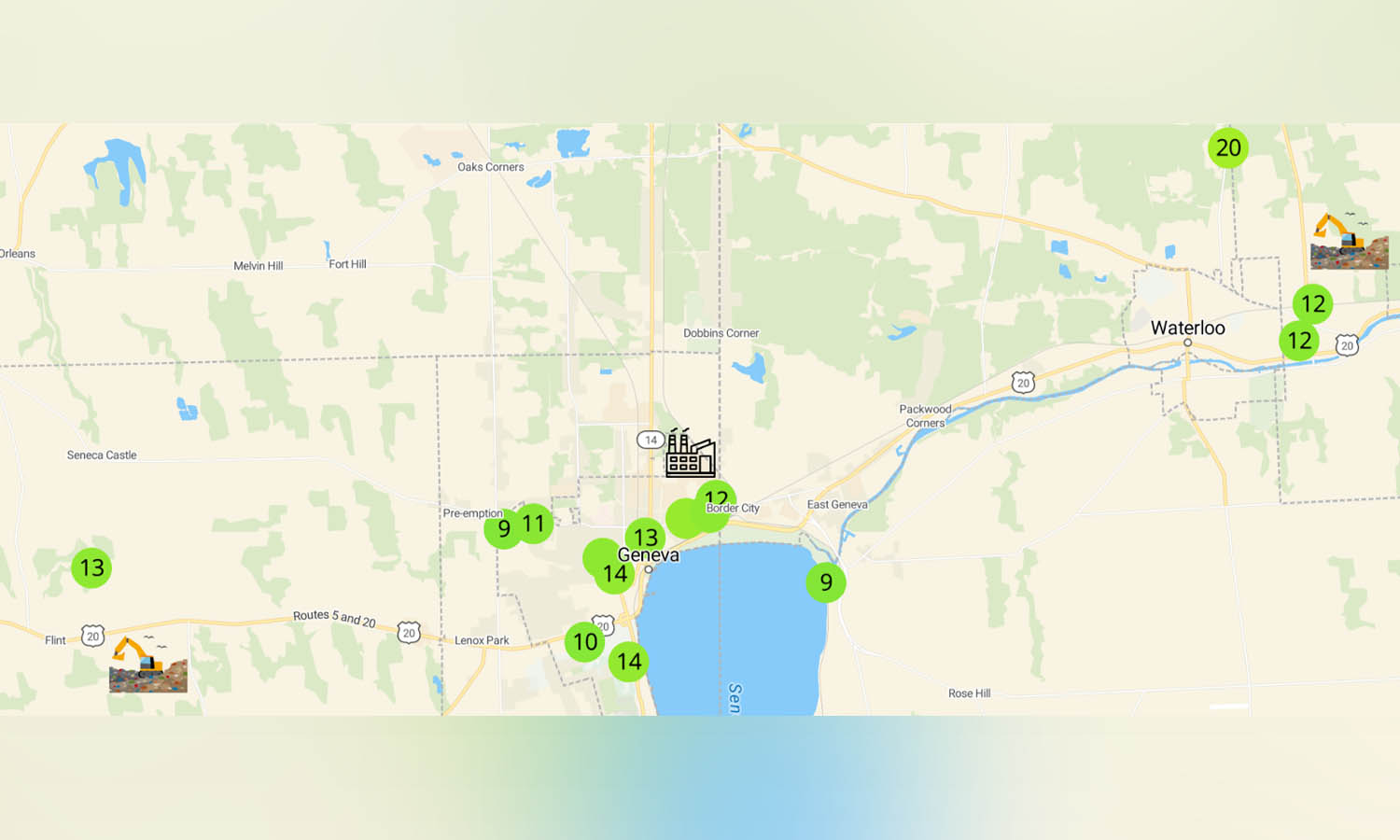
To collect the data, air monitor sensors were installed along Routes 5 and 20 near the landfill in Stanley and throughout Geneva.
Arens, along with HWS Head of Digital Learning Rob Beutner, led a bootcamp to teach HWS undergraduate and Geneva High School researchers the basics of data analysis with the statistical computing language R and how to convey data through maps using ArcGIS Online. Specifically, the students learned how to find and acquire publicly available data, sort and summarize data, visualize and map data, and perform basic statistical comparisons.
The students, Shayna Straney '26, Isabella Mujevic '26, Sabrin Omar Olad '27 and Rachel Brooks '26, monitored the air quality with sensors that determined the particulate matter, the mixture of solid particles and liquid droplets in the air. Particulate matter can come from many places including vehicle emissions, construction sites and power plants, for example.
They found that higher particulate matter levels were more prevalent during the hours people spent commuting to work, showing that major traffic might be emitting more particulate matter. Additionally, higher particulate matter was found in the summer months due to smoke from Canadian wildfires traveling into New York.
"I am an environmental studies major so a project that allows me to do research on our local community regarding an important environmental health factor was intriguing," says Straney. "I enjoyed analyzing, interpreting and visualizing the data and then communicating our findings to the greater community."
"As I continue this research throughout the academic year, I know that my skills, particularly in R Programming, ArcGIS, and community engagement, will be invaluable tools to help build my resume and hopefully get a great job," says Brooks.
Arens says understanding the local environment is the first step to making sure it supports the health and well-being of its inhabitants.
“Air quality can be difficult to assess with just our normal senses because the pollution particles that can cause the most damage are too small to see,” she says. “Moreover, we certainly smell unpleasant things from the landfills or the water treatment plant, for example, but the gasses that might be most dangerous may not have a particular smell. We won’t know if there is a potential problem until we look.”
BluePrint Geneva works to build an empowered and economically independent community through service projects and each project is based on vocalized community needs. The organization had previously established a website for residents to submit complaints of smells near landfills and created a map displaying where complaints have been filed. Public officials are then notified.
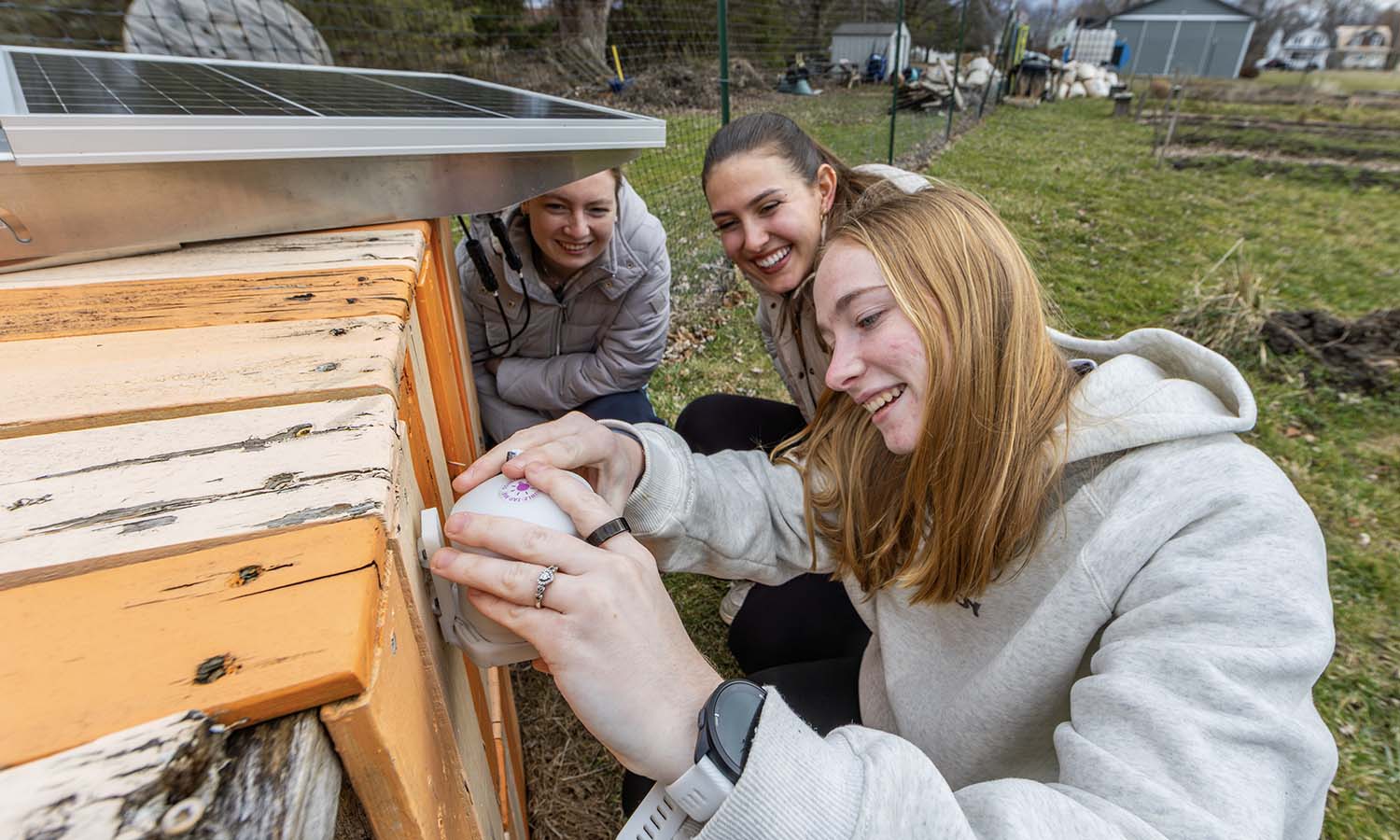
Top: Rachel Brooks '26, Isabella Mujevic '26 and Shayna Straney '26, check one of the PurpleAir sensors at the Geneva Community Garden that has been used to collect data.