HWS News
16 June 2026 Randy Hong ’26 Built a Mind-Controlled Prosthetic Arm. Next Stop: UC Davis.
Supported by faculty mentors across disciplines, Hong designed and programmed a prosthetic arm that mirrors human movement and secured NIH funding for doctoral research.
Randy Hong ’26 arrived at Hobart and William Smith convinced that science was not for him. Four years later, he has graduated with two interdisciplinary majors, built a mind-controlled prosthetic arm from scratch, completed honors research in computational neuroscience and earned a highly prestigious National Institutes of Health grant to support his Ph.D. studies in neuroscience at the University of California, Davis this fall.
“It’s quite a big deal, especially in the current funding environment for basic science,” says Professor of Psychological Science Daniel J. Graham, who mentored Hong’s honors thesis research.
Hong’s path to neuroscience and prosthetics began unexpectedly in a biopsychology course taught by Assistant Professor of Psychological Science Elizabeth Belcher.
“I was hesitant about enrolling into Professor Belcher’s Biopsychology course,” Hong says. “I wasn’t confident in my ability to succeed in the sciences, but I took the course and became fascinated with neuroscience and its applications.”
Originally focused on philosophy, psychology and public health, Hong says a classroom unit on motor function fundamentally changed his trajectory.
“At first, moving a limb seemed simple,” he says. “But Professor Belcher illustrated the science behind it and introduced ideas about spinal cord injuries and the possibility of using technology to help people recover function after traumatic injuries. That fascination with technology, combined with my interest in helping vulnerable populations, led me toward neural computation and prosthetic work.”
The work also connected deeply to his family history.
“My family consists of refugees from Vietnam,” Hong says. “I have been surrounded by people who experienced amputation or bodily disfigurement because of warfare. Technology felt like a way to create real impact.”
That interest eventually led Hong across disciplines and departments — from psychology and neuroscience into physics, mathematics, computer science, biology and engineering.
“I studied physics, public health, biology, math,” he says. “What fascinated me was realizing that mathematics — this abstract tool — could tell you something tangible about the world.”
Working closely with Graham and Associate Professor of Mathematics Yan Hao, Hong conducted honors thesis research focused on how large populations of neurons perform complex calculations and how mathematical modeling can help predict features of brain structure. But outside the lab, another idea continued to pull at him: building a prosthetic device capable of translating human movement into action.
Campus Experiences
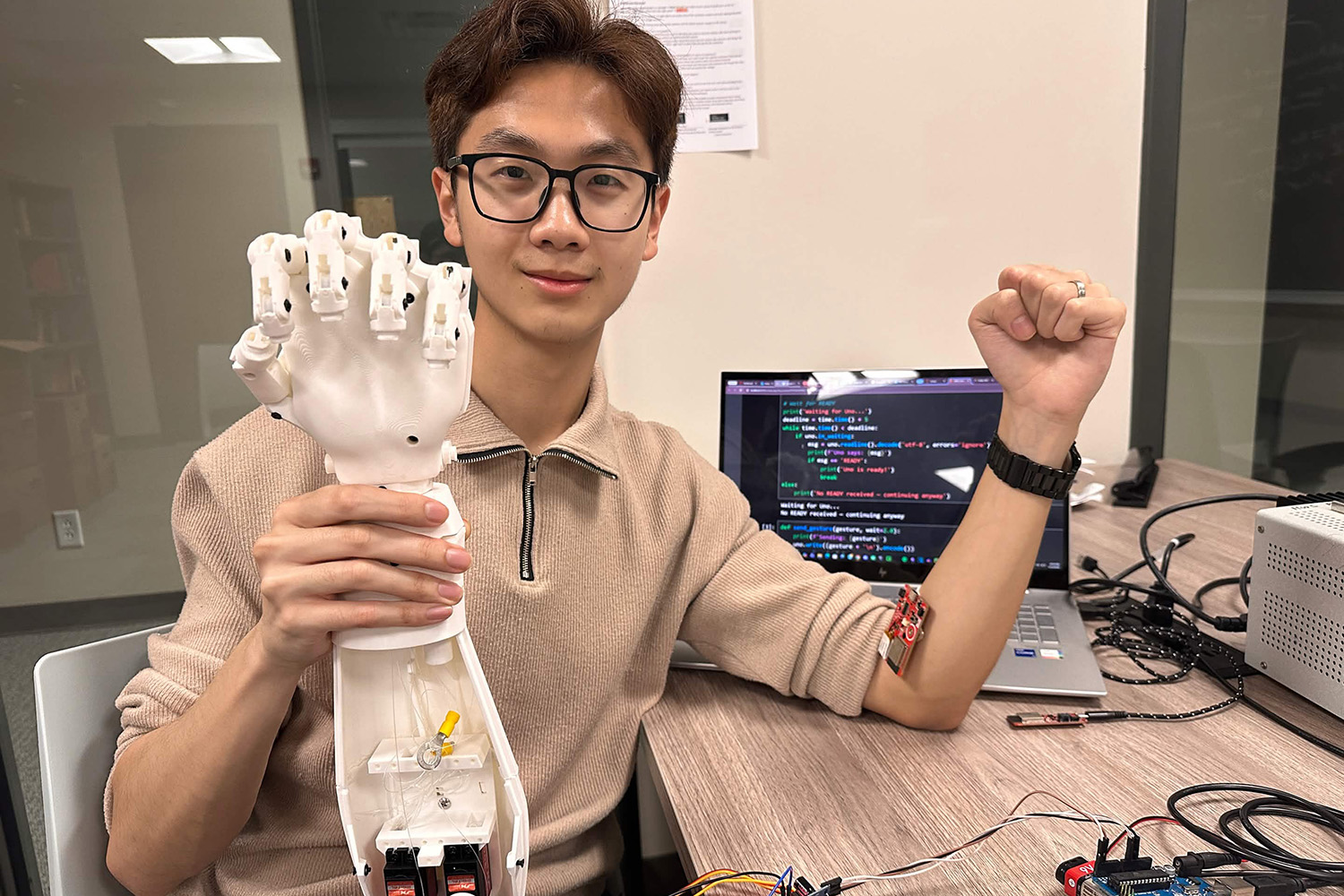
That project took shape this spring through an independent study with Professor of Physics Ileana Dumitriu and assistance from the Physics Department, including support from Professors Ted Allen and Don Spector.
Over the course of a single semester, Hong designed and programmed a prosthetic arm and hand capable of mimicking the movements of another arm and hand through a sensor-based control system.
“He built the entire system himself,” Dumitriu explains. “What impressed all of us was not only the technical achievement, but Randy’s willingness to venture into completely new territory and persist through every challenge along the way.”
Hong says the project would not have been possible without the encouragement he had across campus.
“I found myself overwhelmed with support in my senior year from the physics department,” he says. “I have never received so much enthusiastic support for my interest in the sciences and engineering outside of Dan Graham.”
The collaborative nature of the project also underscored what Hong sees as the defining strength of a liberal arts education.
“There is no neuroscience major at HWS. There is no engineering major,” he says. “There is an engineering club and a physics department. There is no pathway that is paved to what I found interested me. But I was fortunate enough to be surrounded by faculty who were willing to give me the time, space and energy to explore my interests — and we got a pretty cool project out of it: a mind-controlled prosthetic arm.”
Faculty members across disciplines helped shape that journey, including Associate Professor of Gender, Sexuality, and Intersectional Justice Jessica Hayes-Conroy, whose scholarship helped Hong think more critically about who his research could serve, and Professor of Mathematics Joe Rusinko, his Posse mentor, who encouraged him to pursue mathematics and quantitative work with confidence.
Assistant Professor of Computer Science Hanqing Hu also helped Hong further optimize his prosthetics research.
For Dumitriu, Hong’s story reflects the best of interdisciplinary learning at HWS. “Randy embodies what liberal arts education can look like at its most powerful,” she says. “He combines empathy, curiosity and technical skill in a way that allows him to create something meaningful and potentially transformative.”
This fall, Hong will continue that work at UC Davis with some of the world’s leading minds on this issue, where he plans to pursue neuroscience research connected to prosthetics and assistive technologies. A highly prestigious National Institutes of Health grant will fund his Ph.D. studies.
“I think what’s beautiful about it,” Hong says, “is trying to make sense of the brain — the structure and topology of the brain — and being able to apply that to do something that can help other people – a practical, real-world application that could immediately impact people’s lives.”
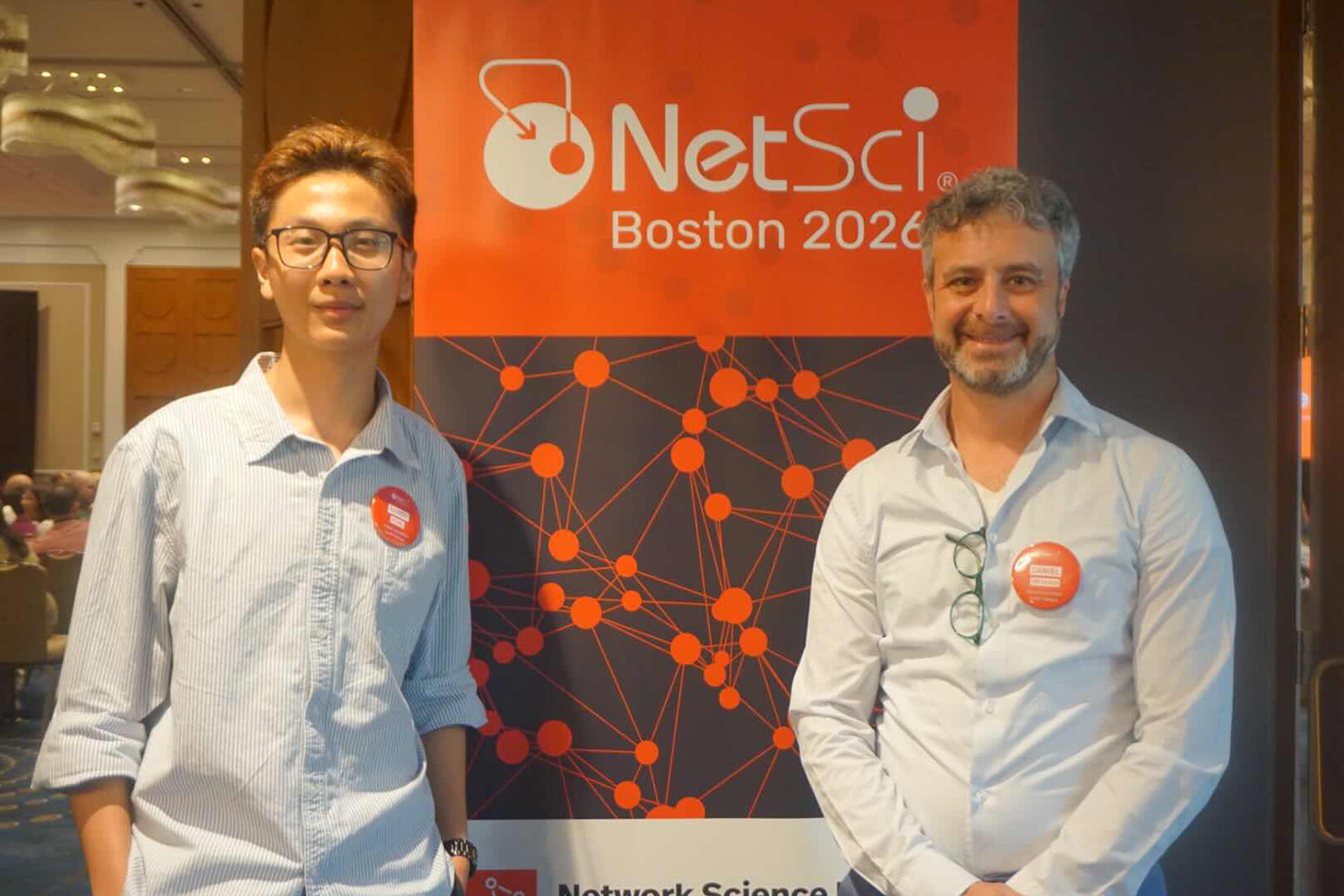
The research partnership Hong built with Graham continues to open doors. In June, the pair traveled to Boston for the Network Neuroscience conference, a featured component of the international NetSci conference, where they presented a research poster and delivered a talk during the conference’s main session — an opportunity to share their work with a global community of scholars at the forefront of network science and neuroscience.
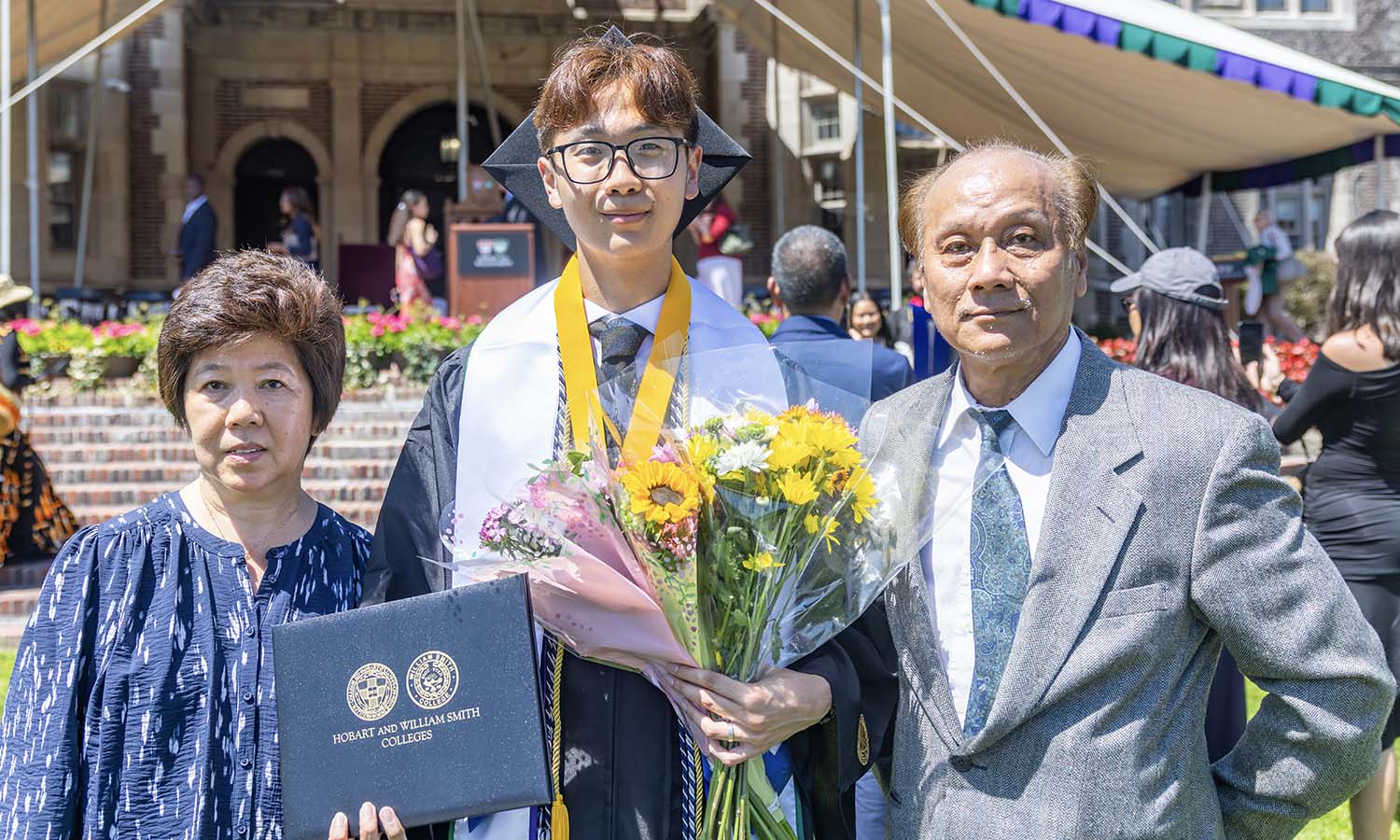
At Commencement, Hong was selected to deliver the Senior Speech. His remarks honored his parents. Read the transcript here.
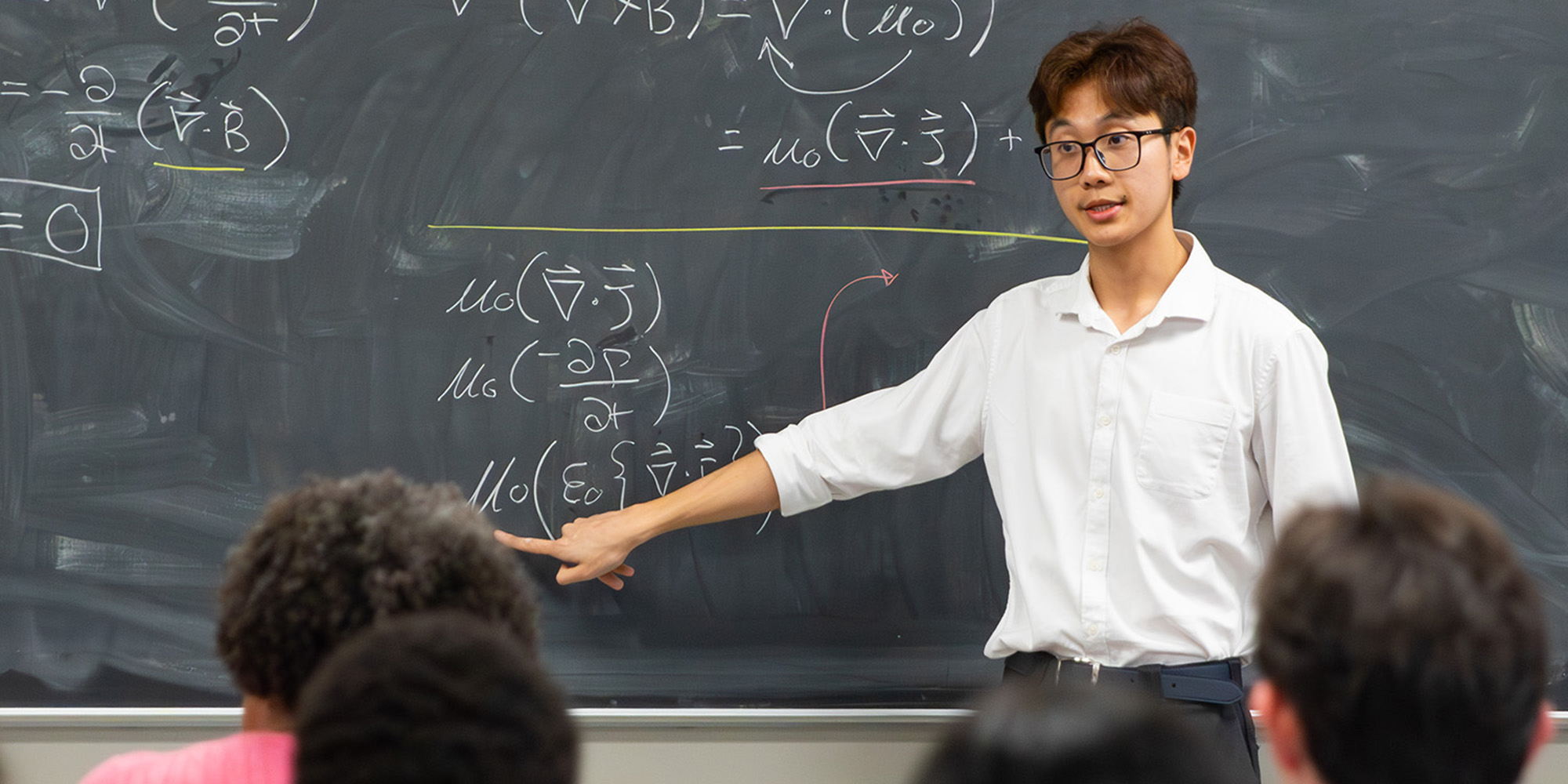
In the photo above, Randy Hong '26 presents “Deriving the Electromagnetic Wave Equation Using Maxwell’s Equations” during the 25th Annual Albert Holland Prize Competition for Physics Oratory. Hong won for his presentation.