HWS News
19 August 2026 Pursuing Truth
Following a national seminar on liberal arts education, Associate Professor Jessica Hayes-Conroy reflects on the questions and perspectives that shape her courses and the public health program she chairs.
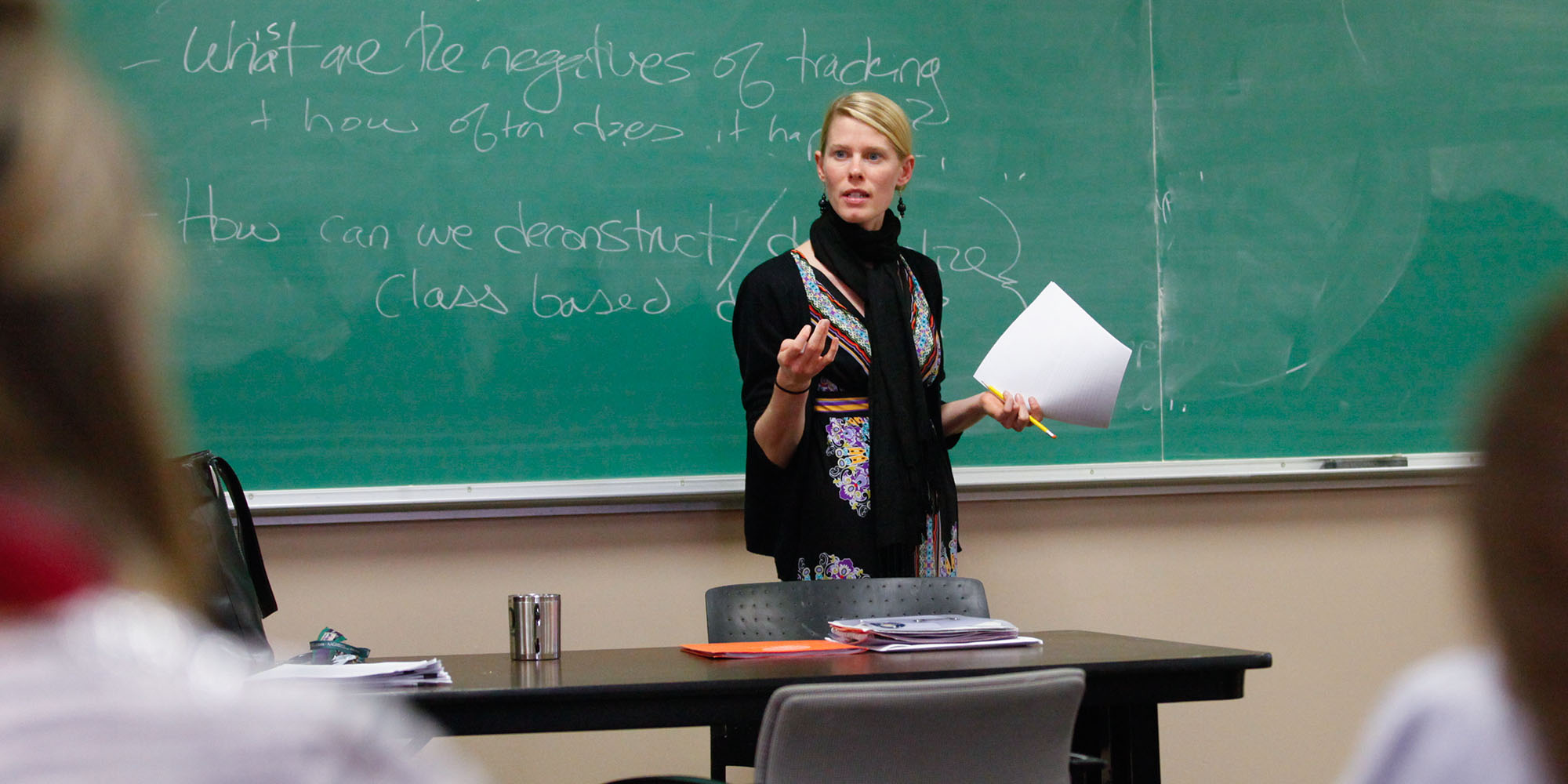
Associate Professor Jessica Hayes-Conroy believes a liberal arts education prepares students for more than a profession. It prepares them for a way of thinking.
“I think the liberal arts is fundamentally the place where we pursue truth,” says the Chair of Public Health and Associate Professor of Gender, Sexuality and Intersectional Justice.
For Hayes-Conroy, whose courses stretch from “The Politics of Health” to “Gender and Geography,” that pursuit means asking difficult questions. In her ongoing work in critical dietetics and health geography, she is animated by a view of the body as something continually shaped through its circumstances and relationships — the kind of thinking, she says, that a liberal arts training makes possible.
The liberal arts, as Hayes-Conroy sees it, does more than expose students to many disciplines — it encourages them to work in the spaces between fields, where un-siloing ideas can open connections and insights no single discipline could reach. That approach has guided her teaching at Hobart and William Smith and her work developing the interdisciplinary public health program, now in its third year.
This summer, she joined faculty from colleges across the country for a seminar at Transylvania University in Lexington, Kentucky on “Redefining & Celebrating the Liberal Arts.”
Organized by the Transylvania University Bingham Center for Teaching Excellence, the seminar brought together faculty from liberal arts colleges to reflect on the purposes of liberal education and imagine its future directions. Speakers discussed pedagogies of care, antiracist pedagogies and alternative assessment.
Hayes-Conroy arrived with a question she has been asking for years: "How can we articulate a vision of the liberal arts that captures everything it makes possible for students?"
Hayes-Conroy sees the public health program she helped develop at HWS as an example of that liberal arts approach. “People may think of liberal arts as a lighter version of a professional program; I actually think of it in reverse,” Hayes-Conroy says.
“I think of it as preparing our students not just how to do the thing, but how to think about how the thing is done. The buzzword has been, for the last 20 years, interdisciplinarity. I think HWS does interdisciplinarity phenomenally well." Students, she observes, have rich opportunities for interdisciplinary study and a deep desire for it.
She points to the ways HWS students move across departments, connect ideas and build academic paths that don't have to fit neatly inside a single field. Business Management and Entrepreneurship, along with Public Health, she says, are two examples that reach across campus to connect with multiple areas of study.
The Public Health program draws from the fields of biology, anthropology, philosophy, mathematics, gender studies, environmental studies, and many more, which in turn helps prepare students for a wider range of positions, from practicing medicine to implementing health policy.
A workshop on linguistic justice was among the Transylvania seminar sessions that stood out. Many of the discussions returned to questions she already raises with students in her courses, including what artificial intelligence reveals about learning, curiosity and being human.
"I'm not anti-AI," she says. "But AI is forcing us to reckon with our own humanity and realize, oh geez, there are a lot of things about being human that matter so deeply.”
Curiosity is one of them.
“I always tell my students when they're taking a class with me, ‘You're going to leave this class with more questions than answers, but that's a good thing,’” Hayes-Conroy says.