HWS News
25 September 2026 • Research Penn’s Research Advances the Future of Precision Optics
New Optica cover article highlights Penn’s research as HWS receives renewed National Science Foundation support for advances in optical coatings.
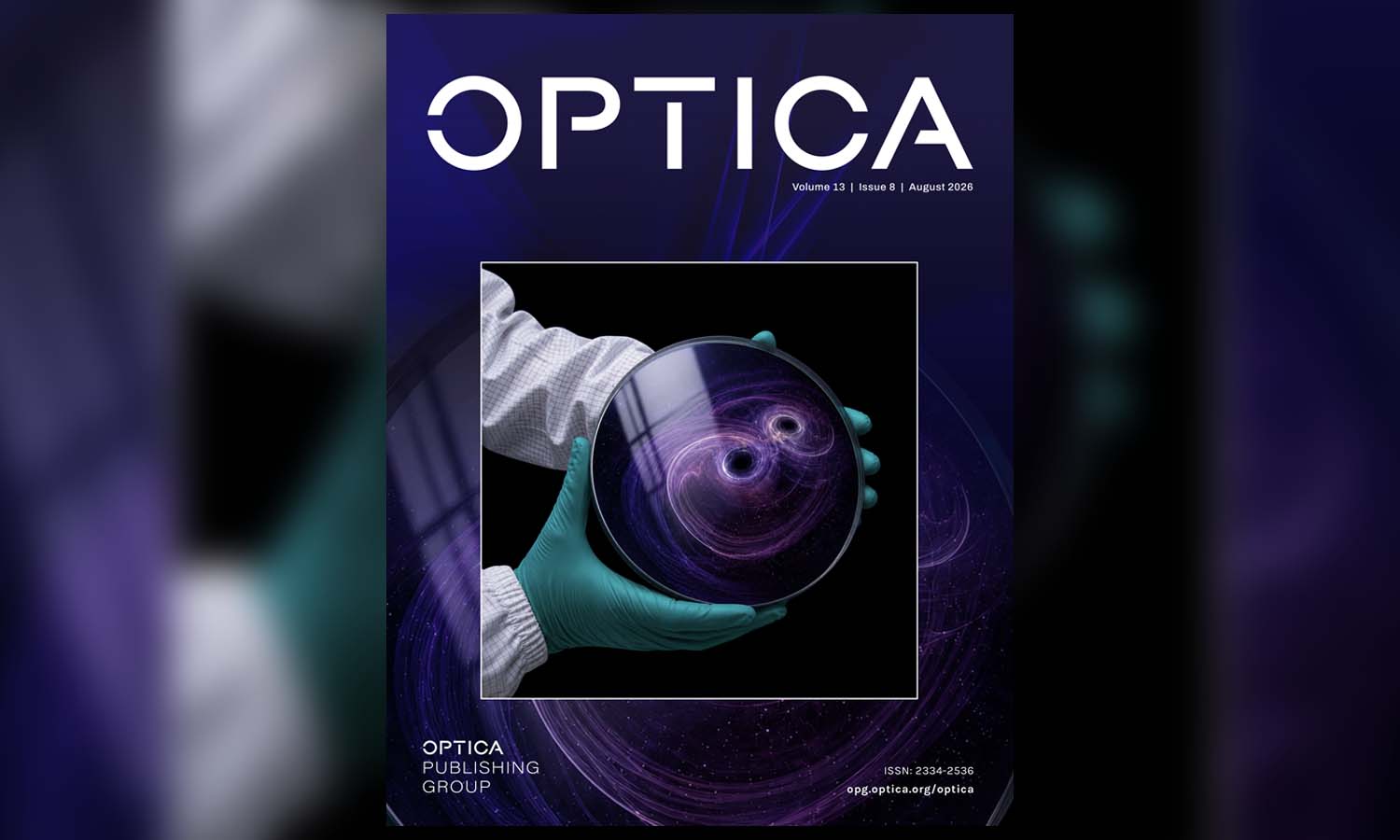
The August issue of Optica featured a cover article by Associate Professor of Physics Steven Penn and colleagues. The article, “Redefining Precision Interferometry and Spectroscopy with High-Performance Optical Interference Coatings,” reviews the state of the art of supermirrors, precision mirrors with extremely high reflectivity and very low noise. These mirrors are required for the highest precision physics experiments, such as detecting distant gravitational waves and measuring small deviations in time. Optica is the flagship journal of the Optical Society of America. The cover image (pictured above) superimposed a rendering of binary black holes on the crystalline semiconductor mirrors for Professor Penn’s lab.
The article is a survey of work from several labs across the U.S., including Syracuse, Arizona and Stanford, and the institutes of standards in the U.S. and Germany, JILA and PTB. Three of Penn’s research papers are cited in the review, highlighting his longstanding contributions to the field.
Penn’s research continues to contribute to advances in the highly precise optical technologies used by scientists to explore the universe and make measurements at the limits of what is possible.
While optical coatings are typically less than one-tenth of a human hair, their impact is significant. High precision instruments, such as gravitational-wave detectors, commonly use stabilized lasers reflected off mirrors to detect minute deviations in space. For example, LIGO detects distances that are one billion times smaller than the atoms that comprise the mirror coating. If the mirror coatings were noisy, the measurement could never be made. Improving those coatings makes the instruments more sensitive and allows researchers to detect signals from ever more distant cosmic events.
Penn has been part of the international LIGO Scientific Collaboration (LSC) for more than two decades. He played a pivotal role in developing the current mirrors for LIGO and is working on making the next generation coatings that will allow the detector to “see” several times farther into the universe.
The importance of LIGO’s work was recognized with the 2017 Nobel Prize in Physics, awarded to Rainer Weiss, Barry Barish and Kip Thorne for their discovery of gravitational waves, a scientific breakthrough made possible thanks to the LSC research team, including Penn. Penn and other LIGO collaborators were awarded the Special Breakthrough Prize in Physics in 2016. The National Academy of Sciences further underscored the field’s significance in its 2020 Decadal Survey, calling gravitational-wave astrophysics “one of the most exciting frontiers in science.”
Penn’s work is continuing with renewed support from the National Science Foundation. In August, HWS received a $50,984 NSF award for “Collaborative Research: Center for Coatings Research.” Penn is part of a team led by Martin Fejer of Stanford University and eight other researchers working to advance optical coating technologies.
The award builds on a $1.077 million NSF grant HWS received in 2023 for a three-year project led by Penn. The research focuses on developing and studying new mirror coatings for the next generation of gravitational-wave detectors, with the goal of making the instruments even more sensitive.