HWS News
31 August 2026 Learning Your Way Forward
At Convocation, the Class of 2030 is encouraged to embrace curiosity, vulnerability in relationships and the messy process of learning their way forward.
Standing at the threshold of their first academic year, members of the Class of 2030 were encouraged at Convocation to be comfortable with the uncomfortable and use their sense of curiosity to chart their paths.
In fact, Jane M. Erickson ’07 said, figuring it out as they go is the whole point.
"You are not going to remember your grades,” Erickson said. “You are going to remember the epiphany that you had at 2 a.m. alone, writing your final paper … and how that really fundamentally changed the way that you see the world.”
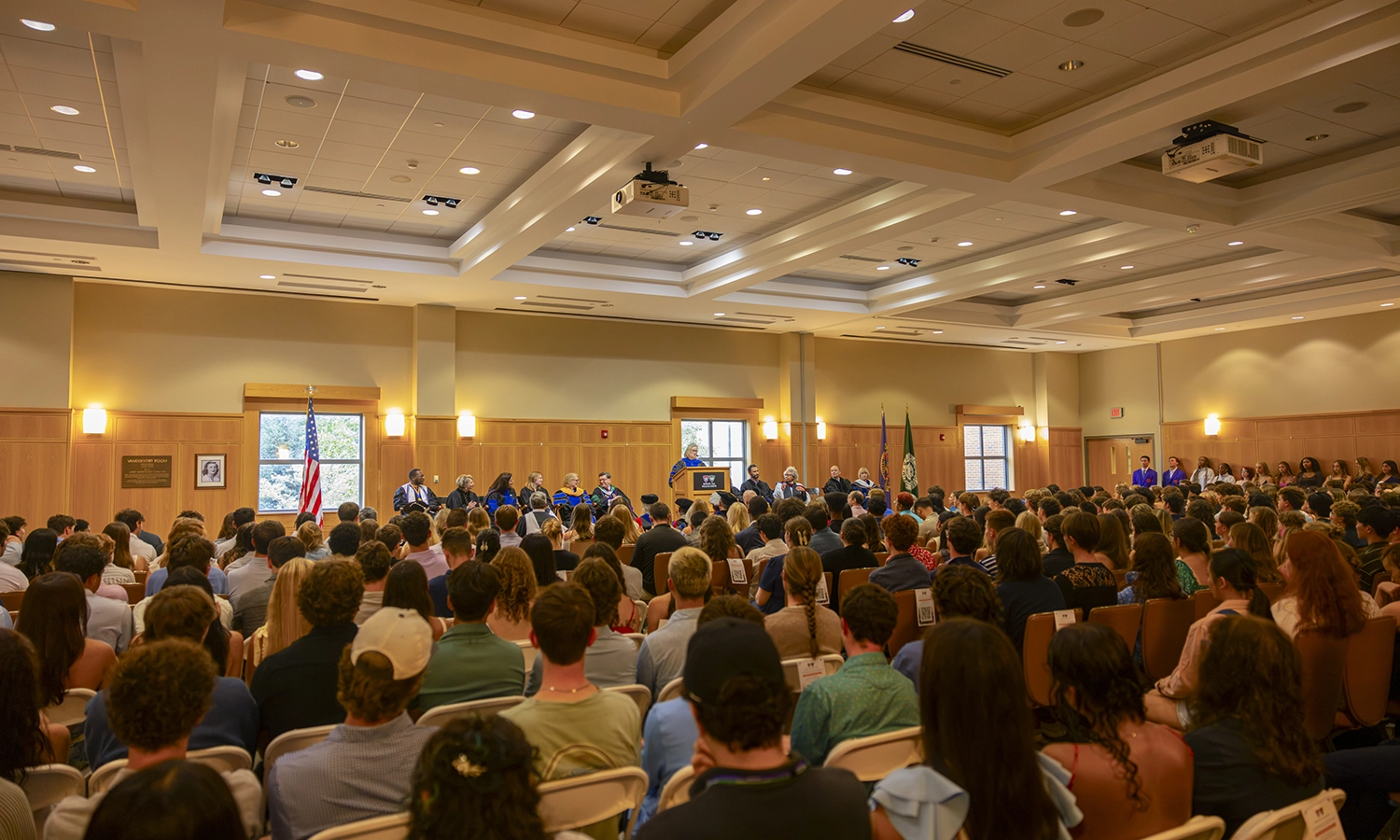
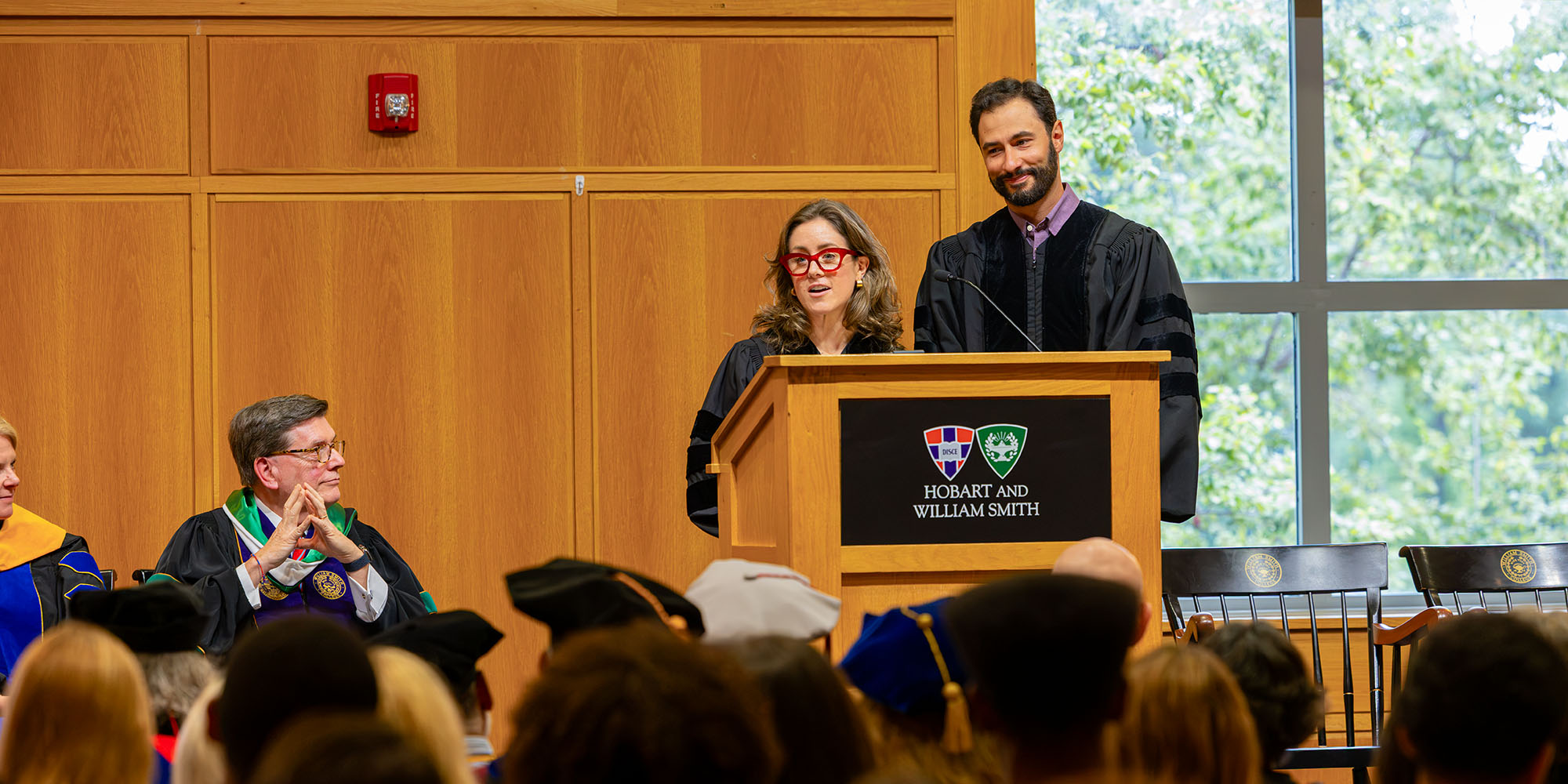
With rain moving the ceremony into the Vandervort Room in the Scandling Campus Center, the couple asked students to consider three ideas that have remained important to them nearly 20 years after graduation: curiosity, authentic relationships and approaching life as a journey rather than a destination.
Erickson told students they will learn at HWS “how to observe, how to interpret, to draw on a wide range of learnings,” and perhaps most importantly, “to see humanity in people who view the world differently than you do.”
“We are living through a crisis of connection right now in our country,” she said. “And I think that the way out, the only way out, is reconnecting with ourselves and with other people.”
Erickson described her professional work helping organizations address complicated social problems where it is impossible to know at the outset precisely what success will look like. In those circumstances, “you have to learn your way forward,” she said, adapting and changing course as new information emerges.
Wasmund illustrated the same idea through his experience on the Hobart rowing team, where years of early mornings and grueling practices dwarfed the six minutes spent racing. Some of his strongest memories are not of competitions but practices when eight rowers found the rhythm that allowed the boat to rise and accelerate beneath them.
“Above all else, we invite you to embrace the journey and commit to it, because that is where the learning happens,” Wasmund said.
Then he left students with a challenge: “Do what machines can’t. Be human and find out what it means to be alive.”
Chaplain and Dean for Spiritual Engagement the Rev. Nita Byrd drew on the words of the late Haudenosaunee spiritual leader Chief Leon Shenandoah, saying: “Human beings don’t know all things. Each one is given a different ability. Some know some things, and others know other things. But no one knows it all. That’s why we need each other.”
Byrd asked students to think of the HWS community as a circle in which each person contributes knowledge and perspective that allows everyone to understand more.
HWS Student Government President Ela Gardiner ’27 showed students how those connections can travel with them. Gardiner described arriving in Washington, D.C. this summer for an internship on Capitol Hill through the Frelinghuysen Assembly Internship Program. Walking toward the Cannon House Office Building on one of her first mornings, she looked up at the U.S. Capitol — a building she encountered repeatedly as a politics student — and wondered, “What am I doing here?”
Soon though, ideas she had discussed in her courses were unfolding around her as “people, decisions, disagreements, deadlines and consequences.”
“HWS had prepared me for that experience in ways I hadn’t fully understood until I was standing in the middle of it,” Gardiner said.
She also discovered that leaving Geneva did not mean leaving HWS. Nine other HWS students were in Washington through the program, while alumni offered advice, answered questions and made introductions.
“The HWS community doesn’t end on the edge of campus,” Gardiner said. “It follows you.”
Associate Professor of Practice in Biology Susan Flanders Cushman ’98 offered three pieces of advice drawn from her experience first as an HWS student and now as a professor: Use time wisely, get to know professors and “walk on the wild side.”
For Cushman, the last meant allowing unexpected experiences to change a carefully imagined path. Studying abroad in Australia led her away from plans involving clinical studies or medicine and toward aquatic biology, eventually bringing her back to HWS as a professor, which she described as her dream job.
President Mark D. Gearan closed Convocation with another argument against navigating college alone.
Citing University of Pennsylvania psychologist Angela Duckworth’s research on successful people, Gearan said one habit appears repeatedly across professions and among high-achieving students: a willingness to ask for help.
“Being a successful self-starter doesn’t mean picking yourself up by your bootstraps,” Gearan said. Sometimes it means raising a hand and asking a professor to explain a concept again.
“Doing it yourself,” Gearan advised, “is no way to live.”
The message echoed Senior Associate Dean Kelly Payne’s opening assurance that every member of the entering class has already earned a place at HWS and Byrd’s reminder that the community needs students’ multiplicity of gifts.
“Take the warm welcome that’s been extended to this great Class of 2030,” Gearan said, “and make this pretty special place an even better place during your time here.”
Top: Jane M. Erickson ’07 and her husband Trustee Paul A. Wasmund ’07 deliver Convocation remarks.