HWS News
4 November 2026 From Theory to Change
As HWS announces a graduate pathway to the Levy Economics Institute of Bard College, two recent HWS grads are already there putting economic theory to work in policy research and government.
When Brighton, N.Y., native Brendon Bennett ’23 arrived at Hobart and William Smith, it was with a career in politics in mind. He had no idea at the time that economics would be the road to take him there.
But after two economics courses at HWS, starting with Econ:160, Bennett discovered a field capable of combining mathematical models, political institutions, history and human behavior to answer the question: How can government improve people's lives?
Today, Bennett is finishing a Master of Arts degree in economic theory and policy at the Levy Economics Institute of Bard College. He’s also working full time as a graduate scholar in the New York State Assembly, researching legislation, drafting policy memoranda and briefing Assemblymember Charles Lavine on issues ranging from insurance to the judiciary.
Bennett says, “I was drawn to the Levy Institute because it combines economic theory and policy and gives you a lot of options of how to use your degree.”
Bennett, winner of the 2022 Pitch competition, and Anjalee Wanduragala ’25 described their experiences at the Levy Institute of Bard College. The nonprofit public policy research organization and HWS recently launched a new pathway agreement for qualified HWS economics majors or minors to pursue graduate degrees at Levy.
For HWS students interested in pursuing careers in policy, finance, research and analysis, the Levy Institute can extend guaranteed admission and credit transfer toward its graduate programs in economic theory and policy.
“Students interested in guaranteed admission should plan ahead, particularly to complete ECON 304: Econometrics by the end of the first semester of their senior year.” Associate Professor GreensteinAfter graduating from HWS, students pursue a one-year M.A. or two-year M.S. at the Levy Institute. The pathway also provides coordinated advising and a streamlined application process, with scholarship opportunities for eligible students.
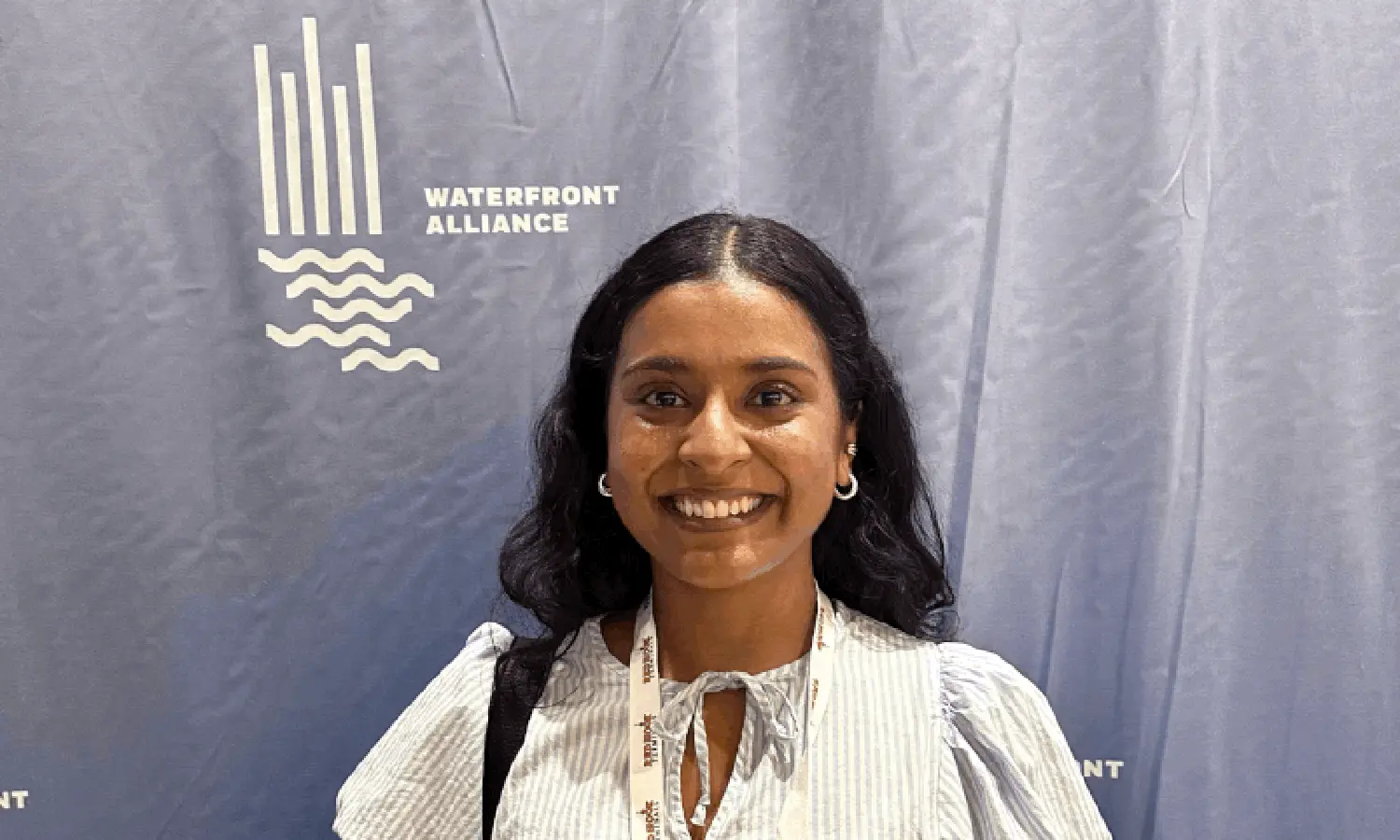
Anjalee Wanduragala ’25 at the 2026 Waterfront Conference in New York City, discussing environmental policy, sustainability and urban development.
Wanduragala is an international student from Sri Lanka and former HWS student trustee. At HWS, she double majored in economics and environmental studies. She’ll graduate from Levy with an M.S. in economic theory and policy in May 2027. Her career goal, she says, is “to contribute to research that informs meaningful decisions.”
“After graduating, I'm hoping to pursue opportunities in economic and policy research, particularly in areas related to inequality, development and environmental policy.”
At HWS, Wanduragala worked with the Finger Lakes Institute on water quality research and youth climate education, studied abroad in New Zealand and engaged in climate initiatives locally and internationally, including the Youth Climate Summit Southeast Asia 2024.
At Levy, she is building on those experiences through quantitative research, econometrics and policy analysis to connect economic theory to real-world policy questions. Exposure to conferences, researchers and policy discussions outside the classroom, she says, helps her see how her academic work connects to the kinds of challenges economists and policymakers address in practice.
"I appreciate that Levy encourages us to think critically about economics and approach real-world problems from different perspectives, rather than simply accepting conventional explanations," she says.
Both Levy and the economics department at HWS, Bennett and Wanduragala agree, push students’ thinking to use multiple theoretical lenses instead of a single mainstream school of thought.
For students, Bennett says, the result is a deeper, fuller and more accurate understanding of complex challenges.
“It leads me to be able to study economics from a more pragmatic point of view,” Bennett says. “How can we use theoretical models and math and literature and history, and put that all together, and say, what are the changes that we can make to the way the world works to improve it?”
Associate Professor of Economics Joshua Greenstein says the approach at Levy and in the HWS economics department is an unusual feature and key connection between the institutions.
"One of the strengths of our program is that we consider ourselves a pluralist department," Greenstein says. "We don't focus on one particular theoretical approach; we expose our students to multiple different types of economic theory, different views from different perspectives, in a way that not all programs do."
Ultimately, this pluralistic lens reduces false assumptions, Bennett says, by considering multiple factors: political, cultural, social, economic and other influences.
To produce meaningful change, Bennett says policymakers must appreciate the multidimensional nature of complex challenges such as climate change or inequality, which many single-paradigm economic models, by their very nature, struggle to resolve.
Bennett says he might never have pursued economics without the pluralistic approach he encountered at HWS and followed to the Levy Institute.
"I don't think I would have studied economics and been a different person if I went to a different school,” Bennett says.
Learn more about the HWS–Levy Economics Institute pathway.
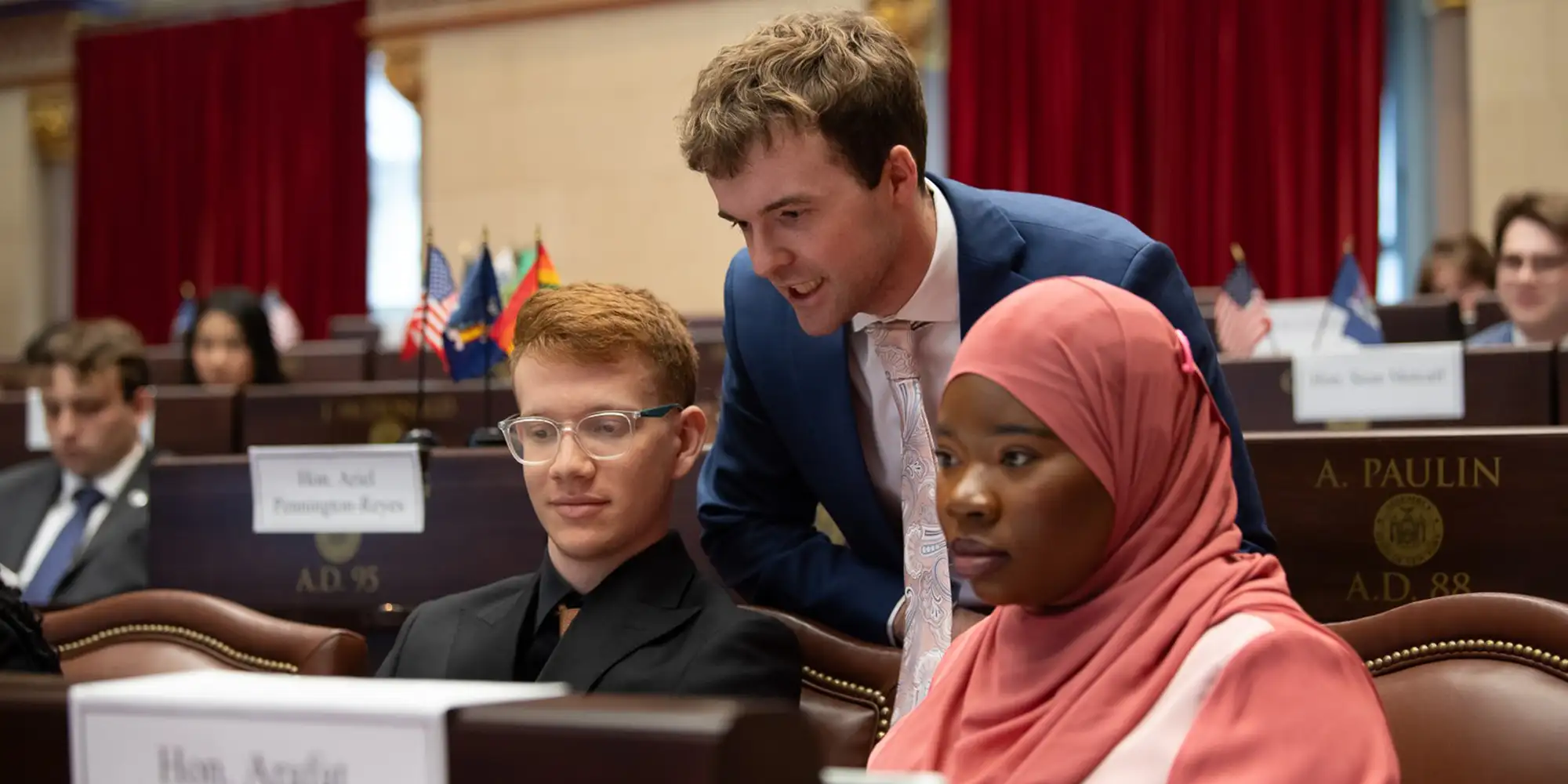
Top Photo: Brendon Bennett ’23 in a mock session showing interns how to debate and vote on bills as members of the New York State Assembly.