HWS News
23 June 2026 • STEM Engineering a New Pathway
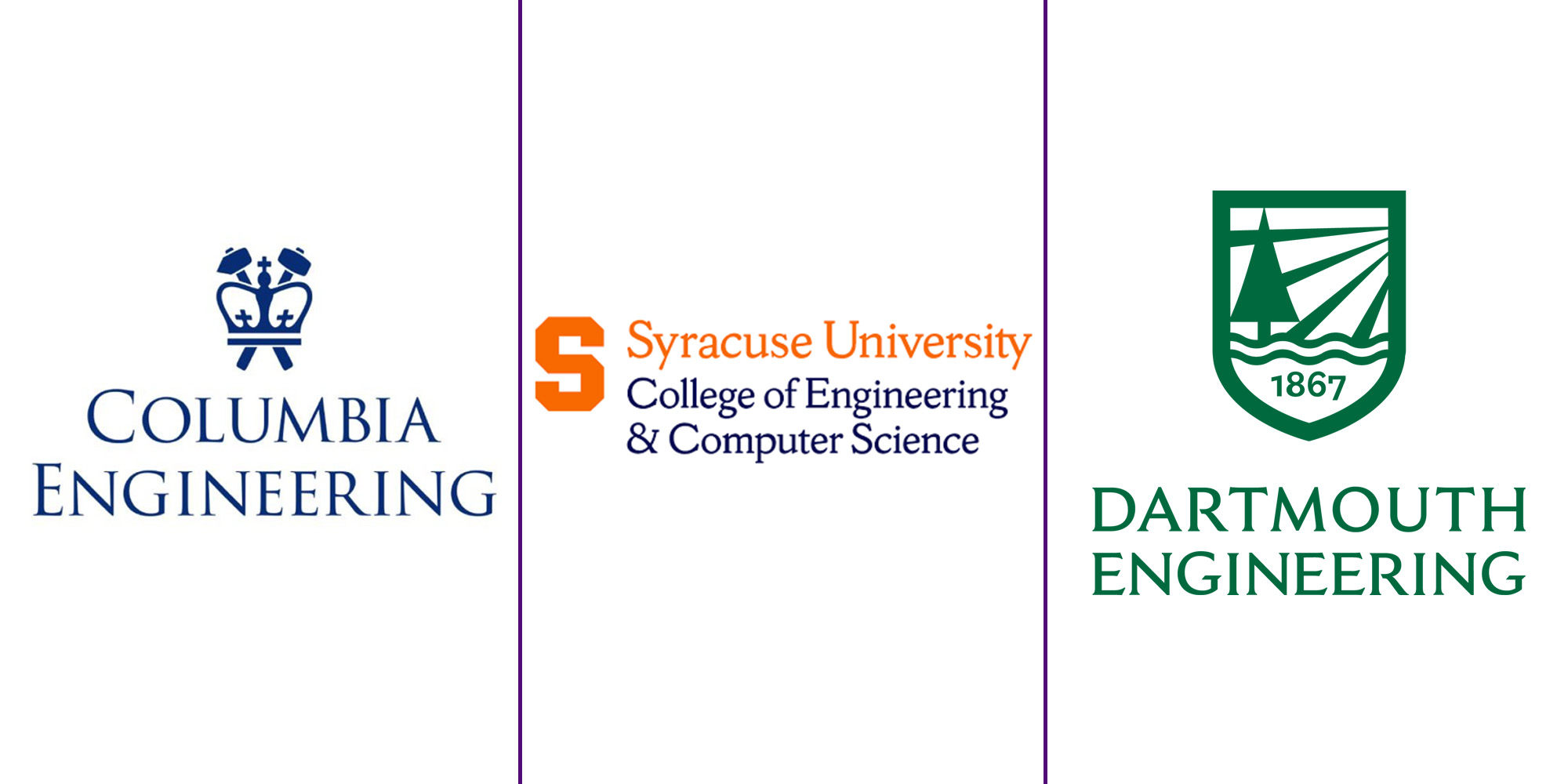
In addition to long-standing engineering partnerships with Columbia University and Dartmouth College, HWS students can pursue an MA in fields ranging from cybersecurity to biomedical engineering through a new agreement with Syracuse University.
Hobart and William Smith students who discover an interest in engineering late in their college careers now have a direct pathway to a master’s degree at Syracuse University’s College of Engineering and Computer Science — without needing to earn a second bachelor’s degree or restart their academic trajectory.
Through a new 4+2 partnership between HWS and Syracuse University’s College of Engineering and Computer Science, students who maintain a 3.2 GPA in a STEM major and receive a faculty recommendation are eligible for direct admission into one of ECS’s 12 graduate engineering programs.
The partnership opens pathways into high-demand industries ranging from environmental engineering and aerospace systems and gives HWS students access to the research infrastructure and applied training of a major R1 engineering institution while building on the broad scientific foundation of a liberal arts education.
Students in the program will develop skills in data analysis, modeling, laboratory research, design and computation while gaining hands-on experience in collaborative problem solving, says Shikha Nangia, Syracuse University’s Milton and Ann Stevenson Endowed Professor of Biomedical and Chemical Engineering and chair of the Department of Biomedical and Chemical Engineering.
“As a result, students graduate not only with strong engineering fundamentals, but with hands-on experience applying them across sectors such as biotechnology, pharmaceuticals, energy, advanced manufacturing, computing and health technologies,” Nangia says.
Unlike traditional engineering pathways that often require students to commit upon enrollment in college, the ECS partnership is designed for students whose interests evolve over the course of their undergraduate years.
Before starting at ECS, students complete their four-year degree at HWS and attend a six-week summer bridge course designed to provide the foundational engineering knowledge needed for advanced graduate coursework.
“This program allows somebody in their junior year to say, ‘I really want to take my biology major or my physics major and do something engineering-related,’” says Associate Provost and Professor of Geoscience Nicholas Metz. “It gives them that opportunity.”
“Liberal arts students should understand that an engineering pathway builds directly on their STEM preparation,” Nangia says. “Our bridge curriculum supports that transition while allowing students to leverage the communication skills, adaptability and interdisciplinary thinking they already bring.”
HWS offers two additional engineering partnerships: one with Columbia University’s School of Engineering and Applied Science and another with Dartmouth College’s Thayer School of Engineering.
In the Columbia program, students typically spend three years at HWS and two at Columbia, earning a B.A. or B.S. from HWS and a B.S. in an Engineering discipline from Columbia after five years. In the Dartmouth program, students usually spend their first two years at HWS, their third year at Dartmouth, return to HWS for their senior year and complete a fifth year at Dartmouth, earning a B.A. or B.S. from HWS and a B.E. from Dartmouth after five years.
The new Syracuse partnership complements those existing opportunities with an M.A. in engineering while expanding access for students across STEM disciplines, says HWS Professor of Chemistry Erin Pelkey. ECS faculty visited HWS in April to begin meeting with interested students.
“It’s the caliber of HWS students that permits Syracuse to extend the program beyond engineering students to STEM students,” Pelkey says.
The pathway also reflects a broader reality facing many college students: Career goals often take shape gradually rather than arriving fully formed before freshman year. A 2023 Inside Higher Ed survey of 3,000 students at two- and four-year institutions found that only 20 percent of respondents from the Classes of 2025, 2026 and 2027 said they had definitively decided on a career path.
“Students who are passionate about physics, chemistry, computer science, geoscience or environmental studies often realize later in college that they want to apply that knowledge directly to solving real-world problems,” says Jeremy Elliott-Engel, Associate Director of STEM Employer Development and Engagement at HWS. “This partnership provides a clear pathway for them to do that.”
The agreement spans a wide range of rapidly growing fields including biomedical engineering, chemical engineering, mechanical engineering, civil engineering, environmental engineering, computer engineering, computer science and cybersecurity.
According to Syracuse ECS and national salary data, graduates entering fields such as computer science, cybersecurity and systems analytics often begin with salaries ranging from roughly $85,000 to more than $110,000 annually. Biomedical and chemical engineering graduates commonly enter the workforce earning between $80,000 and $105,000.
Recent Syracuse ECS graduates have gone on to work for companies including Boston Scientific, Johnson & Johnson, Pfizer, Regeneron, Procter & Gamble and Thermo Fisher Scientific.
The agreement is a win-win for both schools and the region, says HWS Provost and Dean of Faculty Sarah Kirk.
“Students pursue advanced study at a leading institution, while providing Syracuse with students whose education is grounded in both strong scientific preparation and the liberal arts,” Kirk says. “Together, this collaboration benefits our region by helping to retain talented graduates and support workforce development in high-demand fields.”