

Criminal Justice

Study Justice. Lead Change.
Prepare to make an impact in the justice system through a program that combines a strong liberal arts foundation with advanced professional training.

Take the next step
Through a partnership between Hobart and William Smith and Niagara University, students can accelerate their academic journey and earn a Master of Science in Criminal Justice Administration in one year (two semesters). This 4+1 pathway integrates graduate-level learning into select undergraduate courses, allowing students to advance faster while maximizing the value of their coursework. This collaboration offers a smooth, affordable transition to grad school, acknowledging your prior learning and strengthening your academic and professional readiness. A background in criminal justice prepares you to analyze complex systems, evaluate policy and lead within organizations dedicated to public safety and social impact.
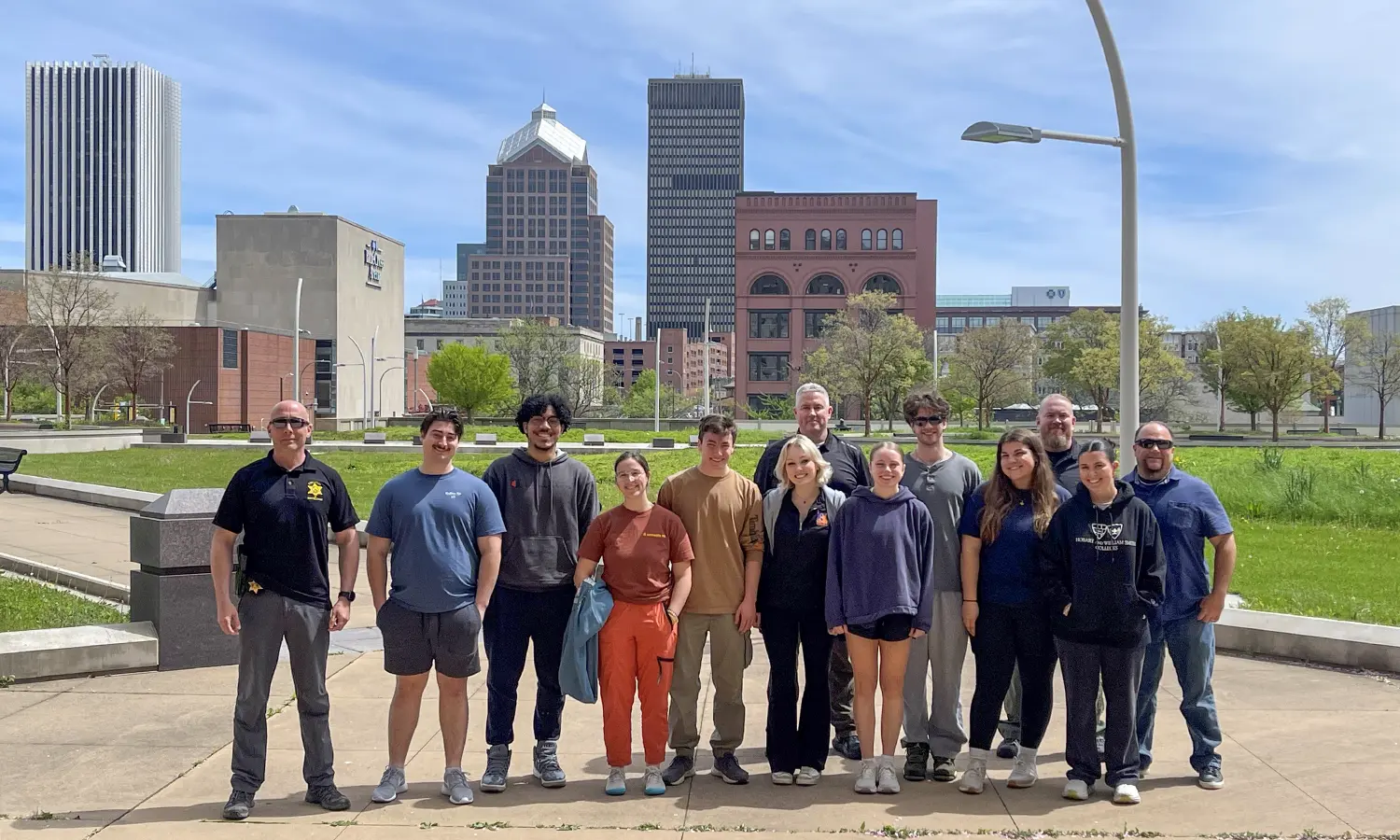
With a Career in Criminal Justice

Read More
"Professor Sutton was the first person I emailed after graduating from the academy. His courses taught me not only how important police work is, but how understanding society through a sociological lens can truly change communities for the better," Emma Fasso '23, MSM '24
- Law Enforcement & Public Safety as a Police Officer, Detective, Federal Agent, Intelligence Analyst or Supervisory Officer
- Courts & Legal Systems as a Court Administrator, Paralegal, Legal Analyst or Judicial Clerk
- Corrections & Rehabilitation as a Probation Officer, Parole Officer, Correctional Treatment Specialist or Case Manager
- Public Policy & Government as a Policy Analyst, Legislative Aide, Program Analyst or Criminal Justice Planner
- Victim Services & Advocacy as a Victim Advocate, Crisis Counselor, Social Services Coordinator or Community Outreach Specialist
- Federal & National Security as a Special Agent, Border Protection Officer, Intelligence Specialist or Homeland Security Analyst
- Cybersecurity & Digital Forensics as a Cybercrime Analyst, Digital Forensics Investigator, Information Security Analyst or Cyber Intelligence Analyst
- Nonprofit & Community Leadership in roles focused on reentry programs, restorative justice initiatives and community-based organizations
- Law & Graduate Study pursuing advanced degrees in law, criminal justice, public administration or related fields

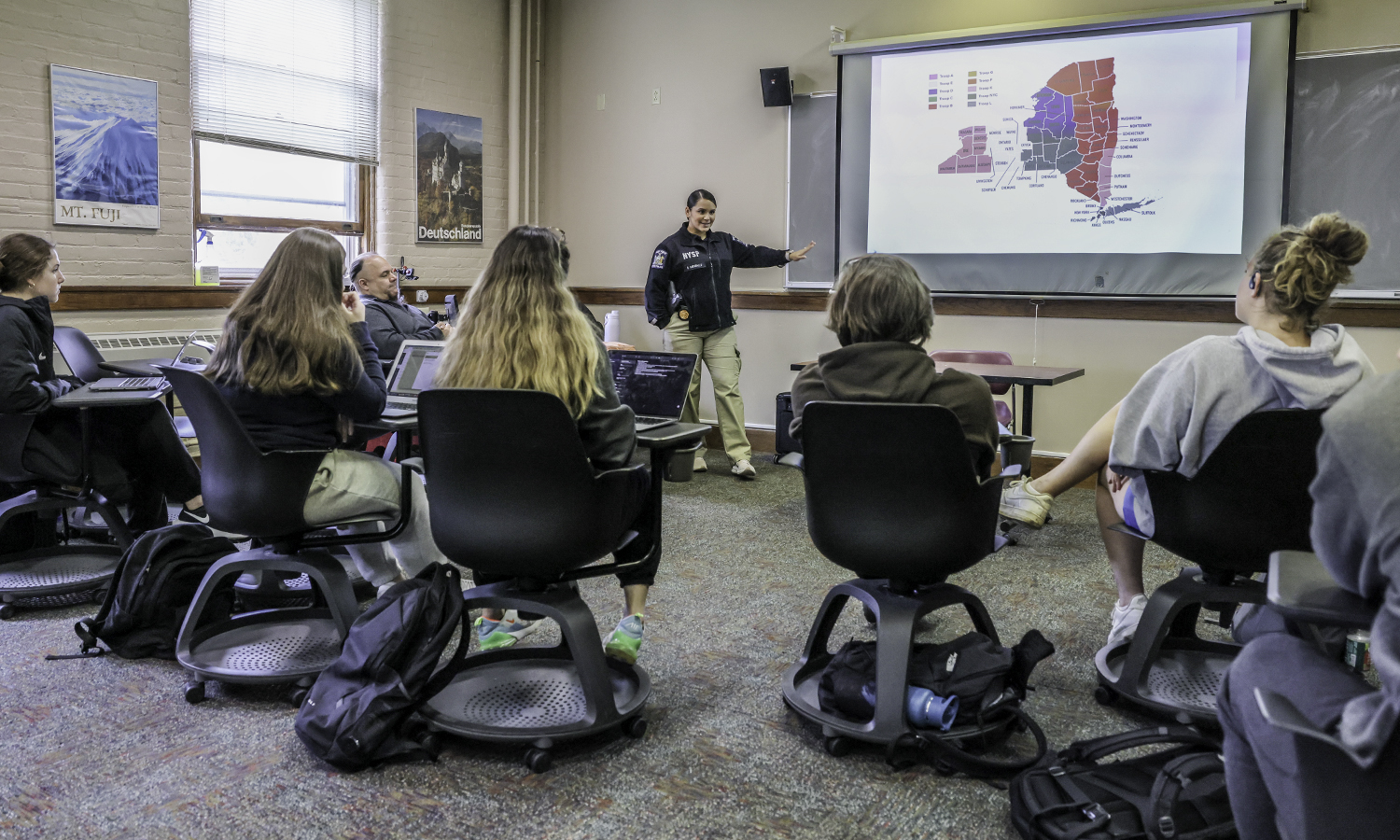


Hobart and William Smith-to-Niagara University 4+1 Pathway
Students who complete a B.A. at Hobart and William Smith with a 3.0 GPA or higher and have taken at least three of the approved courses listed below are eligible for direct admission to Niagara University’s M.S. in Criminal Justice Administration program. A portfolio assessment process also allows students to earn graduate credit for up to three courses based on prior undergraduate coursework.
Undergrad HWS Courses Eligible for Review
SOC 263 Juvenile Delinquency
SOC 265 Penology
This course examines penal and correctional responses to crime, including the historical development, philosophies of punishment, and contemporary practices within the U.S. criminal justice system. It also explores institutions and policies such as jails, prisons, probation, parole, and the death penalty, along with current issues including reentry, prison conditions, mental health, and inequality in corrections.
SOC 266 Sociology of police and policing
This course examines police and policing in the United States from a sociological perspective, focusing on historical development, organizational practices, and contemporary challenges. It also explores key issues such as police accountability, use of force, discretion, misconduct, and the ways policing intersects with race, class, gender, and social inequality.
SOC 362 CRIMINOLOGY
This course provides a comprehensive overview of criminological theory, crime trends, and the major explanations of criminal behavior, along with critical evaluation of key sources of crime data. It also examines major forms of crime and victimization while grounding analysis in sociological concepts such as race, class, gender, power, and social inequality, with emphasis on the role of research and evidence-based approaches.
Niagara Grad Courses Eligible for credit
If your courses pass the Portfolio Assessment (PA), you may earn credit for these graduate courses:
- CRJ 555 – Seminar in Theories of Crime
- CRJ 558 – Seminar in Policing and Society
- CRJ 562 – Seminar in Juvenile Justice
- CRJ 572 – Seminar in Penal Policy
Advising & Support
Students interested in the 4+1 Criminal Justice program should connect early with Professor James Sutton to discuss course planning, program eligibility, application requirements and the pathway to Niagara University’s M.S. in Criminal Justice Administration.
For more information about the 4+1 Criminal Justice program, please consult Professor of Sociology James Sutton at jsutton@hws.edu.
Frequently Asked Questions
The program is open to Hobart and William Smith students from any major. Students must complete a set of approved Sociology courses and meet GPA requirements to be eligible for admission to the accelerated pathway.
No. Students from any academic major may apply, as long as they complete the required prerequisite Sociology courses and meet program eligibility standards.
Students earn both their bachelor’s degree from HWS and a Master of Science in Criminal Justice Administration from Niagara University in five years total.
Yes. Because students receive credit for approved course during their undergraduate years, the program reduces both the time and overall cost required to earn a master’s degree.
Internships are a valuable way to apply classroom knowledge to real-world challenges. These opportunities help students explore career paths and build professional networks. Through the Salisbury Center for Career, Professional and Experiential Education, you’ll explore career paths, receive one-on-one advising and secure a funded internship or research experience. HWS guarantees every student at least one internship or research opportunity and provides the financial support to make it possible.
Yes. At HWS, more than 60% of students study abroad. 4+1 students can participate in study abroad opportunities during their time at HWS. Studying abroad can be a valuable way to explore global perspectives on law, justice systems, and social policy, which complement the academic foundation of the Criminal Justice pathway.
Graduates pursue careers in law enforcement, public safety, courts, corrections, victim services, public policy, cybersecurity and federal agencies, as well as advanced study in law, criminal justice, or public administration.
Students typically apply during their junior year. Applications include academic review, completion of prerequisite courses, and approval for participation in the accelerated pathway.