
Vincent ΓÇÖ83 Featured in Diverse: Issues in Higher Education
8 November 2017 Vincent 83 Featured in Diverse: Issues in Higher Education
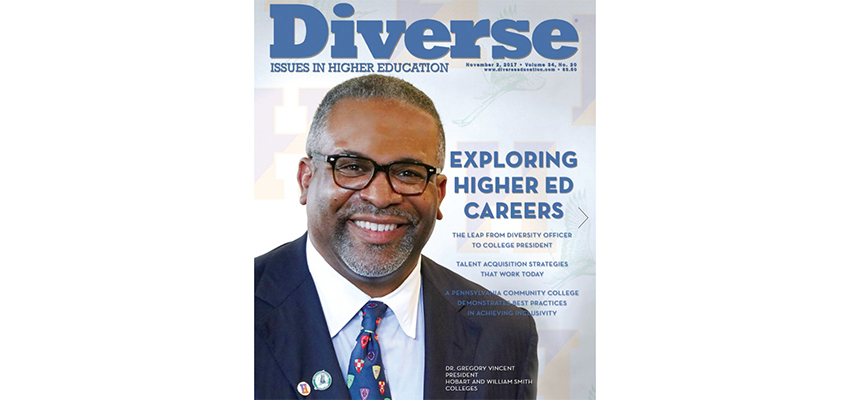
President Gregory J. Vincent 83 is featured in the cover story of the latest edition of Diverse: Issues in Higher Education in which he discusses serving as president of Hobart and William Smith, as well as his previous work as a chief diversity officer.
The article in the Exploring Higher Ed Careers edition of Diverse Issues looks at a trend in higher education of chief diversity officers becoming college presidents. The Nov. 2 issue also notes Vincents recent appointment as HWS president.
Being the go-to person during a critical time for a college is what Vincent, newly minted president (and a proud alumnus) at Hobart and William Smith Colleges, counts as one of the most salient preparatory experiences from his time as vice president for diversity and community engagement at the University of Texas at Austin, writes Jamaal Abdul-Alim of Diverse Issues.
Vincents extensive career is distinguished by his commitment to equity and justice, both in education and in the wider public arena. He joined UT-Austin in 2005 and presided over the universitys Division of Diversity and Community Engagement, now regarded as a national model. Under Vincents leadership, the division grew to encompass a $50 million budget with more than 400 employees and 50 units, as well as 400 local and regional partners, who connect the universitys resources to communities across the state, particularly those facing significant challenges in accessing education.
The article notes that in 2016 Vincent served as university spokesperson in the case of Fisher v. University of Texas, in which the United States Supreme Court ruled to uphold the use of affirmative action in higher education.
I showed that I could deal with and serve as a spokesperson for a campus on a critical issue, Vincent says in the article.
The magazines Nov. 2 cover is a full-page portrait of Vincent wearing a Hobart and William Smith tie designed by Eric Holch 70 and Alan Cadan 61.
The full Diverse Issues article is below.
Diverse: Issues In Higher Education
The Diversity Advantage
Jamaal Abdul-Alim Nov. 2, 2017
By the time Dr. Jamel Santa Cruze Wright became the first chief diversity officer at Eureka College in 2014 and eventually also vice president for strategic and diversity initiatives she had already had her sights set on becoming a college president for several years.
What she didnt expect was for her presidential dreams to materialize so quickly.
I will say that it happened a lot sooner than I anticipated, Wright says.
Wright essentially ascended directly from her role as a chief diversity officer at Eureka to the presidency at the small private college, initially on an interim basis in 2016 and later on a permanent basis earlier this year.
Wright says the experience she garnered in her capacity as the schools chief diversity officer played no small role in that move.
My role was bigger and more encompassing than just CDO, Wright says, explaining that her role and responsibilities prior to becoming president included over-sight for Title IX issues, communications and rolling out a new strategic plan.
All of those things, including the role of CDO, is what really made this happen, Wright says of her presidency.
Dr. Archie W. Ervin, president of the National Association of Diversity Officers in Higher Education, or NADOHE, says Wrights trajectory to the presidency represents the emergence of a new and welcome trend in higher education that is, colleges entrusting their presidencies to former chief diversity officers.
Ervin trumpets the trend in the Presidents Message on nadohe.org, writing that with the recent appointment of Wright as the first woman and first African-American to lead Eureka College, there are now at least six former chief diversity officers who have risen to the CEO ranks.
The other five he mentions are Dr. Juan S. Muoz, president of University of Houston-Downtown; Dr. Shirley Collado, who is set to assume the presidency of Ithaca College next month; Dr. Gregory Vincent, president of Hobart and William Smith Colleges; Dr. Glen Jones, president of Henderson State University; and Dr. Rusty Barcelo, former president of Northern New Mexico College.
Now theres a new pathway to the presidency is what were saying, Ervin says. It used to be people thought you had to be an executive leader. They didnt tend to think of most of these CDOs as vice presidents, so the next step for me is the president.
Ervin says search firms now acknowledge that the CDO role to-day has been complex and wide enough in higher education that it actually is great preparation for the various issues that a college president will face, from financial issues to student and academic issues.
Thats absolutely great training ground for those who aspire to be presidents and CEOs, because thats what they have to do, Ervin says of the CDO experience.
However, Monroe Bud Moseley, vice president and partner at Isaacson, Miller, an executive search firm that specializes in higher education, cautions against overstating the significance that prior experience as a CDO might play in the executive search process.
You have to be careful when people say you can move to president from the CDO role, Moseley says, although he was not speaking in reference to Ervins or anyones particular remarks.
Its not like the only thing youve done is been a CDO, Moseley says. Many of the people had been in student affairs, he said, citing Dr. Juan Muoz as an example.
Indeed, before he became president at the University of Houston-Downtown, Muoz had served as a senior vice president and vice provost for undergraduate education and student affairs at Texas Tech University. The position entailed supervision of more than 40 units and departments including oversight of several academic degrees; the TTU Ethics Center; the Military Veterans Program Office; the Teaching, Learning and Professional Development Center; and the Office of Academic Engagement, according to his UHD biography.
Moseley also noted that many former CDOs who are now presidents had substantial experience in academe.
If you had a richer record in the academy, then theres no reason why a period of time as a CDO will distract search committees from considering you for a presidency, Moseley says. Why? Be-cause we all know the relationships that CDOs help craft.
They stretch across the institution, with student affairs, legal affairs, with faculty and research, so these are people who have multiple skills that can be brought to bear on a presidency.
Moseley says academic experience also goes a long way with the decision-makers and faculty members.
You really need to have some depth in the academic milieu to be credible to trustees, and certainly faculty, for the understanding that you can bring, Moseley says.
CDOs experience with procurement of grants and raising funds is particularly useful, Moseley says, adding, Theyre not inexperienced at writing proposals and submitting ideas with appropriate partners to pursue funding opportunities.
CDOs also tend to have experience helping presidents in times of cri- sis and other critical moments or periods on campus, says Ervin, the NADOHE leader.
This profession turns out to be an excellent profession for training for presidencies because all of us have been in the fire with the presidents, Ervin says.
Being the go-to person during a critical time for a college is what Vincent, newly minted president (and a proud alumnus) at Hobart and William Smith Colleges, counts as one of the most salient preparatory experiences from his time as vice president for diversity and community engagement at the University of Texas at Austin.
Vincent referred to his time as point-person for UT-Austin when the campus was embroiled in the Fisher v. UT Austin affirmative action case. I showed that I could deal with and serve as a spokesperson for a campus on a critical issue, Vincent says.
But his position called for much more than dealing with the media when the national spotlight was on his campus.
Increasingly youre dealing with complex budgets, Vincent says. So youre able to be a part of a cabinet dealing with a complex set of issues and you have the academic credentials. Many have terminal degrees, and they were tenured faculty. Theres a lot about the profile that allows us to move from CDO positions to the presidency.
Ervin, of NADOHE, asserts that CDOs will be better prepared to deal with demographic shift s in the student bodies of the future.
People who havent learned how to successfully respond to that and lead on that are not gonna be the people who are gonna be the president in the future, Ervin says. More and more, youre gonna see search firms asking, What have you done to prepare yourself to lead in an ever-changing and ever diverse community that youre going into?
Presidents who are ill-equipped to deal with diversity, demo-graphic shift s and racial incidents on campus risk being ousted from their posts, Ervin says, citing the 2015 protests that precipitated the ouster of the University of Missouri chancellor and system president.
Dozens of institutions have high-level leaders pushed out of office because of inability to capably respond to those kind of demands, Ervin says.