
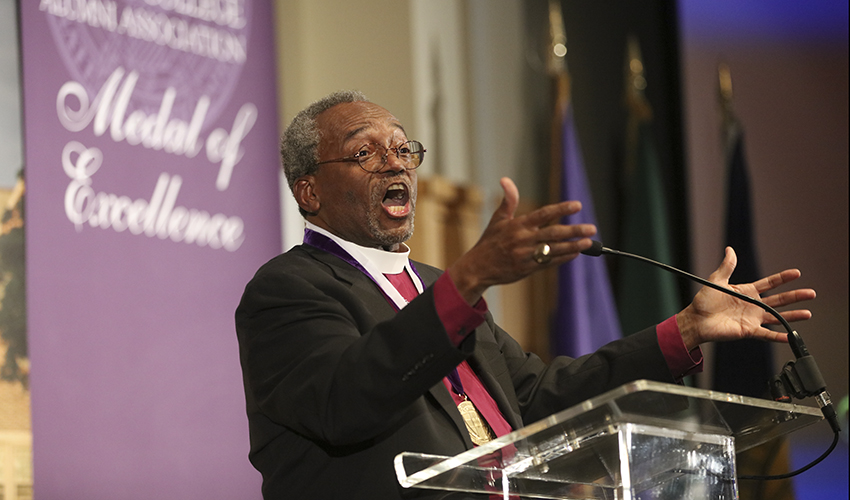
The Most Rev. Curry on Justice, Action and Love in Washington Post
16 June 2021 The Most Rev. Curry on Justice, Action and Love in Washington Post
Our nations heart breaks right now because we have strayed far from the path of love. Because love does not look like one mans knee on another mans neck, crushing the God-given life out of him. This is callous disregard for the life of another human being, shown in the willingness to snuff it out brutally as the unarmed victim pleads for mercy, writes the Most Rev. Bishop Michael B. Curry 75, Presiding Bishop and Primate of the Episcopal Church, in a May 31 opinion piece in the Washington Post.
Titled As a black man, I understand the anger in our streets. But we must still choose love, Currys piece argues that the centuries of racial terror[that led to the] frustration, pain and anger rippling through our streets todaymust not lead to fatalism or despair. We are not condemned to live this way forever. I recommend a different path the path of love.
Read the full article below.
Previously scheduled to offer the Commencement Address for the Classes of 2020 in May, Bishop Currywill deliver the address to the Classes of 2020 when they hold their in-person ceremony on the morning of Sunday, June 6, 2021.
Curry, the first African American to serve as Presiding Bishop and Primate of the Episcopal Church, has been an advocate for an inclusive, authentic ministry committed to racial reconciliation, equal justice and equal opportunity. The author of several books, includingSongs My Grandma SangandThe Power of Love, Curry has led churches in Winston-Salem, N.C., Lincoln Heights, Ohio, and Baltimore, Md. In 2000, he was elected 11th bishop of North Carolina. In November 2015, he was elected to the position of presiding bishop of the Episcopal Church. Curry earned a degree in religious studies from Hobart, where he completed Honors and was a member of the Hobart Student Association. He went on to earn a masters of divinity from Yale Divinity School. In 2016, he returned to HWS to participate in the Presidents Forum and receive the Hobart Medal of Excellence, the Hobart College Alumni Associations highest honor.
As a black man, I understand the anger in our streets. But we must still choose love.
ByMichael B. Curry
May 31, 2020
Michael B. Curry is presiding bishop of the Episcopal Church.
I am an African American man, blessed to serve as the presiding bishop of the Episcopal Church. In my 67 years, I have seen our country change a great deal. But what happened toGeorge Floyd,Breonna Taylor,Ahmaud Arbery,Sandra Bland,Paul Castaway,Melissa Ventura,Eric Garner,Michael Brown,Trayvon Martinand countless others has been a sad constant.
Back in the 1960s and 70s, my father ran the Human Relations Commission for the city of Buffalo. He organized sensitivity trainings for the police department, many of whose members he respected and liked. He also warned me to be careful whenever I interacted with the police, because he knew the dangers for a young black man were real. As events in Minneapolis have revealed, that danger has not changed. What has changed is technology: Today, cellphones document racial terror. That is why we see frustration, pain and anger rippling through our streets today. We should all feel the same.
But that frustration must not lead to fatalism or despair. We are not condemned to live this way forever. I recommend a different path the path of love.
Our nations heart breaks right now because we have strayed far from the path of love. Because love does not look like one mans knee on another mans neck, crushing the God-given life out of him. This is callous disregard for the life of another human being, shown in the willingness to snuff it out brutally as the unarmed victim pleads for mercy.
Love does not look like the harm being caused by some police or some protesters in our cities. Violence against any person is violence against a child of God, created in Gods image. And that ultimately is violence against God, which is blasphemy the denial of the God whose love is the root of genuine justice and true human dignity and equality.
Love does not look like the silence and complicity of too many of us, who wish more for tranquility than justice.
What does love look like? Not like this. These words spoken Thursday night by my friend Craig Loya, the newly elected Episcopal bishop of Minnesota haunt me. I look at searing images of racialized violence across our country against the backdrop of the disproportionate number of covid-19 victims who are black, brown and native and I cannot help but notice loves profound and tragic absence.
So whatisthe path of love? In times like these, how can we find it and follow it?
When I think about what love looks like, I see us channeling our holy rage into concrete, productive and powerful action. In this moment, love looks like voting for leadership at the local, state, and federal level that will help us to make lasting reform. Love looks like calling on officials and demanding they fulfill their duty to protect the dignity of every child of God.
Love looks like making the long-term commitment to racial healing, justice and truth-telling knowing that, without intentional, ongoing intervention on the part of every person of good will, America will cling to its original, racist ways of being.
Love looks like working with local police departments to build relationships with the community and develop mechanisms that hold officers accountable. It means ensuring that no police officer with a history of unauthorized force or racialized violence is shielded and allowed to endanger the lives of those theyve sworn to protect and serve.
Love looks like all of us people of every race and religion and national origin and political affiliation standing up and saying Enough! We can do better than this. We canbebetter than this.
What does love look like? I believe that is what Jesus of Nazareth taught us. It looks like the biblical Good Samaritan, an outsider who spends his time and money healing somebody he doesnt know or even like.
What America has seen in the past several days may leave us wondering what we can possibly do in this moment to be good Samaritans to help heal our country, even the parts we dont know or like. But we have the answer. Now is the time for a national renewal of the ideals of human equality, liberty, and justice for all. Now is the time to commit to cherishing and respecting all lives, and to honoring the dignity and infinite worth of every child of God. Now is the time for all of us to show in our words, our actions, and our lives what love really looks like.