
The Chronicle Highlights HWS First-Gen Approach
20 February 2018 The Chronicle Highlights HWS First-Gen Approach
 In a newly published piece in The Chronicle of Higher Education discussing the challenges faced by first-generation students, Hobart and William Smith Colleges are noted for taking an individualized approach to support and engagement.
The Chronicle article, When Failure Is OK Is Not OK, cites the personal touches that Dr. Julia James 04, the first William Smith Rhodes Scholar, wrote about in a Guardian essay regarding her experience as a first-generation HWS student. The Chronicle piece shares James reflection of being greeted at the bus station by a dean when she arrived in Geneva and that she had received care packages from staff member Lillian Collins as a student.
That kind of individual attention was key to my success in college and prepared me well for Oxford and beyond, says James, who earned a Ph.D. in medical sciences and immunology from the University of Oxford.
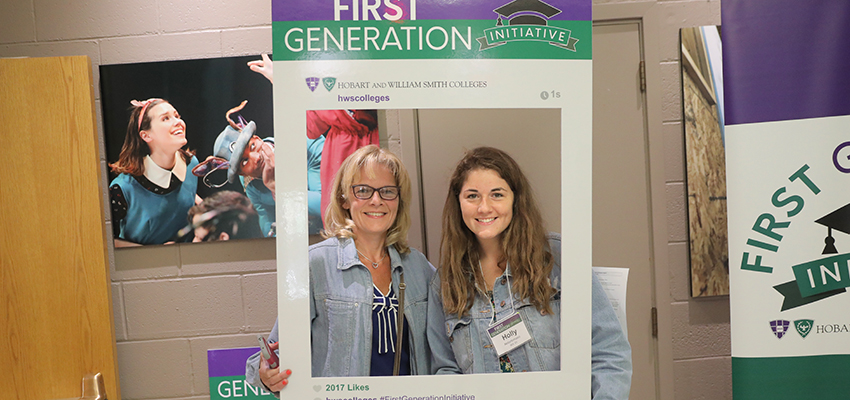
The piece in The Chronicle arrives at the same time the Colleges are expanding opportunities for college access and enhancing support for first-generation students through programs and scholarships such as the Bozzuto Family First-Generation Endowed Scholarship and the First-Generation Initiative. In 2017, HWS Board Chair Thomas S. Bozzuto 68 and his family made a $4 million donation to the Colleges, one quarter of which is designated to create the first-generation scholarship. Bozzuto recently served as the inaugural First-Generation alumni speaker.
The complete Chronicle article is below.
The Chronicle of Higher Education
When Failure Is OK Is Not OK
Tyler Hallmark Feb. 11, 2018
Failure has become a trend in the past decade. As a society, we increasingly say Failure is OK or Failure is essential to success. But in this process of normalizing failure, we ignore the fact that failure affects people differently, and that privilege plays an important role in who is allowed to fail and who isnt.
When I was a sophomore in college, I was enthralled by the world of entrepreneurship. I joined business clubs and attended countless talks from CEOs and start-up wizards. But as time wore on, I realized that the world of business was not for someone from a low-income background, like me. One entrepreneur who gave a talk at my college told us that he had borrowed $50,000 from his parents to launch his first start-up and then proceeded to go bankrupt in his first year. The lesson? Take a risk; its OK to fail.
The recurring theme of Its OK to fail didnt (and still doesnt) resonate with me, because I couldnt afford to fail. I didnt have parents who could lend me $50,000. In fact, $50,000 was more than my single mother could make in three years at her near-minimum-wage job. The lesson I learned was that if I didnt have money to risk losing, I shouldnt be in business.
By my junior year, I had sworn off my business major, focusing instead on communication and education. Although I felt that those fields were more inclusive for someone from my background, I still couldnt escape those dreaded motivational talks, which left me anything but motivated. Its OK to fail, one professor told the class. Students worry too much about their GPA. And while I was never one to panic about grades, I did lose a key scholarship after finishing my freshman year with a 2.5 GPA.
Unfortunately, this is the reality for many low-income, first-generation students those who are in college only because of the scholarships that got them there. If those scholarships are lost, their dreams may be lost as well. More-privileged students dont have those concerns. If they fail courses one year and require an extra year in college, they can afford it.
This imbalance of privilege is found in high school, too, where low-income students tend to fall behind their peers academically. By normalizing failure, we tell them its OK because they can take remedial courses in college to catch up, not acknowledging that those courses will burden them with additional costs and time to degree. Its no wonder that first-time, full-time, bachelors-degree-seeking students who enroll in a remedial course in the first year after high school are74 percent more likelyto drop out of college than their nonremedial peers are.
Instead of Its OK to fail, heres what we should be saying to low-income and first-generation students:
First, tell them they are good enough, because many of them probably havent been told that very often. As soon as they step on campus, we need to combat anyimpostor syndrome the feeling that one is a fraud who doesnt deserve success that they might be experiencing. As much as we consider impostor syndrome an individual problem, overcoming it should be a group effort that involves professors, counselors, and administrators.
Second, tell them that they belong, not only when they arrive on campus but throughout their time at college. Low-income and first-generation students face many barriers to graduation, and it is important that institutions continually foster a sense of belonging.
One way colleges can do this is by adding personal touches. For example, one postdoctoral researcher has said that her undergraduate experience as a first-generation student atHobart and William Smith Collegeswas improved by such things as a dean greeting her at the bus station when she arrived in town, and a staff member who sent her care packages in the mail like the ones other students received from their parents back home.
Third, tell the students that they shouldnt be afraid to ask for help and point them to where the help is. Part of that work for colleges includes removing any remaining stigma associated with using counseling services. Although the stigma has been reduced over the years, largely thanks to such student-advocacy groups asActive Minds, work remains to be done.
Similarly, students often do not learn about or use tutoring and other academic services until it is too late. A 2012report from the Center for Community College Student Engagementshows that this is especially prevalent at community colleges: More than 87 percent of them reported offering supplemental instruction, yet 82 percent of students said they had never used those services. One idea for getting students to use such services is to meet students where they are and place support centers where students congregate, like in dining halls and study areas.
For low-income and first-generation students to persevere, one of the first steps needs to be inclusiveness. That means acknowledging the privilege that comes with saying Failure is OK and realizing that such blanket statements are not only dismissive of some students struggles but also can actually be harmful to their success.
Tyler Hallmark is a doctoral student at Ohio State University.