
Philbrick Yadav on ΓÇ£Politics, Governance, and Reconstruction in YemenΓÇÖs WarΓÇ¥
6 February 2018 Philbrick Yadav on Politics, Governance, and Reconstruction in Yemens War
In recent publications and international media coverage, Associate Professor of Political Science Stacey Philbrick Yadav explores the many facets of the civil war that has engulfed Yemen since 2015.
Philbrick Yadav, who serves on the steering committee for theProject on Middle East Political Science (POMEPS), coedited that organizations most recent collection of scholarship, which examines the ongoing war and humanitarian crises in Yemen, the central actors, alliances, and war dynamics, and how these are likely to shape whatever future agreement may arise in Yemen.
A condensed version of the collections introduction written by Philbrick Yadav and her coeditor, POMEPS Director Marc Lynch appeared in January on the Washington Post political blog, Monkey Cage. In that article, Why it wont be easy to resolve Yemens many wars, they begin to articulate the conflicts various political, religious and social complications, and outline how Yemen has fractured in ways that will make any negotiated settlement extraordinarily challenging and fragile.
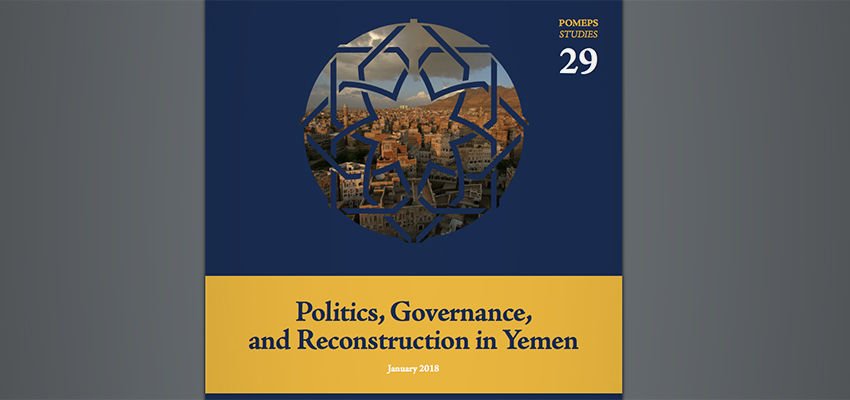
The entire collection, POMEPS Studies 29 Politics, Governance, and Reconstruction in Yemens War, is available online.
In another article on the Middle East Report Online, Philbrick Yadav elaborates on the idea that Yemens war is best understood as a series of mini-wars reflecting the intersection of diverse domestic drivers of conflict and Gulf regional fragmentation. Noting that the future of Yemen rests with at least three fragile coalitions of actors, she writes that now, almost three years into a highly asymmetric war, neither a military nor a diplomatic solution seems near at hand.
In a February interview on France 24, Philbrick Yadav describes the complicated and evolving alliances and motivations of actors within the civil war in Yemen and the range of violence and humanitarian catastrophe experienced in different areas of the country.
Philbrick Yadav, who has lived in Yemen and is a member of the executive committee of the American Institute of Yemeni Studies,has been writing about Yemens opposition politics for more than a decade. Since Yemens uprising in 2011, shespublished a book exploring the dynamics of Islamist activism and alliance building, and articles in several academic journals, includingTheInternational Journal of Middle East Studies and Middle East Report.She haspreviously published analysisof the Yemeni uprising and the countrys Islamist politicsin Monkey Cage. In 2017, she was elected to the POMEPS steering committee.
A member of the HWS faculty since 2007,Philbrick Yadavearned a Ph.D. in political science from the University of Pennsylvania and a B.A. in anthropology and Middle Eastern studies from Smith College, and has spent several years conducting field research in Yemen, Lebanon and Egypt. Before joining the Colleges,shetaught at Mount Holyoke College, and in 2008 was a visiting scholar at the Harvard Academy for International and Area Studies.