
HWS Presents at RAS
16 December 2016 HWS Presents at RAS
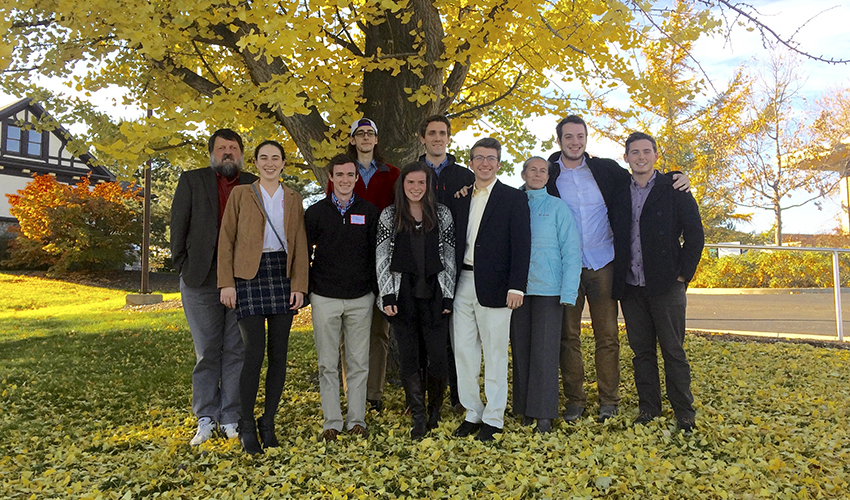
At the Rochester Academy of Sciences annual fall conference, eight Hobart and William Smith students presented research with potentially profound impacts on water quality, agriculture, public transportation, cancer prevention and the intersection of physics, computer science and engineering in the HWS curriculum.
HWS faculty mentors including Professor of Geoscience John Halfman, Assistant Professor of Physics Ileana Dumitriu, and Physics Lab Technician Peter Spacher, Ph.D., joined the students at Roberts Wesleyan College in Rochester, N.Y., where hundreds of undergraduates, graduate students and college and university faculty gathered to share research on subjects spanning basic and applied sciences.
It was an excellent opportunity for our students to present in front of professors and students from a wide-selection of institutions in central and western New York, says Halfman.
Scott Calnan 17, who is enrolled in the CollegesJoint-Degree engineering programwithDartmouth College, presented his ongoing work as part of the HWS team participating in the SpaceX Hyperloop Pod Competition. Calnans work applies the principles of homopolarmotors, which use direct current and two magnetic poles to produce rotational movement,to the acceleration and braking system for the SpaceX transportation project competition. Founded by Tyler Hanzlik 17, theHWS teams preliminary designwas accepted to the competition in January 2016.
To detect muons (elementaryparticlessimilar to electrons) in the upper atmosphere, an HWS team integrated a detection device in a rocket, which waslaunched in June 2016at the NASA Wallops Flight Facility in Virginia. At the RAS conference,Joseph Carrock 17presented the data collected during that flight. Coauthored withFrank Oplinger 18andTyler Hanzlik 17, the project showed trends similar to the data collected during the 2015 HWS RockSat-C flight, describing increases in muon count as the rocket ascended.
In his research on Multiple Myeloma, an incurable cancer of plasma cells that reside in bone marrow,James Cooper 17found that particular protein in one type of white blood cell can induce metabolic fitness in myeloma cells and prosurvival effect.
Chris Demas 17, who is completing a physics Honors projects on two distinct topics, presented on both. In one, advised by Dumitriu and Spacher, Demas is examining Photodynamic Therapy (PDT), a technique for treating both cancer and acne, and the precise dosing of light needed to activate the chemical that destroys the unhealthy tissue. The other project, advised by Dumitriu, Spacher and Halfman, uses drone technology and spectroscopy to determine algae content in bodies of water.
Geoscience majorsHarry Simbliaris 17,Serena Bradt 18andBriana Breezy Swete 17presented the results of their summer research, which also explored water quality challenges of the Finger Lakes.
Investigating how annual changes in precipitation influence the concentration of total phosphate in Owasco Lake, Simbliaris showed that precipitation resulting in phosphorus loading along streams in turn impacts water quality in the lake.
Over the summer,Swete used drone technologyto track blue green algae on Owasco Lake. Using that research, Swete, Bradt and Dumitriu co-authored a presentation, Exploratory drone research on water quality of the Finger Lakes, which detailed the results of monitoring the aerial extent of algal blooms and nearshore macrophytes.
Garrett Tongue 17, who served as a Teaching Assistant in Dumitrius course on electronics, presented on the unique learning opportunities the course offers. Students develop practical skills in soldering, using oscilloscopes, reading electrical diagrams, troubleshooting circuit failures, and point to point wiring, as well as a deep understanding of the theories of electrical engineering.