
HWS Hackathon 2019
20 December 2019 HWS Hackathon 2019
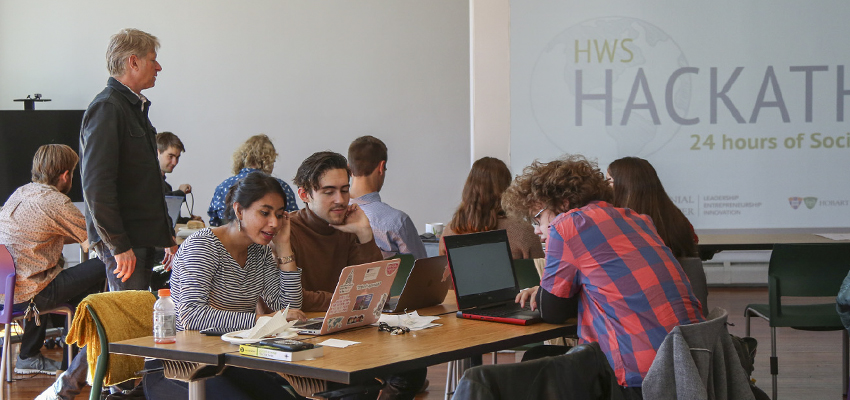
 In a rapid 24 hours, the fifth annual HWS Hackathon tasked students with identifying solutions that would improve water quality around the world. Seven participating teams rose to the challenge and tackled issues such as preventing algae blooms, cleaning beaches of micro-plastics and creating underwater data centers.
The purpose of the Hackathon is to increase creative problem-solving and idea generation when it comes to our most challenging social issues, says Director of the Centennial Center Amy Forbes. Students are presented with a problem, spend an afternoon meeting local and regional experts on the topic, and then create products, services and businesses that have the potential to solve, mitigate and disrupt the issue.
This years winning team was Earth Enthusiasts, who addressed the harmful algal blooms affecting public health, ecosystems and tourism industries around the world. Juniper Asaro-Niederlitz 22, Jack Polentes 21 and Katherine Vangaever 21 focused their project on the harmful algal blooms incoastal waterways caused by chemical runoff, storm water runoff and eutrophication. Their proposal included a community supported agricultural (CSA) model for selling oysters. Using the oysters natural water filtration properties to prevent the accumulation of phosphorous and nitrogen, the business would raise oysters in Seneca Lake then sell them to local restaurants and individuals. The Earth Enthusiasts received $500 for their winning proposal. This year marks Polentes third time winning the Hackathon competition, and Asaro-Niederlitz and Vangaevers second.
 The runners-up included Max Brodheim 20, Will Elliman 20, James Monaco 20 and Hayes Torrence 20, who proposed a system that uses drone technology to gather data more precisely.
Third place finishers Jackson Danforth 23, Avi Rajkarnikar 23 and Joseph Tate 23 also confronted harmful algal blooms by creating a mechanism that could filter water bodies. The team conceived of a helix fixture that promotes natural moss growth through LED lights. Their proposed idea would be powered by excess solar energy.
Experts from various backgrounds joined students at the Hackathon to share information about the people and resources currently being allocated to water pollution research and problem solving. They included Seneca Watershed Steward Ian Smith, Assistant Professor of Biology at Nazareth College Padmini Das, Manager of Ontario Country Soil and Water Conservation District Megan Webster, Associate Professor of Ecology and Evolutionary Biology and Dwight Webster Sesquicentennial Faculty Fellow at Cornell University Peter McIntyre, Director of New York State Water Resources Institute Brian G. Rahm, postdoctoral research fellow at Cornell University and lecturer at Boston University Marine Program Paul Simonin, and Assistant Professor of Environment and Forest Biology at SUNY-ESF Roxanne Razavi.
This years keynote speaker for the event was Associate Professor in the School of Mathematical Sciences at Rochester Institute of Technology Matthew Hoffman. Hoffman is also the Director of RITs Master of Science program in Applied and Computational Mathematics. Hoffmans research seeks to model the transport of microplastics in freshwater systems.