
Hackathon 2017 Addresses Climate Change
20 September 2018 Hackathon 2017 Addresses Climate Change
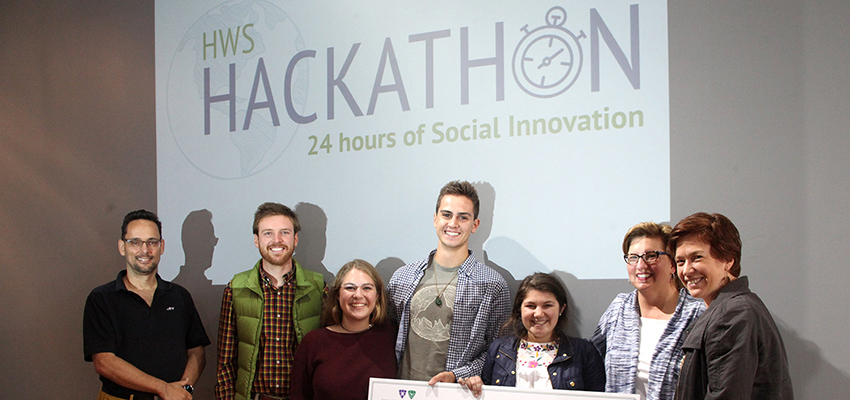
 A team of first-year students excelled in this years Hackathon, a 24-hour competition that uses social innovation to tackle a global problem. Chloe Brown 21, Isabella Pardales 21 and Jack Polentes 21 created a solution that addressed the issue of climate change, particularly in the Finger Lakes region and nationally. The third annual event took place on Sept. 30-31 at 22 Castle Street, the new downtown incubator for entrepreneurship.
Over the course of the competition, 10 teams proposed solutions to address the pressing issue of climate change on a local level. Teams had the opportunity to discuss the topic with experts in the field of earth science, environmental studies, renewable energy, public policy and sustainability before they raced the clock to create a solution. They were tasked with creating a business solution for climate change and present it in a four-minute pitch to a panel of alum judges.
Brown, Polentes and Pardales won $500 for their proposal titled One Block at a Time. Our project focused on the localization of human consumption in urban areas to reduce transportation, increase efficiency and drive social sustainable success, says Polentes. In order to do this, we proposed the implementation of Super blocks a kind of micro-community organization strategy first observed in Barcelona. Their idea also integrated vertical farming, solar grids and micro-CHPs in their proposed development.
This years judges included Julie Bazan 93, chief operating officer at Cobblestone Capital Advisors in Rochester, N.Y.; Edmund Ted Kidd 87, a partner at Energy Efficiency Specialists in Rochester, N.Y. and Katharine Strouse Canada 98, program coordinator for the Maxwell Program in Citizenship and Civic Engagement at Syracuse University.
The Hackathon also included a keynote address by Mike Hoffman, executive director of the Cornell Institute for Climate Smart Solutions and professor of entomology at Cornell University. As executive director, Hoffman has helped raise the profile of challenges posed by a rapidly warming climate and has helped people who grow food adapt to the changing conditions as well as reduce their carbon footprint.
In addition, two teams each received $200 as runners up. Samuel Allen 20, Harrison DeMaira 19 and Jackson Lesure 21 created a company with the goal of reducing carbon emissions through the increased use of renewables energies such as wind and solar. Whitney Campbell 19, Carlos Robles 18 and Saoirse Scott 19 initiated a life-cycle assessment that labeled clothing based on its negative and positive impacts on the environment.
The event was co-sponsored by the Centennial Center and the Entrepreneurial Studies Program.