
Infrastructures of Movement: Bridges and Borders
29 March 2019 Infrastructures of Movement: Bridges and Borders
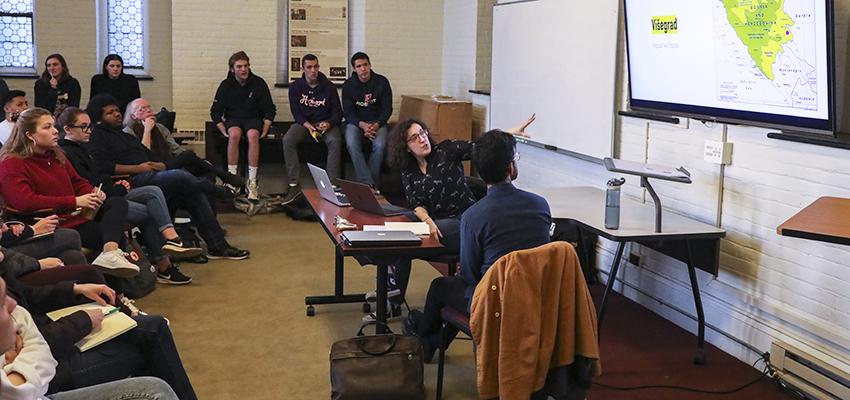
 Before a standing-room-only audience, the Fisher Center for the Study of Gender and Justice hosted Infrastructures of Movement: Bridges and Borders, two presentations that explored the fallout of displacement from different perspectives on March 27.
The evenings presentations weredelivered by Ashwin Manthripragada, assistant professor of German Area Studies at HWS, and Emina Muanovic, assistant professor of German Studies at Linfield College in Oregon.
Muanovics presentation, Bulldozer (Contra) Memory: The Pacification of Landscapes in Post-War Bosnia, explored the aftermath of the war in Bosnia and Herzegovina, when techniques of warfare gave way to practices of pacification through the construction of dueling memorial sites, acts of urban reconstruction or bulldozing, conjuring and inscription of new futurities into torn up landscapes, NGO feeding frenzies, the emergence of new forms of sociality amidst the rubble. The talk pursued ongoing displacement (of populations, capital, history) via practices of pacification. The promise of mollification by capital has given rise to ever multiplying ethno-villages and the construction of a theme-town in a still ethnically cleansed space.
In her scholarship, Muanovi explores the literary and filmic imagination of borders, place, environment and technologyalways with a critical eye to intersections of race, gender, sexuality, migration background and socio-economics. As a former war refugee, she privileges transnational approaches, focusing, for example, on diaspora literatures and, in particular, on narratives of forced displacement.
Manthripragadas presentation, Unfantastic Transmogrification: Hassan Blasims Grey Wolf of Disbelief, examined the ways in which contemporary narratives of displacement incur magical realism, through the lens of The Truck to Berlin, Iraqi-born Hassan Blasims autofictional short story written from Finland. Magical realism develops as a genre of discontent along the border zones of the 21st century to redress refugee tragedy fatigue suffusing public opinion, expose the definitional problems of refugee, underscore the accident of our birth, and disrupt the cultures of comfort that create grave conditions of non-arrival for the forcibly displaced.
Manthripragada studies the unfixed, innovative space of the transcultural in written and visual media. His scholarly work is rooted in German-language cultural production of the 20th century that incorporates, imagines and interprets India, but it also branches out significantly to the study of minority literature and prison education reform.
The Fisher Center celebrates its 20th anniversary throughout the 2018-19 academic year with the theme On the Move, hosting artists, scholars, authors and activists to examine contemporary concerns surrounding mobility, movements and migration.