
First-Year Seminar Symposium
4 January 2019 First-Year Seminar Symposium
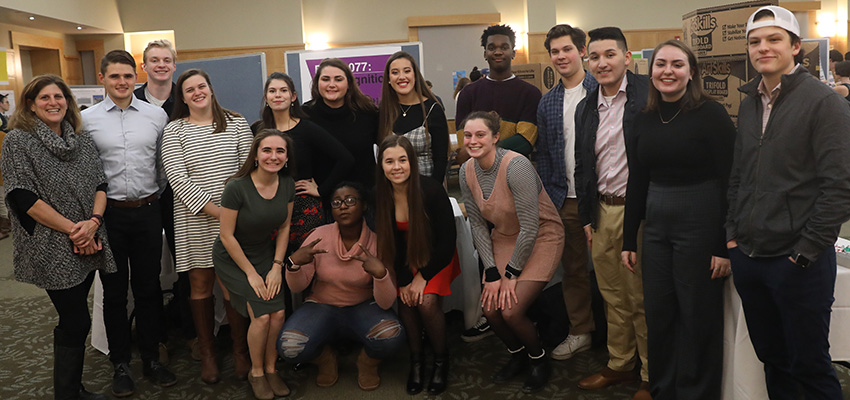
 Designed to build a foundation for skills in critical thinking and communication at the Colleges, the First-Year Seminar (FSEM) ranges in topics from fictional worlds and semiotics, to political power in Egypt, mindfulness, and Russian culture and cuisine. During the FSEM Symposium on Nov. 29, students showcased the projects that have catapulted them into the world of interdisciplinary inquiry and analysis through poster presentations, interactive learning demonstrations, digital maps and more before their peers and members of the HWS staff and faculty.
As part of Metacognition and Social Justice taught by Dean for Teaching, Learning and Assessment and Director of the Center for Teaching and Learning Susan Pliner, students engaged the audience in tests and games to elicit behaviors and assess whether they were indicative of fixed thinking or a growth mindset. Students also shared the results of practicing self-reflection as they prepare for exams, engage in dialogue and make important decisions.
We keep reflection journals and evaluate how well we think we did on particular assignments, says Mercy Sherman 22. Its amazing how my perception of reality and how things actually happen can be different. Being able to notice my own tendencies has made a huge impact on my academic and social life during my first semester of college.
Through their FSEM Facets of Islam, Dweh Harris 22 and Michael Patterson 22 have expanded their knowledge of different ideologies and gender politics. Having worked together to research the clash of religious conservatism and western capitalism, Harris and Patterson focused their presentation on the increase of customer cultures and its critiques in Dubai, United Arab Emirates (U.A.E.).
The theme of the class this semester has been questioning and taking a closer look at assumptions more broadly, says Patterson. By focusing specifically on this one country, Ive come to see Dubai with a new set of eyes. The U.A.E. is at a fascinating inflection point in its history.
During the First-Year Writing Seminar Symposium, Raja Hammad 22 and Hannah Patterson 21 discuss their project Challenging Gender Norms and Body Image: Disney Princesses as part of their FSEM Russians Discover America: Imaginers, Observers, Immigrants with Associate Professor o0f Russian Studies Kristen Welsh.
 Students in the Sustainable Living and Learning community, co-taught by Associate Professor of Environmental Studies Kristin Brubaker, Assistant Professor of Environmental Studies Whitney Mauer and Professor of Economics and Chair of the Environmental Studies Department and Entrepreneurial Studies Program Thomas Drennen, narrowed their area of focus to a specific product or raw material, tracing its path of consumption from source to disposal. The resulting presentations show a complex web of trade between the developing and developed world.
I studied the environmental impact of coffee by tracing the bag you get at the grocery store back to the crop, says Anna Rider 22. Harmful growing practices have been dictated by the volume of consumer demand, which has had consequences for the quality of soil in these regions.
Unlike the traditional one semester FSEM experience, Sustainable Living and Learning continues through the Campus Sustainability section of an introductory environmental studies course in the spring semester. The entire community of students also meets once each week with all three professors. The courses also have attached an upper-level teaching assistant and three Writing Colleaguesfor extended lab time used for larger discussions and experiments in the kitchen and learning commons of Rees Hall.
Taking this course has made an impact on my own life. Course work such as the trash audit we did earlier in the semester has pushed me to limit the amount of single use plastics I use and to think more broadly about consumer habits, says Sarah Gillis 22.
Read more about the FSEM program and the courses offered this year.