HWS News
6 March 2026 Opening the Black Box
A new Reader’s College course creates a space for students to examine artificial intelligence openly, critically and without fear.
When Instructional Technologist Sarah Gobe stepped into a classroom this semester to teach her first Reader’s College course, she wasn’t there to deliver answers. She was there for questions, which many students are already asking quietly among themselves about artificial intelligence.
“AI can be scary,” she says. “It challenges how we teach and how we assess. It’s important to validate those feelings. But it’s also here. We need to create space to talk about it.”
The class meets once a week for 90 minutes to examine how AI works, when to use it and how to think critically about its role in classes. Built around weekly readings and discussion, the course focuses on developing “AI literacies,” skills that Gobe believes are quickly becoming essential across disciplines.
The course comes at a moment when AI is reshaping how students research, write and solve problems. One early focus of the course is helping students understand that large language models are prediction tools, not authoritative sources. Students must cross-check information to be active participants in their own thinking rather than passive recipients of machine-generated responses.
“Students have spent their whole lives doing keyword searches,” says Gobe, whose background includes librarianship. “This is different. These tools predict text based on patterns. You can’t just accept it as truth.”
The Reader’s College course is part of a broader campus effort to engage thoughtfully with AI. To that end, HWS is piloting BoodleBox, a paid platform providing students and faculty access to multiple AI tools, including ChatGPT, Gemini and Claude.
Approximately 300 faculty, staff and students are participating in the pilot, exploring how the technology can support teaching and learning while addressing concerns about privacy, equity and academic integrity. “Equity matters,” Gobe says, highlighting the platform’s tiered access that levels the playing field for all students.
Gobe’s role at HWS has shifted to AI technology, which Gobe has experienced as a teacher but also as a student and learner. While auditing a course that used unfamiliar mapping software, she turned to AI for help breaking down complex steps. The tool acted as a kind of personal tutor, explaining concepts at her pace and helping her move forward.
“That’s when it clicked for me,” she says. “This can make a huge difference for learners. It’s not just about convenience. It’s about access and understanding.”
Gobe spent much of the summer reviewing a steady stream of AI vendor demos pitched to colleges. Gobe says she pivoted to BoodleBox for its emphasis on teaching literacy and supporting educators with clear guardrails.
To broaden awareness and buy-in to the technology, Gobe shared it with an “AI group,” a collaborative initiative by Director of Digital Learning Rob Beutner and the Digital Learning Center team. Whether BoodleBox proves to be the right fit remains to be seen, Gobe says, but her on-campus group and Reader’s College course is bringing conversations about AI’s role in higher ed into the open in a way that provides the HWS community equal access to tools.
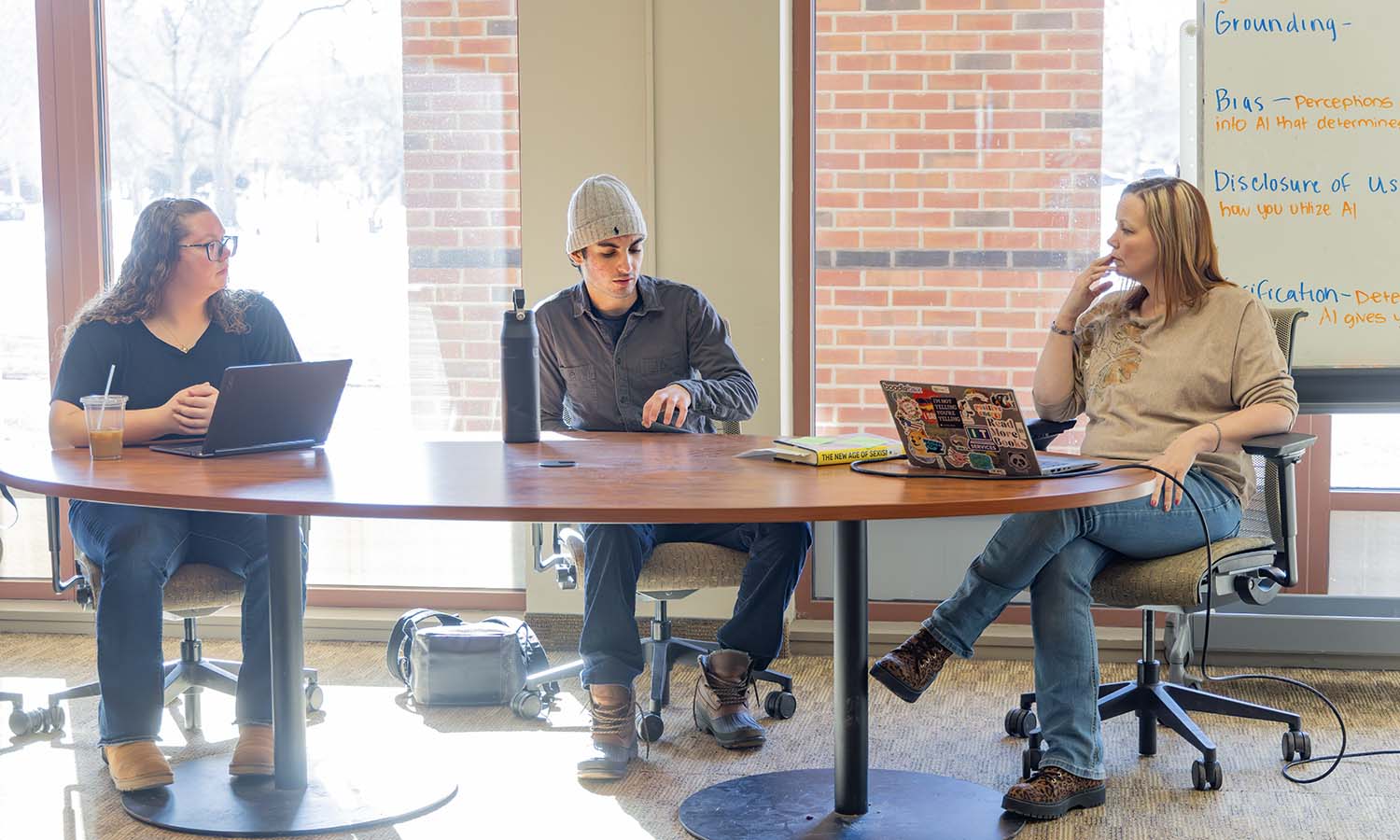
Top: Zane Benoh '28 speaks during a discussion with Anna Camnitz '26 and Instructional Technologist Sarah Gobe.