HWS News
23 November 2026 A Voice for His Generation
The youngest guest in President’s Forum history discusses what it takes to give students a voice in mental health policy — and why connecting them with one another may be the harder task.
Carson Domey is a graduate student at the University of Texas at Austin and, at the age of 22, is already the executive director of a national coalition working with students at more than 100 colleges and universities to influence mental health policy.
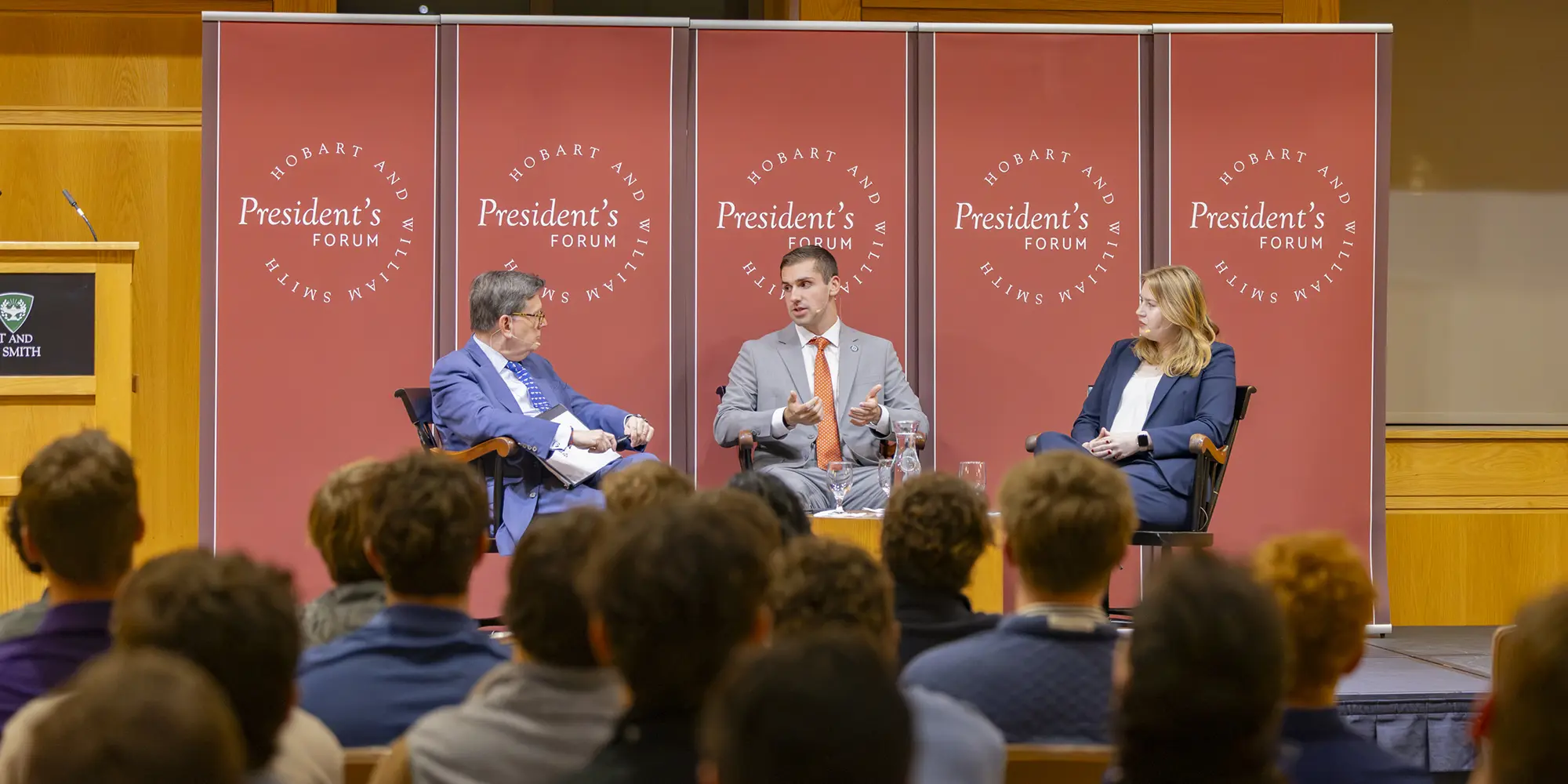
On Thursday, Nov. 19, he became the youngest guest in the history of the President’s Forum Series, joining President Mark D. Gearan and Hobart and William Smith Student Government President Ela Gardiner ’27 for a conversation about advocacy, public policy and finding purpose.
Domey leads the Coalition for Student Wellbeing he founded in 2024 while pursuing a Master of Public Affairs at the University of Texas at Austin's LBJ School of Public Affairs. His work has taken him before lawmakers on both sides of the political aisle and into conversations with college presidents and administrators across the country.
The President’s Forum series, which has recently featured former U.S. Deputy Secretary of State Wendy Sherman and political strategist Maya Rupert, has brought prominent leaders to campus since Gearan established it in 2000.
Domey first met Gearan when he was a high school sophomore attending events at Harvard Kennedy School's Institute of Politics, where Gearan served as director. Four years later, they ran into each other in a Washington, D.C., hotel lobby. When Domey launched the coalition, Gearan was among the first college presidents he approached for support and now serves on its advisory board.
Today, the coalition works in more than 40 states. Among its initiatives is an effort to put the 988 Suicide & Crisis Lifeline on student identification cards, making the number readily available to students who need help (it is on all HWS ID cards). Domey said campus-level initiatives have reached more than 400,000 students this year.
Domey described the different approaches he takes with lawmakers across the country, particularly in his home state in Massachusetts and his adopted state, Texas, where political priorities can differ sharply. The work requires relationships that can withstand disagreement, he said, but legislative victories are only part of the job.
Responding to a student's question about turning advocacy into institutional change, Domey said: “It's almost easier to get a bill passed than it is implemented.”
The challenge that surprised him, however, wasn't getting students into rooms with lawmakers or college administrators. It was getting students to connect with one another.
He encouraged students to start with the people around them: Smile, build trust, take action. Find a club, team or other community.
Those relationships, he suggested, can become a network of support.
“Don't just be a part of a community, but contribute to a community,” Domey said. “You might very well find your purpose through that… You'll be contributing not just to your own health, but by being somebody who wants to invest in a group of other people to see their success just as much as yours.”
Asked by Gardiner how other students might pursue similarly ambitious work, Domey returned to an intensity of purpose that dates to age 12, when he began advocating for health care access.
"You need to be obsessed with what you're doing. It's the same story in business,” he said.
But your purpose, he told students, does need to be a national cause. People can discover it in the ordinary work of helping the people around them.
Top: (From left to right) Hobart and William Smith President Mark D. Gearan, Coalition for Student Wellbeing Executive Director Carson Domey and HWS Student Government President Ela Gardiner ’27.