HWS News
14 July 2026 The Power of Play in Teaching
Professor of Religious Studies Richard Salter has been selected for a national faculty roundtable examining how play can inspire creativity, curiosity and deeper learning in the classroom.
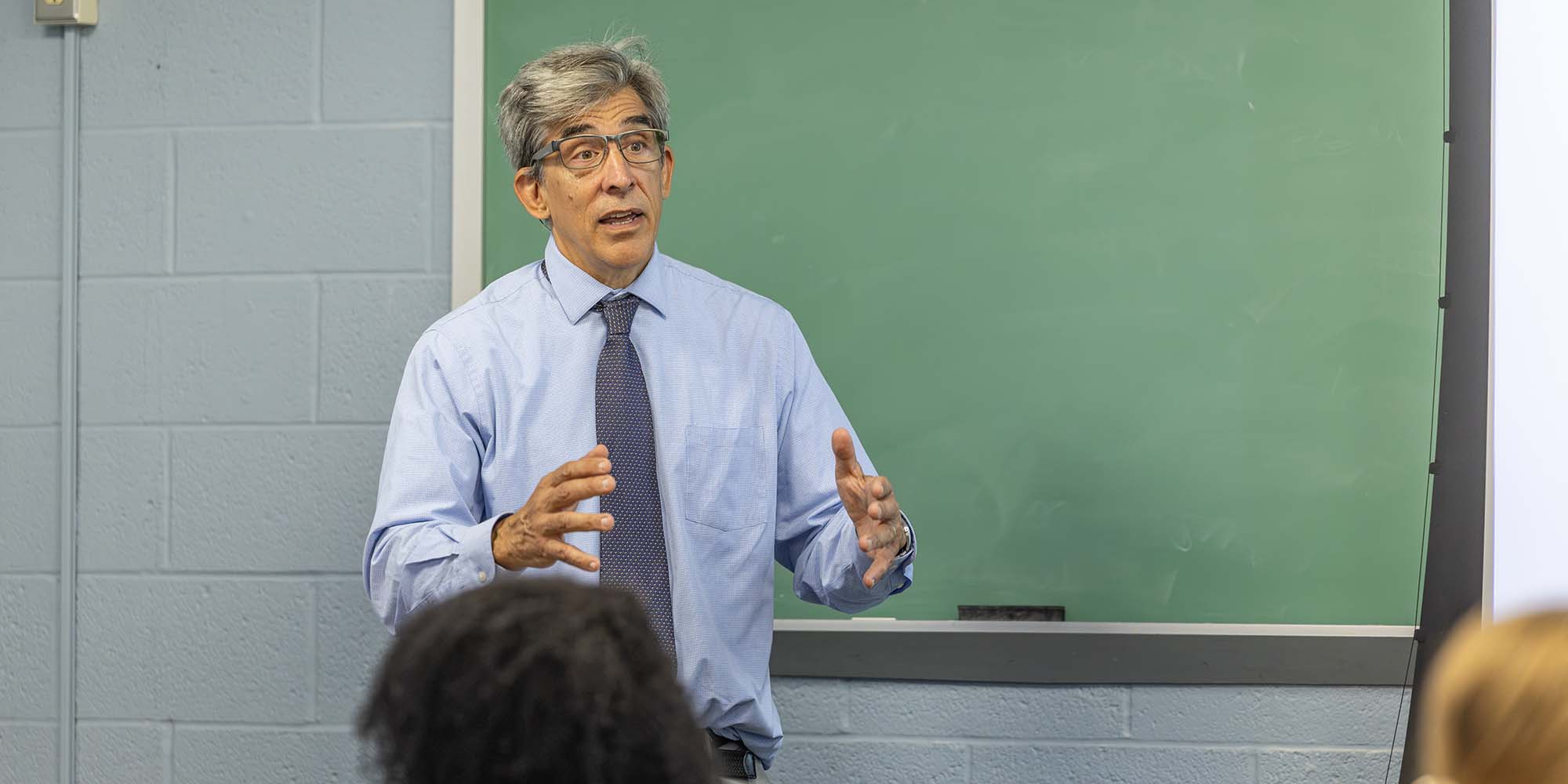
Professor of Religious Studies and Chair of Religious Studies and Holocaust Studies Richard Salter ’86, P’15 has been selected to participate in the 2026 Pedagogy of Play Roundtable, an invitation-only faculty development program hosted by the Wabash Center for Teaching and Learning in Theology and Religion.
Held Sept. 24-27, the national gathering will bring together educators from colleges, universities and seminaries across the United States, Puerto Rico and Canada to explore how play can transform teaching and learning. Through workshops and experiential activities, participants will examine the theory of play while developing innovative classroom practices to bring back to their campuses.
For Salter, whose teaching challenges students to explore complex questions about religion, ethics and culture, the opportunity builds on ideas he is already exploring in the classroom.
“I teach a course called ‘Religion and Sports.’ I always try to keep in mind that sports are a form of play,” Salter says. “To get students thinking about sports, I first introduce play and ask students to play in class. What I have found is that it can be hard for students to play, especially if the play is unstructured. And yet, play is something that humans, and other animals, do everywhere.”
Salter hopes to gain strategies for incorporating more unstructured play into courses across the curriculum. In classes such as “Torah and Testament" and "Liberating Theologies,” he explores how theologians have imagined creation itself as an act of play. The roundtable, he says, will help him move beyond discussing those ideas to be creating opportunities for students to experience them.
“I worry that student learning is too structured. I think student life is too structured,” he says. “There are so many things they ‘should’ do. Days are organized in 15-minute intervals. Encouraging play is a way of opening learning to surprises.”
This summer, Salter also participated in Technos International Week, the longstanding partnership between Hobart and William Smith and the Tanaka Memorial Foundation that brings HWS faculty and students together with peers in Japan for an immersive academic and cultural exchange. While he sees no direct connection between the two programs, he says the experience reinforced the value of play in building relationships across cultures.
“One of the things that the organizers of Technos International Week did was set up opportunities for us to play with other participants and with local students,” Salter says. “Those sessions were great fun. Perhaps one of the best ways of getting to know people is to play games with them.”
Salter’s selection for the Pedagogy of Play Roundtable reflects HWS’ commitment to innovative, student-centered teaching. As he joins colleagues from across North America to rethink the role of play in higher education, he hopes to return with new ideas that encourage curiosity, creativity and discovery.
When asked how students might benefit from his participation in the roundtable, Salter challenged the premise of the question.
“What if there is no ‘benefit?’” Salter says. “I suppose I want students to consider that play might be important or worthwhile even if — particularly if — there is no benefit.”