HWS News
24 November 2026 From Code to Cures
By making biology programmable, the $3.8 billion AI company Matthew McPartlon ’16 co-founded is changing how scientists design drugs.
When Matthew T. McPartlon ’16 arrived at Hobart and William Smith, he thought he was going to study economics, until an introductory computer science course revealed a passion he didn’t know he had and changed the course of his life.
A decade after graduating from HWS, McPartlon with his partners at San Francisco-based Chai Discovery are using artificial intelligence models they designed to predict and reprogram interactions between molecules. Their aim? To collapse early-stage drug discovery from months or years to days or weeks.
Existing methods to discover new drugs are messy, random and fail to give scientists precise control over the molecules they generate, McPartlon explains.
"Traditionally, (drug discovery) is really like a needle in the haystack kind of problem. You're just kind of throwing whatever you can at the wall,” he says. “The other approach is animal immunization, where you (inject) an animal with a disease and hope it makes good antibodies for it.”
By contrast, Chai uses AI to design potential antibodies for specific biological targets allowing scientists to be more intentional and precise.
To do it, Chai doesn’t compete with pharmaceutical companies. It partners with them, including some of the industry’s biggest names — Pfizer, Eli Lilly and Bristol Myers Squibb — who use Chai’s models to give their scientists more control over the molecules they generate. For Eli Lilly and Pfizer, Chai also builds custom models using their proprietary data.
As a July 2026 New York Times story on Chai Discovery points out, many people tend to associate AI with all-purpose tools like Claude or ChatGPT, but specialized applications such as Chai’s, focused solely on drug design, are attracting major interest from investors for the impact they stand to make. Chai’s ultimate vision, its founders state: “to bring the precision and predictability of engineering to one of the hardest problems in science — better, faster therapeutics, for even the toughest 'undruggable' conditions.’”
Chai’s $400 million in series C round funding in July bumped up its valuation signaling investors’ growing confidence in the commercial potential of its models: Today, the company McPartlon co-founded only two years ago is valued at $3.8 billion.
Chai Discovery Co-Founder Matthew McPartlon '16
"I was very new to CS,” McPartlon remembers. “The first time I ever wrote a line of code was in “Intro to CS” at Hobart; I just kind of fell in love with it."
Associate Professor of Mathematics and Computer Science Stina Bridgeman taught coding conceptually. That approach revealed to him computer programming’s creative possibilities. He went on to take six classes with Bridgeman and complete an independent study, drawn in by her rigorous teaching, thoughtful feedback and willingness to let him pursue his ideas. “She let me push ideas as far as I wanted.”
With Bridgeman, coding wasn’t just memorization.
"Thinking of coding not as a type of language where you need to learn syntax and learn instructions and commands but really just a sandbox that you can kind of, like, play around in,” he says.
"I was very fortunate to have great professors in the Math and CS department. I think the foundation that I got at HWS is definitely what shaped my entire career path and educational trajectory."
Following graduation, McPartlon entered his doctoral program at the University of Chicago intending to study theoretical computer science, focused on algorithms. As his research progressed, he became increasingly interested in machine learning and its potential applications in biology.
After completing his Ph.D. in 2023, he spent about a year leading machine learning research at a company developing molecular glues as a potential drug therapy. The experience prompted him to consider whether AI could address a much broader challenge: making drug discovery itself easier.
“The work I was doing was really incredible,” he says. “I started thinking ‘Can we solve, like, a more general problem? Can we make drug discovery, in general, a lot easier, as opposed to just one specific area?’”
In the final year of his doctoral studies, McPartlon met future Chai co-founder and CEO Joshua Meier who double-majored in computer science and chemistry at Harvard University. After graduation, Meier had gone on to work on a language model for protein sequences at Meta.
The two met while working together at an antibody design company. After pursuing separate paths for about a year, they reunited with two other co-founders to launch Chai in 2024.
They started with $30 million in seed round funding that same year, followed in August 2025 by $70 million in Series A funding from some of the biggest names in technology — Open AI, Thrive Capital and Yosemite, the oncology venture capital firm founded by Steve Jobs’ son, Reed Jobs. By last December, Chai had raised an additional $130 million in funding.
The $400 million capital injection this summer, McPartlon says, is allowing the company to go after harder problems by developing more AI models for antibody design and making Chai’s software more intuitive for the scientists who use it.
Chai’s business model, McPartlon explains, isn’t to compete with pharmaceutical companies or replace scientists with AI but give them the tools to apply their knowledge more precisely.
In a 2025 study, Chai researchers reported that their AI model produced promising antibodies in approximately 16% of initial laboratory tests — or 160 out of every 1,000 candidates — more than 100 times the success rate of previous computational antibody-design methods.
For McPartlon, the possibilities became personal this year when his father was diagnosed with three different cancers — prostate, liver and skin — within a matter of months.
“It really made the type of work that we're doing resonate a lot with me.”
Following targeted radiation for prostate cancer and surgery to remove a liver tumor, McPartlon’s dad is doing well. He continues to be monitored for skin cancer.
But the experience has given McPartlon another perspective on the potential of more precisely designed medicines.
Scientists, for example, could apply Chai's software to the chemistry of tumors. Because many tumors are more acidic than surrounding healthy tissue, scientists are investigating whether they can design molecules that bind to their targets only in those more acidic conditions, reducing unwanted effects on healthy tissue.
It's one example of the increasingly complex problems McPartlon hopes Chai's technology will help scientists solve.
“What people who are affected with disease have to go through is crazy,” he says. “To think that we can actually have a lasting impact on that is pretty incredible.”
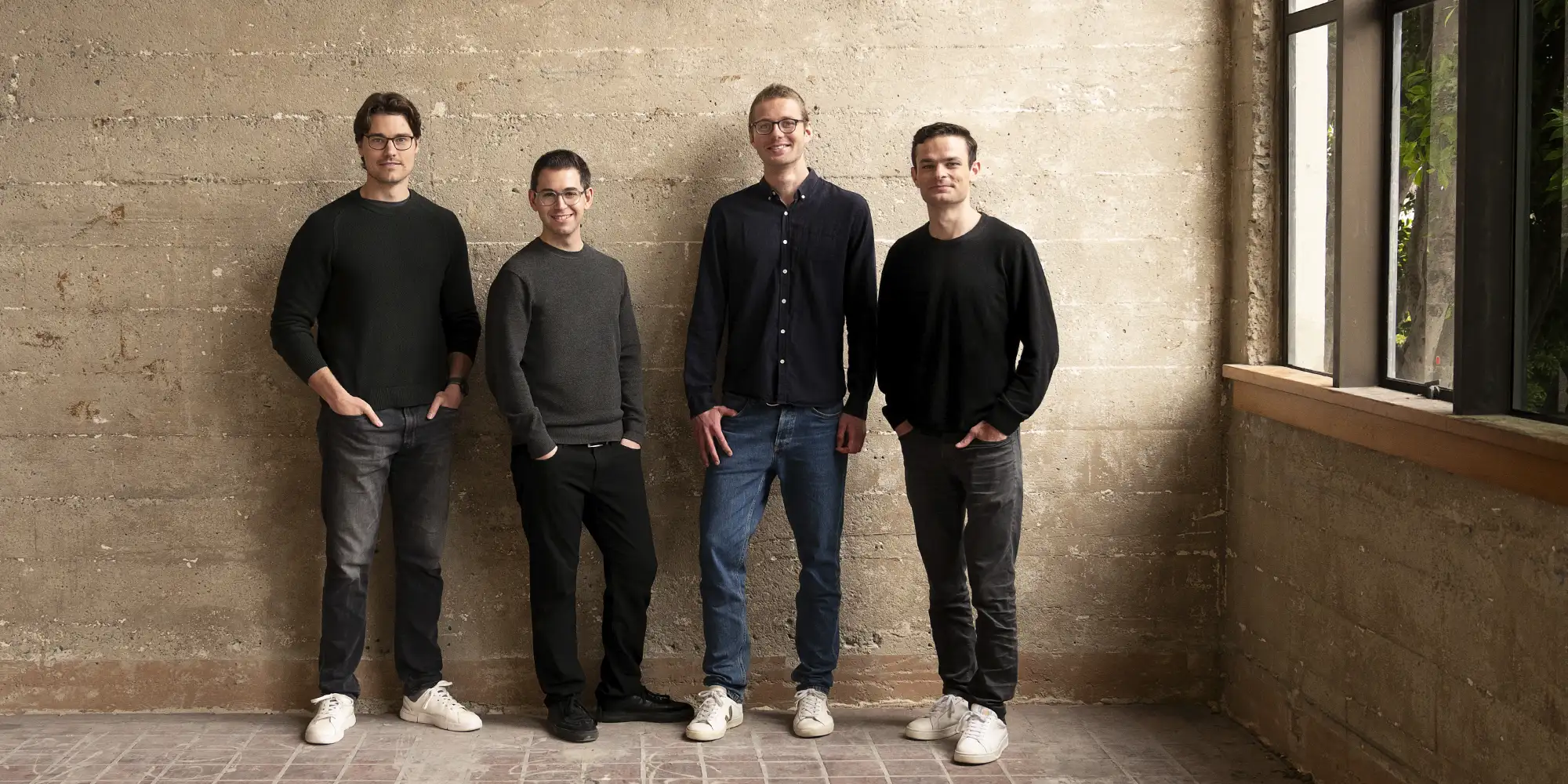
Top: (From left to right) Chai Discovery co-founders Matthew McPartlon ’16, Joshua Meier, Jacques Boitreaud and Jack Dent. Photo by Winni Wintermeyer