HWS News
8 June 2026 A Lifelong Writer Comes Full Circle
What began with a student-run magazine at Hobart has led Jarvis Coffin ’79 to his first published essay collection, a meditation on nature, place and the art of paying attention.
The Running Iron was his idea. It was the summer of 1977, between our sophomore and junior years at Hobart. I was a taking a class at Harvard Summer School and spending as much time as possible at Fenway Park. Jarvis Coffin, my closest friend then and now, was home in Buffalo, working and, as usual, dreaming. One day, I got a letter from him. Inside was an outline for the magazine – The Running Iron – he said we were going to start when we got back to Geneva in the fall. We did, and it was the start of a lifetime relationship with ink on paper – real and virtual – for each of us.
Within a couple of years, I was sitting in press boxes in Tampa, Fla., covering everything from Pony League baseball to the Tampa Bay Buccaneers. Jarvis went to New York and interviewed in the publishing industry but wound up at Dancer Fitzgerald Sample, a big Madison Avenue advertising agency. That business, he says, “was how I stayed adjacent to writing.”
Now, after a long career in print media advertising sales in New York and Boston and eight years as the chef and co-owner of a historic inn in southern New Hampshire, Jarvis’s proximity to writing has changed. He’s in the middle of it.
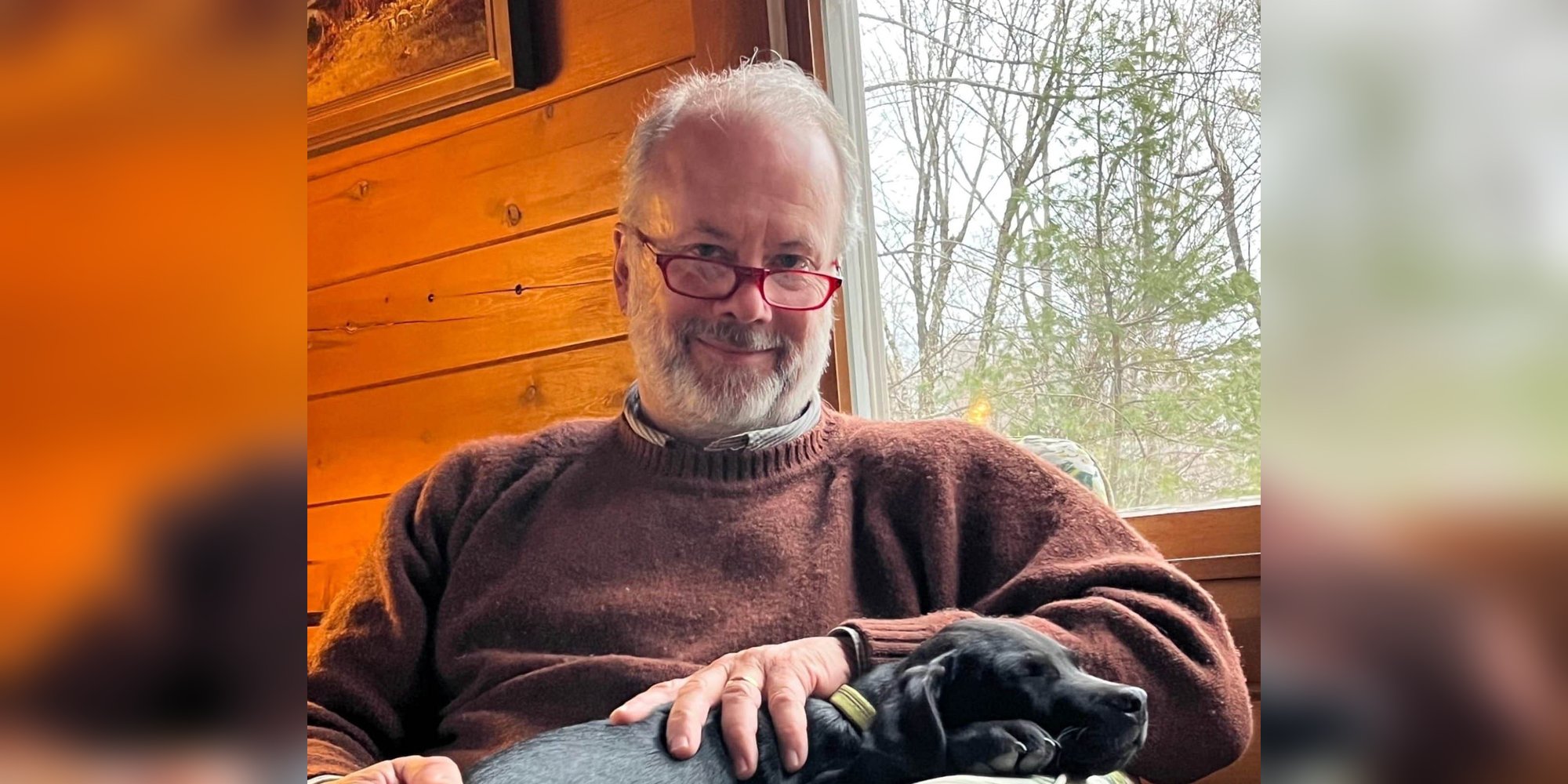
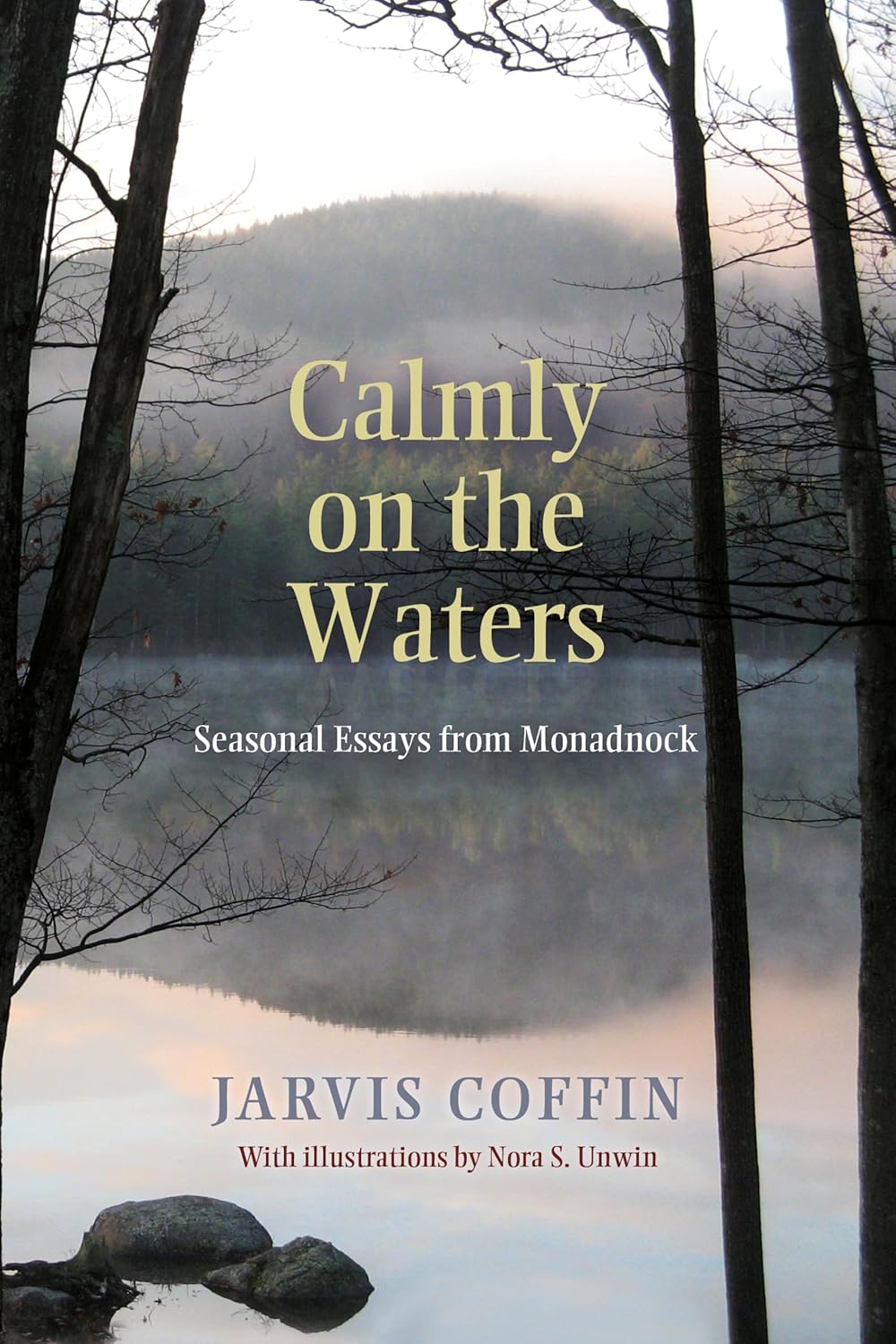
Four years after he and his wife, Marcia, sold the Hancock Inn and repaired to their Ward Cedar log cabin in the woods, Jarvis’ first collection of essays is about to be published. It’s titled “Calmly on the Waters.” The stories focus on the natural life that surrounds their house on Hunts Pond and also life more generally in a small New England town. They are culled from pieces Jarvis began to write and email to guests at the inn after they’d departed and also from his biweekly column in his local newspaper, the Monadnock Ledger-Transcript.
It all began, Jarvis says, when “I began writing a monthly letter to the inn’s [customer] list. I called it ‘Postcard from the Hancock Inn.’ It went out to about 5,000 people. I was getting about a 60 percent open rate – people were reading it and enjoying it. When we sold the inn, I thought I’d carry on with the postcard. I sent it out to about 100 people, and I told people they could sign up. Damned if a bunch of them didn’t.”
That was June 2022. In August, the Ledger-Transcript publisher called and asked Jarvis if he’d like to write a bi-weekly column. He said yes, and he’s been doing it ever since.
“In both cases, I write these 600-to-1,000-word essays about life around a pond in Hancock, New Hampshire,” he says. “I think everyone benefits from a chance to stop and take stock of the things around them.”
This stage of Jarvis’ writing life began in earnest when he and Marcia sold the inn. “I told Marcia I was gonna leg it out with the writing thing, which is all I ever really wanted to do,” he says. In addition to the essays, Jarvis has a finished novel, awaiting publication, about a third-generation newspaper publisher who must decide whether the government’s crackdown on misinformation saves the First Amendment or destroys it.
He knows something about this from stops at USA Today and The Los Angeles Times, and because the two of us, along with two other partners, started Burst Media, an advertising company, at the dawn of the commercial internet in 1995. I stayed on for 6 months, but ultimately remained at my editing job at The Washington Post. Jarvis stayed as president and chief executive for 16 years.
Then, he became a chef. Initially, and for a number of years, he cooked breakfast for the guests at the Hancock Inn. Eventually, personnel problems dictated he become the full-time chef. He came to this naturally. His first stab at it was cooking an egg for his grandmother, who had polio, when he was a boy. “I took it up to her” in her room, Jarvis says. “She was so grateful.”
The writing bug hit him early, too. In seventh grade in Wilton, Conn., to be precise. He wrote a story called “The Incredible Revelation” about a boy who has a dream, wakes up and knows that his dream was that his life was only one day long.
“That was my spark, like cooking my grandmother’s egg,” Jarvis explains. “I took it to my English teacher, Miss Persons. I just dropped it on her desk. Two periods later she’s in the hallway screaming over the tops of the kids’ heads for me to come here, come here. She told me it had made her day – it was so great, and she gave me a big hug. I’ll just never forget her excitement. That’s when I became a writer.”
“Writing has always been the thing between us,” he says. “Here we are today; you’re writing about my writing.”
Most writers find inspiration in the work of others, and often, they’ll incorporate the writing voices of their heroes into their own until they mold the sound into one uniquely their own. One of Jarvis’ models was the playwright David Mamet, though more for his experience and wisdom than his voice. Mamet was a guest at the Hancock Inn, and over a single malt or two at the bar one night told Jarvis: “You’ve just got to be willing to be out there naked in the wind.”
The great New Yorker essayist E.B. White is more of a stylistic model, Jarvis says. “I read those [essays] and I know exactly what he’s going through. The day he’s having, and what’s growing in
his garden, and what the dog has done.” Jarvis says. “And I’m there with him. I know how he’s feeling.”
That’s what he hopes the people who buy his book will feel. “We can all benefit about thinking richly about our place,” he explains. “And everybody is going to bring their own voice to it.”
EXCERPTS FROM ESSAYS
From “Winter Enchantment”
“Here is a thing about me: I like the open country in summer, the rolling hills and fields, with tall grasses swept by comfortable breezes. I miss the farmlands of upstate New York where I lived for many years. But in winter, give me a forest with snow on the trees. I know about snow’s inconveniences. They are made up for by the moments of beauty and solitude. You will not get me south for that reason. I prefer peering into the woods from underneath the snow-laden bough of a hemlock, to idling with the cartop down, nine deep at the traffic light in the Florida sunshine. I can wait for July.”
From “Summer”
“Summer means one thing here: growing season. Yes, the warmth brings outside visitors to the hiking trails and swimming holes, plus the country inns, restaurants, markets, and boutiques that have anxiously awaited their business through winter and spring. But we were mainly farmers once upon a time—our stone walls prove it—and summer has always meant the fleeting time of year for growing fruits and vegetables. Now, or never.”
From “Bear”
“Most days (this was a Tuesday), it is possible to wander around all four acres of our property without clothes on. We are in the woods, on a pond; our immediate neighbor is typically here on weekends and, even so, we might not disrupt her if we happened to streak to the garage to fetch our mobile phone from the car. You would have to hike in to catch us fully exposed, but don’t bother—we are usually, almost always, fully dressed, boots on, except in the rarest of circumstances, one of which I can now identify: when a bear wanders into the yard just as one of us is about to step into the shower, and the dog’s outside.”
From “Culmination of Days”
“We are lulled by a sense of peace and quiet around the pond. We do not think much about the fish that fall prey to the loons, or the squirrels snatched from their nests by owls, or the frogs swallowed by snakes. Do these things make it a violent world? The ash trees are dead thanks to the emerald ash borer. The porcupines are eating our pear tree. I am busy stamping out the ground ivy that is choking our lawn. And most of it happens with the subtlety of a summer breeze until we are jolted by a splash and the anguish of a caregiver, and reminded that life has made provision for everyone—itself, most of all.”