
Lives of Consequence
Donald Resnick '49
American Painter
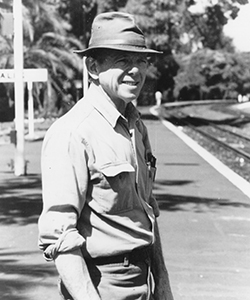
American painter Donald Resnick ’49 is credited as a significant 20th century American landscape painter.
His paintings depict scenery from Long Island and Maine, continuing the heritage of American Post-Impressionism while remaining individual and distinctive in style. His large-scale canvases reveal great masses of forms and shapes, beautiful moving fields of color and a brilliant sense of light. He painted what Phyllis Braff in The New York Times calls “luminous…canvases [that] are sensuous celebrations…A powerful natural radiance is always present in [his] large, vigorously brushed paintings, for each area of pigment either holds or reflects a light that has been carefully analyzed and translated into color.”
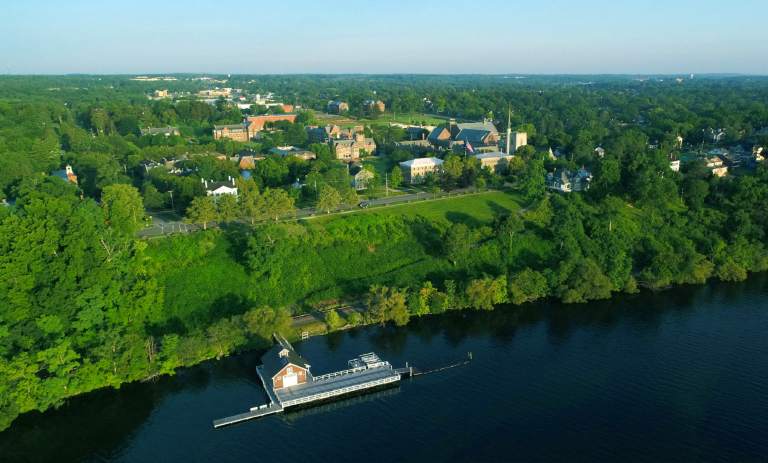
The Collections of Hobart and William Smith Colleges include several of his works, including four paintings that have been installed in the Scandling Campus Center’s new common room.
Resnick graduated from Hobart College in 1949, receiving a B.A. with a concentration in sociology. During his time at the Colleges, he was a member of the Phi Phi Delta fraternity, played varsity baseball and golf, participated in intramural football and boxing, and served as the manager of the basketball team.
Following graduation, Resnick attended The New School for Social Research (now The New School), but left to work in public relations at NBC. In 1951, he earned a B.S. magna cum laude in education from the State University of New York at Brockport. He went on to serve in the U.S. Coast Guard for two years during the Korean War.
After the war, Resnick began again to study art, first at the School of Visual Arts in New York, then in Salzburg, Austria from 1956-1957, where he studied painting under the prominent Austrian expressionist Oskar Kokoschka. Resnick later studied with renowned artists Raphael Soyer, Seymour Lipton and Julian Levi.
Since Resnick began painting professionally in 1958, his work has been showcased in dozens of museum collections, including the Smithsonian American Art Museum, the Portland Museum of Art, the Rose Art Museum, and others in New York, Toronto, Boston, and on the HWS campus. His work has been reviewed in The New York Times and more than 20 other publications.
The portrayal of light in Resnick's works is credited with allowing the audience to view a landscape in a new way. Art critic Paul Duval said of Resnick’s work, "Resnick works magic to make the commonplace transform into the luminous." Resnick did not paint figures in his landscapes, only subtle hints at human life-such as a cabin or cottage in the distance. Critics say that this makes it “clear that Resnick's work is in fact a response to nature, and not a utopian attempt to recreate nature.”
Resnick himself described the inspiration for his paintings as an “intense experience of a place — its particular light, its particular space — at a unique moment in time. This is the case whether I’m standing along the wind-blown coastline, hiking near a still tidal inlet, or walking by a rippling mountain stream. Painting is my way of sharing what I have seen and experienced. Painting is my story. So, if while viewing my work others see nature in a new and vital way — seeing the natural world as a place in need of protection — then I have succeeded in some small manner.”
A loyal alumnus, in 1999 Resnick received the Medal of Excellence, Hobart College Alumni Association’s highest honor, awarded to an alumnus who, by reason of outstanding accomplishments in his particular business, profession or community service, has brought honor and distinction to his alma mater.
He passed away in 2008.