
Lives of Consequence
Matthew Lamanna '97
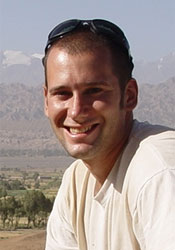
Considered to be a pivotal contributor to the understanding of how dinosaurs and their environments evolved through time, Lamanna has travelled to five continents on paleontological expeditions. In Egypt, he was on the team that discovered what is believed to be the second-largest dinosaur that ever lived - a discovery that is hailed as one of the most significant paleontological finds of recent history. He also travelled to China as part of the team that found a new species of waterfowl, one of the oldest members of a family tree that leads to the modern duck and provides a missing link in the early evolution of birds.
Raised in upstate New York, Lamanna attended Hobart, where he double majored in biology and geoscience. After graduation, he went on to study dinosaur paleontology in the Department of Earth and Environmental Science at the University of Pennsylvania.
In 2000, while pursuing his Ph.D. at UPenn, Lamanna travelled to Egypt with fellow Penn graduate student Joshua Smith to search for a lost dinosaur site first discovered by a German paleontologist in 1911. There, they discovered the giant sauropod dinosaur - a long-necked, plant-eating dinosaur that they named Paralititan ("tidal giant") because it died in what was an ancient coastal environment. The expedition was funded by the Art and Entertainment network and resulted in a two-hour documentary, The Lost Dinosaurs of Egypt, and a book published by Random House. His research received coverage in many major national publications and programs, including CNN, The New York Times, USA Today, Reuters, NPR, the BBC, National Geographic, and the Associated Press. An article about the find appeared in the journal Science.
Lamanna now serves as the assistant curator of vertebrate paleontology at Carnegie Museum of Natural History. Hired in 2004, Lamanna is the first full-time dinosaur paleontologist on the Museum's staff since the turn of the 20th Century. He served as lead scientific adviser for Museum's $36 million, 22,000 square foot Dinosaurs in Their Time exhibition, in which the museum's historic Dinosaur Hall was expanded and updated based on current scientific understanding of dinosaur biology and Mesozoic biodiversity. The exhibit is home to the nation's third largest display of mounted original dinosaur skeletons.
Lamanna has also advised dinosaur exhibitions for other institutions, including the Miami Science Museum and the Natural History Museum of Los Angeles County. He has lent his expertise to a wide variety of print and broadcast media, including The Discovery Channel, The Science Channel, Art and Entertainment, The History Channel, PBS, Fox News, CNN and ABC.
Lamanna received his Ph.D. and M.S. in the department of earth and environmental science at the University of Pennsylvania. He earned a B.S. with high honors in geosciences and biology from Hobart.