

Lives of Consequence
Charles James Folger, 1836
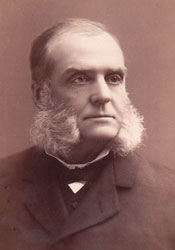
Politician, judge and Geneva firefighter, Charles James Folger was appointed Secretary of the United States Treasury in 1881 by President Chester A. Arthur. During his career, Folger opposed the monopoly of railroads, advocated for the establishment of Cornell University and, as Secretary of the Treasury, reduced the public debt by more than $300,000,000.
Born in Nantucket, Mass., Folger moved to Geneva, N.Y. when he was 12 years old. In 1836, he graduated with high honors from Hobart before selecting the law as his career. He began his legal studies under Mark H. Sibley and Alvah Worden, two attorneys who practiced in neighboring Canandaigua, N.Y.
Admitted to the Bar in 1839, he practiced in Lyons for a short time before returning to Geneva in 1840, where he established a private law office. Serving as Justice of the Peace, he showcased his judicial abilities and was consequently appointed Judge in the Ontario Court of Common Pleas in 1844. Resigning his post at the end of his first year, he was Master and Examiner in Chancery until the Chancery Court was abolished by adoption of the Constitution in 1846.
A committed citizen of Geneva, Folger was a member of one of the city's earliest fire companies, "Outcast Company No. 5" of the Geneva Fire Department, serving as both a volunteer firefighter and foreman from 1846 to 1852. On Feb. 19, 1886, Folger, along with 26 other prominent Geneva citizens, organized a new and independent fire company, with the members unanimously deciding to name it the Charles J. Folger Hook and Ladder Co. in Folger's honor. In addition to his service as a volunteer firefighter, Folger acted as a major financial contributor, helping the company to purchase a modern horse-drawn hand engine.
In 1851, he was elected County Judge of Ontario County and held the office for four years. Near the end of his term, he began to take an active part in state politics and, in the fall of 1861, he was elected state senator. He was reelected three times in 1863, 1865 and 1867, serving eight years in succession.
During the majority of his senatorial term, he served as the President pro tempore and was elected as chairman to the Senate Judiciary Committee. After his first year, he was recognized as the leader of the Republican Party. He was the author of the Protective Labor bill, which guaranteed laboring men the right to work for whatever wages they chose. An early opponent of monopolies, Folger opposed Cornelius Vanderbilt's attempt to acquire a railroad monopoly through the acquisition of the Erie Railroad in 1868.
While serving as a chairman to the Senate Judiciary Committee, Folger acted as a legal advisor to Ezra Cornell and 1853 Hobart alumnus Andrew Dickson White, the founders of Cornell University. Helping to draft the Cornell Bill, Folger used his influence in order to secure the university's land grant. After the Cornell Bill was signed into law on April 27, 1865, Folger was elected as one of seven additional people to serve on the Cornell Board of Trustees, a position which he held from 1865 to 1873.
In 1867, Folger was a delegate to the Constitutional Convention, where he was elected as chairman of the Judiciary Committee.
In 1869, Folger resigned as senator to accept President Ulysses S. Grant's appointment as Assistant U.S. Treasurer. He held this post until 1870, when the Court of Appeals was reorganized under the amended Constitution that he had helped to frame during the 1867 Constitutional Convention. As a result, he was elected as an Associate Judge of the New York Court of Appeals in 1870.
In May 1880, Governor Alonzo B. Cornell designated Folger as Chief Justice of the New York Supreme Court after the death of former Chief Justice Sanford E. Church. On Aug. 24, 1880, he was formally elected as Chief Justice.
In 1881, he resigned his place on the bench to become Secretary of the Treasury in President Chester A. Arthur's cabinet. During his tenure, Folger instituted civil service reform, including the introduction of classification rules in departmental hiring, which required that jobs be classified and graded according to objective criteria such as the amount of skill and training required for acceptable performance, the relative difficulty of a particular job and the degree of responsibility associated with a position.
In 1882, he was nominated by the New York Republican Convention for Governor, but was defeated by Grover Cleveland.
In addition to his national political role, Folger also served as the president of the Geneva Village Board of Trustees and was a benefactor of the 34th Separate Co. of the National Guard, named "The Folger Corps" in 1880.
Folger continued to serve as secretary of the U.S. Treasury until his death on Sept. 4, 1884.