

Lives of Consequence
Edward Oziel Graves, 1864, M.A. 1884
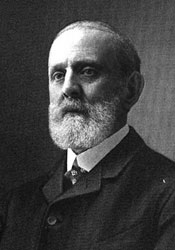
Businessman, civil servant and reformer, Edward Oziel Graves instituted new procedures for the examination and appointment of civil service candidates while working for the U.S. Department of the Treasury. His changes eliminated the patronage of civil servant appointments in favor of an enforced merit-based system.
An article in The New York Times in 1885 commented, "A history of Mr. Graves' career in the government service would include a history of the civil service reform movement in the national government, as he has been indentified since 1873 or 1874 with every attempt made to supplant the spoils system with the merit system."
After graduating from Hobart College, he was appointed as a clerk to Secretary of the Treasury Francis E. Spinner. In 1868, he was promoted to chief clerk, at which point, in spite of opposition by most members of congress, Graves worked toward the establishment of civil service reform. Made a member of the first board of civil service examiners, he authored rules to govern the first examinations, prepared and supervised the first examinations. During this time he presented a special report on the commission's results, which was printed and served as a supplementary rule manual, predating the 1883 Pendleton Civil Service Reform Act. Shortly thereafter, when the position of chief examiner of the U.S. Civil Service Commission was created by executive order, he was given the post.
In 1874, he was made superintendent of National Bank Redemption Bureau of the Treasury Department. In 1876, Treasury Secretary John Sherman made him chair of a commission to investigate the efficiency, organization, and management of the Bureau of Engraving and Printing (BEP). As a result of his efforts, the BEP's expenses were reduced by nearly one-half, leading to its reorganization.
Charged with creating a plan for the establishment and management of the sinking fund for the District of Columbia, Graves presented plans to the government that would be used for more than a quarter of a century.
In 1883, he was appointed assistant treasurer by President Chester A. Arthur and later named chief of the BEP. During his four years in office, he reduced the number of employees by more than 100 and the treasury's annual cost to the government by more than $223,000 (the equivalent of roughly $5 million today). Graves also introduced power presses for printing U.S. and national banknotes.
In 1884, Hobart College awarded Graves a Master of Arts degree; he was subsequently invited to address alumni about "The Meaning of Civil Service Reform" during the Hobart College commencement ceremony in 1885.
In the spring of 1889, he resigned from the Bureau and headed west to Seattle, Wash. As president, he organized Washington National Bank, which would eventually become Washington Mutual, Inc. Although the bank started off modestly with only one employee, it quickly began making banking history. The association's first loans were approved in February 1890, one of which was an amortized home loan, perhaps the first of its kind in the United States. Washington National went on to approve more than 2,000 amortized home loans during the ensuing 20 years, becoming a much-used source for home mortgage loans.
In his later years, Graves was also a partner in a private bank at Whatcom, Wash., and was elected a trustee of the Seattle Chamber of Commerce 17 times.
While at Hobart, Graves was a member of the Theta Delta Chi fraternity, the Sigma, Epsilon, Iota club, Jack-son Euchre Club and the Hermean Society. Additionally, he served on the board of editors for the Echo of the Seneca yearbook, was sophomore class president and served as treasurer of the Hobart Baseball Club.
He died in 1909 at the age of 65.