
Lives of Consequence
Cornelius Cole 1847
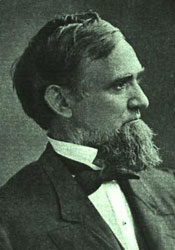
Pioneer, citizen and statesman, Cole led a distinguished political career, serving as Sacramento's District Attorney and serving as both a U.S. Representative and U.S. Senator. Instrumental in founding California's Republican Party, Cole was a close friend of President Abraham Lincoln and advanced the interests of the Pacific Railroad both personally and politically, which led to the construction of the intercontinental railroad.
Born in Lodi, N.Y. in 1822, Cole was the seventh of twelve children. His father, David Cole, was a Captain in the Revolutionary War.
Cole began his education at a district school before continuing at Ovid Academy and Genesee Wesleyan Seminary at Lima, N.Y. Prior to entering college, he surveyed land to earn funds to pay for his education so that his father could also educate his younger sisters. Entering Geneva (now Hobart) College in 1843, Cole attended classes with Edward Stuyesvant Bragg, also Hobart Class of 1847, who would go on to become the leader of the Iron Brigade. Cole eventually also attended Wesleyan.
After graduating from college, Cole briefly served as a schoolteacher before going to work in the law office of Seward, Morgan and Blatchford in Auburn, N.Y. While there, Cole studied under the four partners and was admitted to the bar of New York on May 1, 1848. His employers in the firm eventually went on to prominent political careers, as did Cole himself. William Seward became Secretary of State for Abraham Lincoln, Christopher Morgan became New York State's Secretary of State, and Samuel Blatchford was a U.S. Supreme Court Justice.
In 1849, Cole was lured by gold fever to head west, where he was the first of the forty-niners to reach the mines of California. Reaching California in July after five months of traveling, Cole spent the next five months mining with his small group before winter arrived, at which point the men sold their claim for $1,000.
In 1850, he started a law firm in San Francisco with fellow New York attorney James Pratt, but the firm was short lived as two disastrous fires in the same year claimed the neighborhood and their offices. Cole then returned to Sacramento, where he started another law firm of his own. Among his first clients were Leland Stanford, Collis P. Huntington, Mark Hopkins and Charles Crocker, whom he assisted in the formation of what would become their vast railroad empires.
While in Sacramento, Cole was one of the first and most prominent founders and supporters of the Republican Party at a time when Republicanism was sufficient cause for personal injury and unlimited abuse of its advocates
In 1856, Cole began publishing the Sacramento Times, a Republican newspaper, thanks to financial help from some politically like-minded friends. Cole shared editing duties with James McClatchy, who would later go on to found the Sacramento Bee, which is still in publication today.
In the mid 1850s, Cole began his political career when he became a member of the Republican National Committee. From 1859 to 1862, Cole served as Sacramento County District Attorney, enforcing the laws and refusing to either turn a blind eye or accept bribes. In 1863, Cole was commissioned to serve as captain of the Santa Cruz Cavalry in the Second Brigade of the California Militia. From 1863 to 1865, he was elected as a Union Republican to the 38th Congress. During his tenure, Cole was assigned to the Committees on Post Offices and Post Roads as well as the Select Committee on the Pacific Railroad.
A couple years earlier Cole and several other prominent Californians had formed the Central Pacific Railroad Company of California with the goal of building a railroad over the Sierra Nevada Mountains along a route surveyed by Theodore T. Judah. Cole's appointment to the Select Committee on the Pacific Railroad created a conflict of interest and he was forced to sell his shares of original stock in the company to Leland Stanford for a little under $4,000. Due to Cole's efforts as a Congressman over the following years on behalf of the company, those shares were soon valued at several million dollars.
An 1890 L.A. Times article quotes Cole: "Those shares of the original stock became eventually…, largely through my exertions in Congress, worth several millions. Such is the sacrifice of a man in public life…but for which he gets no credit."
While serving in Congress, Cole supported a bill that authorized a grant to California to preserve the Yosemite Valley and Mariposa Grove as a state park, 26 years before it eventually became a national park. Additionally, Cole became good friends with Abraham Lincoln and visited with him often.
After the surrender of the Confederate leaders, Cole stayed on in Washington, D.C. until April 14. Before leaving, he met with Lincoln in the White House and then departed on the evening train headed to New York. En route to New York he received the news that Lincoln had been shot and the Secretary of State Seward stabbed. Upon reaching New York the following morning, he was informed that Lincoln had passed away but that Seward, though severely wounded, would recover from his attack.
After returning to California, Cole found that he had been nominated for a senatorial position. In 1866, after a long campaign against several notable candidates, he was elected as a Republican to the U.S. Senate, serving from 1867 to 1873. During his tenure, Cole was called upon to participate in the great and difficult work of reconstruction following the Civil War and sit in judgment at the impeachment trial of President Andrew Johnson, who succeeded Lincoln upon his assassination.
During his tenure in Washington, D.C., the Coles hosted several parties which were attended by many of the dignitaries of the era, including Samuel Clemens aka Mark Twain.
In 1881, after losing the re-election bid when he sided with the Californian people against the interests of his political support - the railroads, Cole took up residence on his 500-acre ranch and opened a law office in Los Angeles, which he actively maintained up to his hundredth birthday. Years earlier, Cole had represented Major Henry Hancock, who was being sued about ownership of his land. Cole won the case and Hancock paid him by deeding him 500 acres which would eventually become a large part of the city we know today as Hollywood.
His ranch, which was bounded by Sunset on the north and Melrose to the south, was developed into the town of Colegrove in 1880. A thriving town, Colegrove had its own Post Office, Board of Trade and schoolhouse. In 1910, the city chose to be annexed to the City of Los Angeles in order to have access to its water system.
In addition to his political and real estate careers, Cole was an avid writer, essayist and poet, with many of his articles featured in local newspapers. On his 102nd birthday, he handed in a manuscript of poetry, titled "Ideals in Verse," which was later published. In the winter of 1908, his memoirs were published. In 1923, Cole was interviewed by the directors of "The Dramatic Life of Abraham Lincoln" for his insight into the man; many of his recollections helped shape the movie.
On Nov. 3, 1924, Cole, who by then was known as the "Grand Old Man of California," died at his home in Hollywood. At the age of 102, Cole was the oldest former U.S. Senator in American history, and he has yet to be surpassed. At the time of his death, Cole was the only man to have lived during the lifetime of every President of the United States, with the exception of George Washington.