

Lives of Consequence
Dr. Willis Alfred Adcock '43, P'71, Sc.D '89
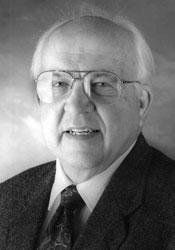
Inventor
Inventor, chemist, electrical engineer and educator, Dr. Willis Adcock is behind some of the most important inventions of the 20th century.
Born in Canada, Adcock immigrated to the United States in 1936, later attending Hobart where he earned a Bachelor of Science degree cum laude in math and chemistry. After graduating from Hobart, Adcock joined the U.S. Army where he became a technical staff member in the Clinton Laboratories in Oak Ridge, Tennessee. While in the Army, he applied for and received United States citizenship giving him security clearance to be a junior member of the team that developed the atomic bomb. In 1948, he left the Armed Services to attend Brown University where he earned a Ph.D. in physical chemistry.
In 1953, he joined Texas Instruments in Dallas, Texas, as the manager of development at the Integrated Circuits Department. While working at Texas Instruments, Adcock grew the first silicon boule, an innovation that made possible the construction of the silicon transistor, turning the company into a world leader in semiconductors. These semiconductors revolutionized the world of technology, paving the way for the creation of smaller and less expensive calculators, computers and radios. In his role as manager, he recruited Jack Kilby to Texas Instruments and supported the research that led to the invention of the integrated circuit in 1958.
Although he left Texas Instruments for a year in 1964 to work as a technical director for Sperry Semiconductor in Norwalk, Conn., he returned in 1965 as manager of advanced planning and technical development. Later, he served as assistant vice president and finally vice president of corporate staff form 1982-86. He retired from Texas Instruments in 1986 as vice president and principal fellow.
After retiring from Texas Instruments, Adcock became a professor of electrical and computer engineering at The University of Texas where he was appointed to the Cockrell Family Regents Chair, a position he held until becoming chair professor emeritus in 1993.
Adcock was a Fellow of the I.E.E.E. and the A.A.A.S., and he was a member of the National Academy of Engineering and the American Chemical Society. He was also a member of Sigma Xi and Phi Beta Kappa as well as a Principal Fellow of the Texas Institute. In 1989, he was awarded an honorary degree from Hobart College.
Among his many accomplishments, Adcock held a number of basic patents for digital photography and at the time of his death was working on a torque converter. His first patent in this area was issued on June 3, 2003, just seven months before his passing.