

Lives of Consequence
Dr. Jeffery L. Brown '61
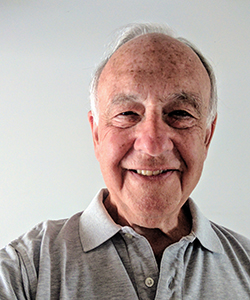
Pediatric Physician, Researcher, Professor, Veteran, Author
As the founding partner of a six-physician pediatric group, Dr. Jeffrey Brown ’61 has treated generations of patients, often within the same families. He has written several books and dozens of articles, taught medical students and residents, and acted as a civilian interrogator in war crimes investigations. He has chaired a community hospital’s pediatrics department and served on two executive committees of the American Academy of Pediatrics. He has testified at congressional hearings as a consumer advocate and, most recently, advocated for improving healthcare for military veterans — especially care received outside of the Veteran’s Administration.
But by his own admission, Brown’s success was far from certain when he entered Hobart and William Smith.
“Before the days of learning disability specialists,” he recalls, “I was accepted to Hobart’s Class of 1961, despite an inability to memorize by rote and a 78 grade-point average. As a reach, I declared a biology-chemistry-premed major, struggled to achieve a 2.50 and applied to medical school.”
With high MCAT scores and encouraging faculty recommendations, he was accepted at four medical schools and enrolled in the medical college at the University of Maryland in Baltimore, “where process repeated itself.” As a medical student, Brown struggled to maintain passing grades but nevertheless earned acceptance for post-graduate training at Mount Sinai, Cornell and Columbia.
Due to “a miscalculation in career planning,” he enlisted as a medical officer during the Vietnam War to avoid being drafted. Aided by just 30 medics, Brown was the only doctor seeing to the needs of “900 troops in a front-line infantry battalion” — and this just six weeks after completing a civilian hospital internship. His experience in Vietnam, however, helped clarify his mission in his work as a doctor: to protect the children in his care.
“When we were not in the field, we visited local villages as part of the war strategy to ‘win hearts and minds’ of the local population,” he says. “Despite carrying a weapon and the squad of troops needed to maintain security, I looked forward to visiting these patients, many of whom were children, as a diversion from treating war wounds with just a medic’s bag. Because I gradually developed the feeling that I was protecting these children, not just treating their wounds and illnesses, I returned as a civilian, trained to become a pediatrician, and then practiced community pediatrics for more than 40 years.”
Read Brown’s personal account of his service in Vietnam.
Brown, who returned from the war a recipient of the Bronze Star for Valor and the Combat Medical Badge, went on to found and serve as a community pediatrician at Pediatric Associates, a six-physician Yale New Haven Health practice in New York’s Westchester County. Meanwhile, he served as a clinical professor of pediatrics at New York Medical College and an associate clinical professor in pediatrics and psychiatry at Weill Cornell Medical College. For 20 years, he was an administrative chair at a Cornell Medical College-affiliated hospital and pediatrician for the in-patient pediatric psychiatry service at the New York-Presbyterian Hospital’s Westchester Division.
Named a “Best Doctor” 11 times by New York Magazine and eight times by Westchester Magazine, Brown also served as an in-house pediatrician for an award-winning parenting series on Lifetime TV. He has been featured on more than 300 radio, television and print segments, including interviews on The Today Show and CBS Morning News, and with The New York Times,The Chicago Tribune, Washington Post and Philadelphia Inquirer.
“I was always lucky enough to receive the backup and support of a wonderful family that now includes children and grandchildren,” Brown says.
Reflecting on his years of service and success as a physician, he also notes that his acceptance to HWS was “a sentinel event that led to most of the meaningful aspects of my personal life and professional career. Had the admissions officer not granted me entry despite a significant learning problem, there is little question that my life would have been very different.”